
www.buildingsandcities.org/journal-content/special-issues/climate-change-risk-decisions.html
Climate Change Risk and Decision-Making
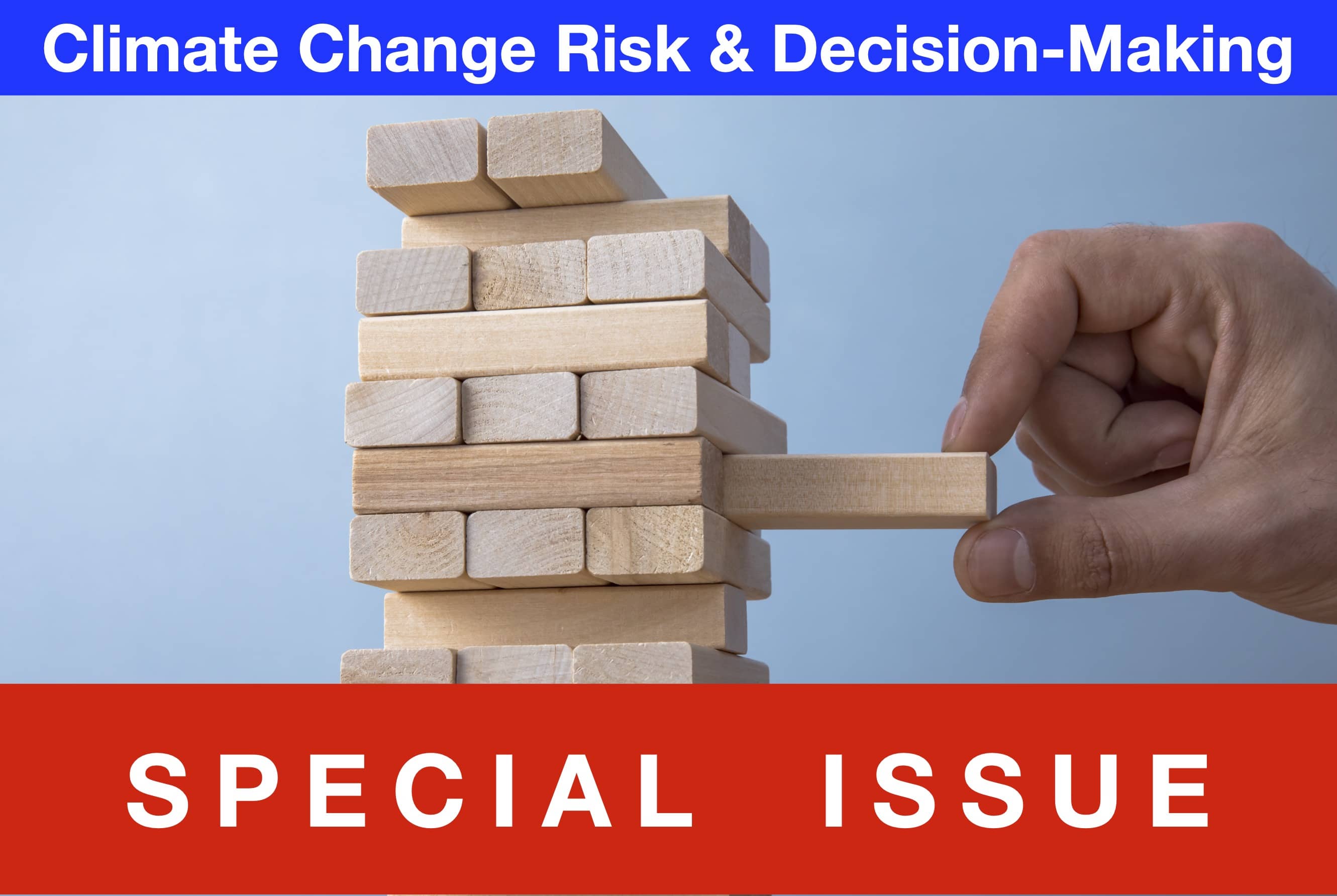
What understandings and processes do built environment actors need to address mitigation and adaptation risks in the built environment?
Although technical knowledge exists for responding to climate change mitigation and adaptation, who owns (or should own) responsibility and accountability for making and recommending decisions about the climate risks in production, management and regulation of the built environment? Who is responsible/accountable for managing them throughout a building’s/built environment’s life cycle? What are the particular circumstances surrounding the longevity and interdependencies of the built environment and these responsibilities? The relative lack of research and guidance on the subject within the field means this is a pressing task for the sector and a significant challenge to all involved.
Guest editors: Simon Foxell and Ian Cooper
As climate change is a present reality and even more extreme and volatile weather conditions are anticipated in future with a high degree of confidence, the capacity to address and act appropriately in response to risks and uncertainties in the built environment sector becomes ever more pressing. There is an urgent need for work in this field – to be followed by sector leadership, for professional and other responsibilities on climate risk to be recognised and for individuals, organisations and governments to decide how to respond; whether though policy, guidance, best practice exemplars, insurance reform, behaviour and culture change, codes of practice or regulation.
The contributions in this special issue share common characteristics. Despite the varying locations under examination, the different spatial scales being addressed, and the separate (but overlapping) focuses of attention, all the authors are more concerned with social problems raised by attempting to tackle climate change than with dealing with climate-related risks themselves. Although they look in different directions, they have a shared point of convergence: the need for governance to control who makes decisions and so whose voices get heard. They also share a common diagnosis of what needs to be done: the governance arrangements currently in place for making decisions about how to respond to the challenges imposed by climate are defective and unlikely to prove successful. In aggregate, they advance a common remedy too. Decision-making needs to become more integrated by enrolling a wide range of top-down, middle-out, and bottom-up actors – from national and local government and their agencies, through professionals and private sector organisations, to local communities. Localising decision making is deemed particularly important, authors argue, if selected interventions are to be sufficiently grounded in local knowledge about the contexts in which they will have to work.
Table of contents
Climate change risk and decision-making [editorial]
S. Foxell & I. Cooper
Climate-related risks: implications for municipal governments in Brazil
C. Nastari Fernandes, P. Ciminelli
Ramalho & F. Lima-Silva
Towards a new neighbourhood-scale climate risk-adaptation approach
C. Rigoni, S. Oliveira, O. Romice, A.
Moreno-Rangel & A. Chatzimichali
Urban informal settlements in Africa: transforming adaptation governance
K. Buyana & H. Sseviiri
Anticipating chronic climate risks [commentary]
J. Baker
Chronic climate risks to urban infrastructure
[commentary]
S. Greenham & E.Ferranti
Reimagining climate action, community engagement and professional responsibility [commentary]
J. Robinson, E. Smit, P. Robinson & A. Gloger
Professional ethics in a climate crisis
[commentary]
C. Davies & H. Ellis
Who is responsible for climate change? [commentary]
I. Cooper
Latest Peer-Reviewed Journal Content

Moving homes and energy poverty: residents’ concerns, capabilities and responses
M Jalas, J Rinkinen, S Numminen & E Valkealahti
Reference study for biogenic carbon storage in the residential building stock
O Iliescu, I Talvitie, A Amiri & S Junnila
Building space heating and cooling in NDCs 4.0
T P Lützkendorf
Building component reuse as sociomaterial interaction: lessons from precast concrete
J Uusikartano, L Alkki & V Capitani
Validating national reuse indicators from regional demolition data: a Swedish example
F Ericsson, K Mjörnell & U Janson
Climate change risk and decision-making [editorial]
S Foxell & I Cooper
Technologies of reconstruction [editorial]
P Tombesi
Urban form metrics for building occupancy modelling: applications and impacts
D Reiter, M Jehling & R Hecht
Retrofit realism: affordable low-carbon policies for existing homes
N Eyre & R Khosla
Join Our Community

The most important part of any journal is our people – readers, authors, reviewers, editorial board members and editors. You are cordially invited to join our community by joining our mailing list. We send out occasional emails about the journal – calls for papers, special issues, events and more.
We will not share your email with third parties. Read more
Latest Commentaries
Practitioners’ Views of POE
Post-occupancy evaluation (POE) is widely valued but weakly embedded in practice. Ant Marsh, Kate van Someren, Lara Clarke and Tom Randall (Arup Building Performance and Commissioning Services) explain the findings from a survey and focus groups with UK construction industry practitioners. They identified fragmented responsibility, split commercial incentives and a persistent fear of “bad news”. Making POE routine requires a shift from producing reports to a focus on improving outcomes by owning and acting on learning.
Who is Responsible for Climate Change?
Ian Cooper (Eclipse Research) explores the questions of responsibility raised in the recent Buildings & Cities special issue ‘Climate Change Risk and Decision-Making’. Focusing here on carbon emissions and mitigation, global responses will require grounding in what can work locally. New responsibilities arise for the wide range of built environment decision-makers: clients, professionals and their institutions, central and local governments, product suppliers, financiers, insurers, etc. A framework is needed to manage the complexity of responsibilities especially for variety of actors, the time frames and spatial scales.