The case is clear for climate adaptation. What frameworks and actions are needed to address climate-related risks?
As the climate is changing,
urban areas around the world face multiple risks of both acute and chronic climate
hazards.Sarah Greenham & Emma Ferranti (University of
Birmingham) consider the impacts on urban infrastructure of these different
risks and what kinds of actions are needed to address them.
In the UK the July 2022 heatwave saw 40°C observed for the first time, resulting
in the first ever red warning for extreme heat i.e. "a very likely risk to
life, substantial disruption, and possibly widespread damage to property and
infrastructure". Impacts were reported for railways (track buckles, overhead
cables sagging, cancelled and reduced train services), airports and roads
(flight suspensions and road closures following asphalt lifting or melting),
and the power network (power cuts due to overheating equipment). Additionally,
in December 2024 Storm Darragh resulted in red, amber, and yellow warnings for
wind and rain across the UK western coastline, with impacts reported on power
infrastructure (2.3 million customers lost power, reports of power lines falling),
marine transport (pier damage), as well as airports and railways (service cancellations
and closures).
Urban areas also face chronic risks i.e. "longer term challenges that can erode our
economy, community, way of life and/or national security" (HM Government 2025). Chronic climate risks arise more slowly
and operate over longer time scales. These include: increases in average
temperature and heat stress, changing seasonality such as extended warm seasons;
sea level rise and coastal erosion; sustained changes in rainfall that put
pressure on drainage systems and sewage overflows (increases), or drought
conditions, water scarcity, and subsidence (decreases). Impacts are less
obvious in the short-term, being incremental and cumulative, but lead to persistent
impacts, reduced asset performance, and gradually increased operational and
maintenance costs. Examples include road degradation, reduction in the quality
of green infrastructure and its wider services, and disruption of port
operations from sea level rise.
Addressing both acute and chronic risks to urban
infrastructure is a shared responsibility across multiple actors. Although
infrastructure assets may be owned by a specific organisation, in the tangled
web of our urban environments, the resilience of a particular asset often
depends on the actions of another organisation. For example, the inundation of
private and/or public buildings because of surface water flooding following an
acute heavy rainfall may be a short-term consequence of problems with drainage
assets, that are the responsibility of the highways team and the wastewater
utility provider. Over the longer term, this flood risk is a consequence of a
longer-term shift to more heavy rainfall patterns and could be exacerbated by the
creep of impermeable surfaces across the urban area and reduced green
infrastructure. Accordingly, no single organisation can manage all aspects of
climate resilience, but understanding the risks an organisation or community
faces, is a step towards building resilience.
UK Climate Change Risk Assessment
The UK National Risk Register (NRR) outlines the most
serious risks facing the country. This is supplemented by the 2025 Chronic Risk
Analysis (CRA), that overviews 26 medium-long-term risks that may exacerbate
those risks within the NRR. Climate change is one of these risks. Additionally,
the UK’s Climate Change Act 2008 mandates a 5-year rolling cycle of adaptation
reporting and national climate change risk assessments, which informs national adaptation
planning. This provides a structure under which some actors operating in the
urban environment can consider the climate risks impacting their infrastructure
or operations. The UK’s fourth government Climate Change Risk Assessment (CCRA)
will be published in 2027, underpinned by an independent technical report (CCRA-IA4;
Lowe et al. 2026) and the Well-Adapted UK report, produced by the Climate
Change Committee (CCC 2026). These utilise the scientific evidence base and organisation-specific
information provided via the Adaptation Reporting Power (ARP) process mandated
by the Climate Change Act that invites a range of infrastructure providers and
bodies with functions ‘of a public nature’ to provide reports on how they
manage climate risk. The CCRA-IA4 reviews climate risks to infrastructure
across the 2030s, 2050s, and 2080s time horizons under different levels of
global warming. Accordingly, this risk assessment provides the framework for
synthesising chronic infrastructure risks, which are considered in the
Well-Adapted UK report. However, both documents utilise existing reports and
studies, so where there is no evidence, no chronic risks are considered. Moreover,
while national infrastructure providers typically submit ARP reports, there was
only one local authority report preceding 2024 (the Greater London Authority in
2012). Encouragingly, 12 local authorities and two combined authorities submitted
an ARP report in the fourth round (ARP4) in 2024, but the evidence for chronic
risks to local infrastructure, or to private or public buildings in urban areas
remains a major evidence gap. This matters, because awareness and
quantification of climate risks is needed to make the business case for climate
adaptation.
From risk assessments to adaptation action
The Well-Adapted UK report estimates that the overall cost
of climate change to the UK is currently 0-2% of Gross Domestic Product (GDP).
In a warming world without adaptation, these costs could increase to 1-5% of
GDP – roughly equivalent to £60-£260 billion today – by 2050. Furthermore, the
median benefit-cost ratio of adapting UK infrastructure is 5:1 (CCC 2026). Thus,
the case for adaptation is clear, but the reality is challenging. There are
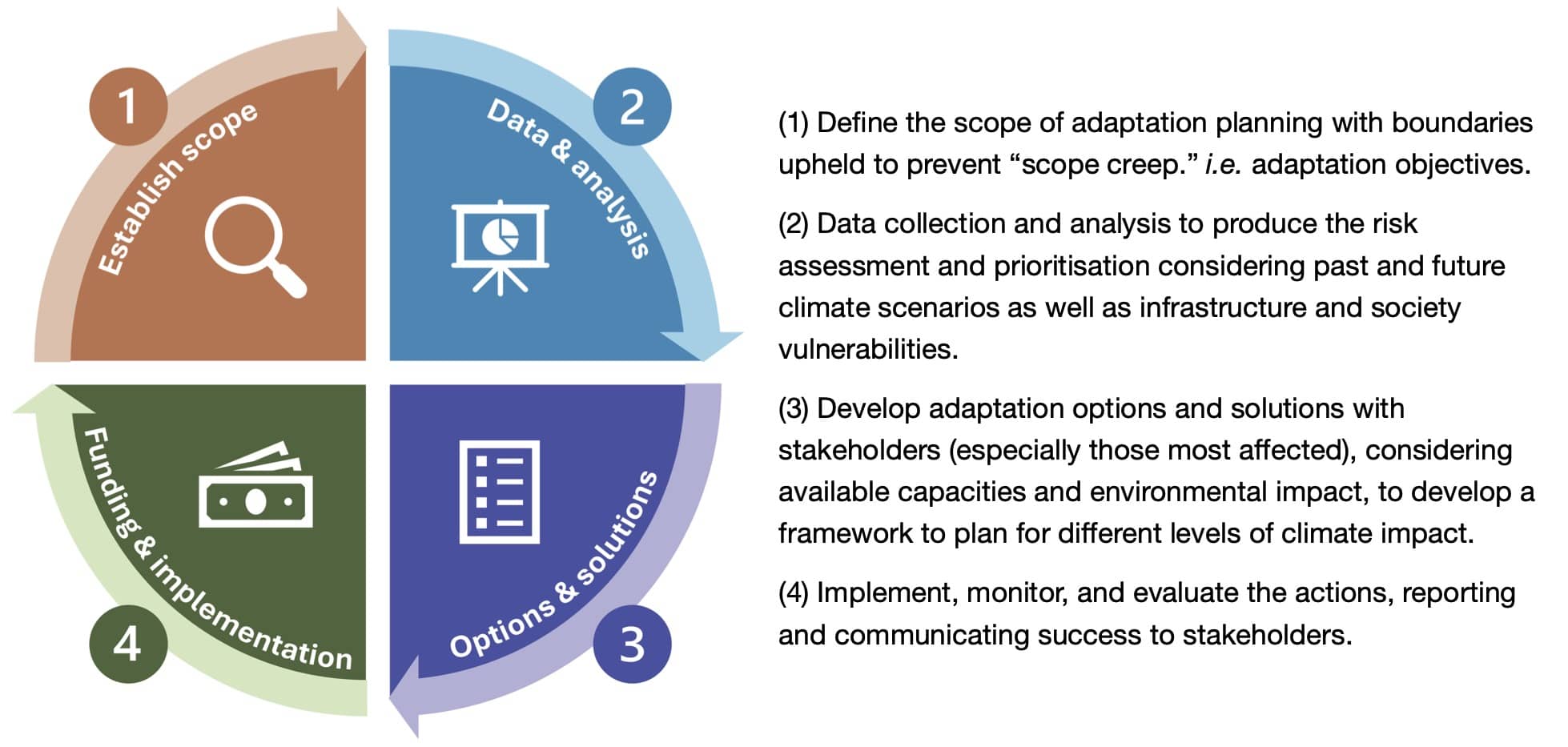
multiple adaptation frameworks to support climate adaptation (e.g.Figure
1). These are typically iterative, and require the organisation to define
the scope, data, and adaptation options, before proceeding to implementation,
which must be supported by monitoring, evaluation, and reporting to measure the
effectiveness of actions.
Figure 1. The iterative climate change adaptation cycle. Source: adapted from Greenham et al. (2022)
The framework is straightforward, but practical application
in the urban environment is complex, for there are multiple infrastructure
owners and operators, from public and private sectors, with multiple questions
to consider at every step. For example:
Should
there be one risk assessment for the whole urban area, or should each
organisation conduct one?
Who
is responsible for deciding adaptation actions?
Who
should govern and finance these actions?
How
can the adaptation process be inclusive and support vulnerable communities, who
are often disproportionately impacted by infrastructure failures?
Considering the example of surface water flooding of private
and/or public properties, actors include at least: utility providers; the local
authority; and property owners, residents, and users, for the duration of the
climate risk. Furthermore, who pays for the adaptation actions and the
monitoring and evaluation, and who benefits? This is particularly complex
for chronic risks, where impacts are typically slow to manifest and incremental,
and the lifetime of the risk may be different to the lifetime of the
infrastructure owners and users.
There are, however, some good practice examples of
cross-sectoral work addressing chronic climate risk across the UK. The Thames
Estuary T2100 Programme brought together multiple actors including the
Environment Agency, the Greater London Authority, Thames Water, Transport for
London (TfL), port operators, property developers, landowners, local
communities, and more, to plan climate resilience to sea-level rise and storm
surges along the Thames Estuary until 2100 (Defra 2023). More recently, TfL advanced
its system-wide understanding of the interdependent climate risks facing its
transport infrastructure and operations (TfL 2024). This was a pioneering
study, and urban areas need more interdependent risk mapping exercises across
multiple sectors, underpinned by shared risk registers, such as the National
Underground Asset Register. The Rapid Adaptation Pathways Assessment (RAPA)
Toolkit developed by ADEPT in collaboration with the Environment Agency helps
local authorities bring stakeholders together to undertake strategic and flexible
decision-making for long-term climate risks such as coastal erosion (ADEPT 2025).
RAPAs have been piloted by local authorities in South Gloucestershire,
Wiltshire, and West Sussex and are part of ongoing research on the WM-Adapt
project in the West Midlands (WMCA 2026).
Untangling the web for a well-adapted UK
The UK was not built for the current or future climates, but
a well-adapted UK can be achieved if the right action is taken across society
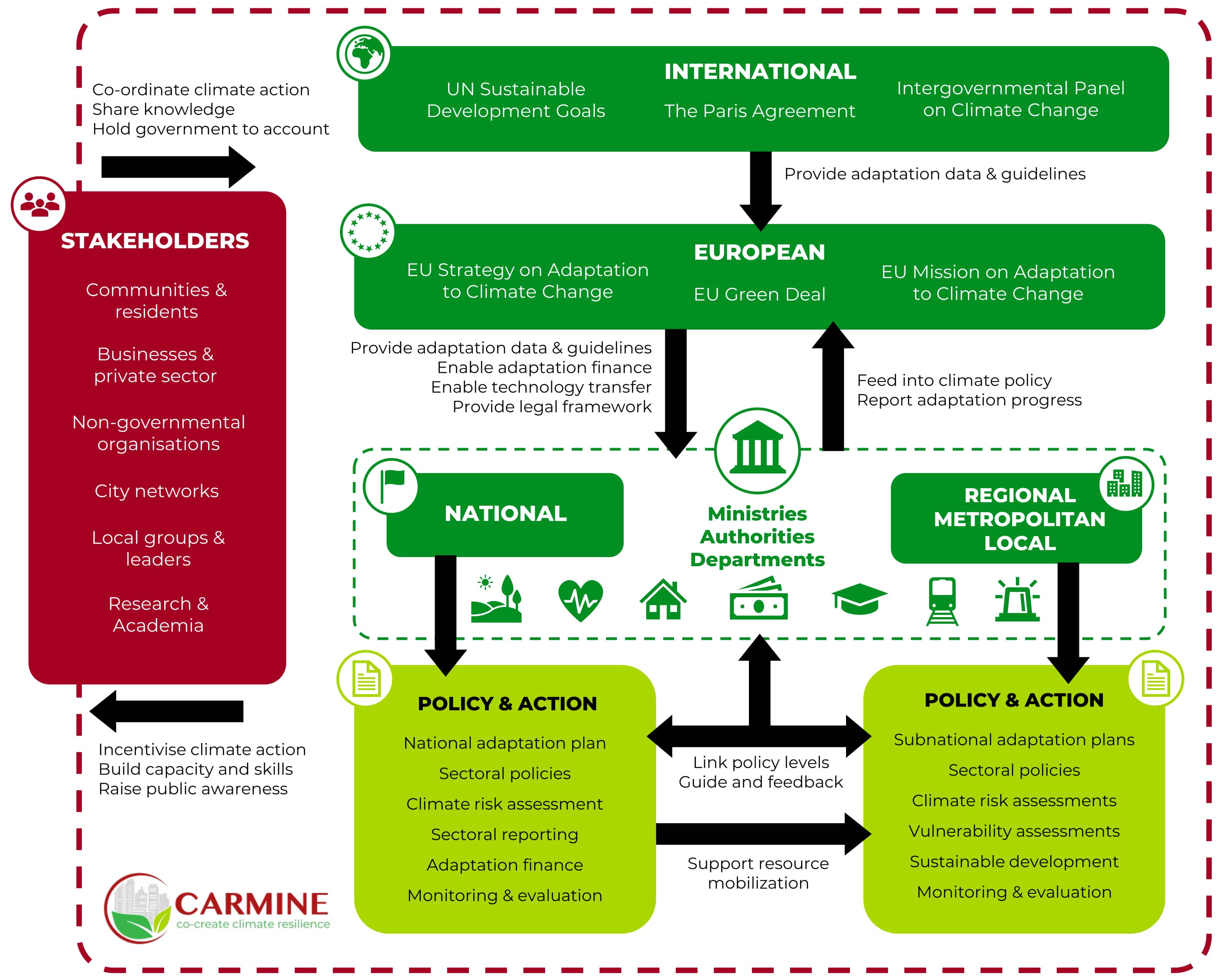
(CCC 2026). Climate change impacts are often felt locally, and adaptation requires
multiple actors and actions operating and bound by policies at local, regional,
and national scales. Multi-level governance frameworks (e.g.Figure 2)
help visualise the necessary information flows and can strengthen the
horizontal and vertical links across different policies and strategies. They
can also reveal policy gaps or opportunities where governance structures are
needed. Via stakeholder engagement, there is a means to integrate the
perspectives of the communities, residents, and other interested parties such
as businesses and market-based organisations from the outset of adaptation
planning and action.
Figure 2. Multi-level climate change governance framework. Source: produced by the
        CARMINE project.
Within the UK, there is a disconnect between the
predominantly national-level climate adaptation reporting cycle and the local-level
management of local infrastructure. However,
climate adaptation is gaining prominence at the regional level, with the West
Midlands and West of England Combined Authorities submitting ARP4
reports. Combined Authorities have an increasingly important leadership role in
regional climate action via advocacy and regional capacity building (e.g.
WM-Adapt), although urban planning (and thus the opportunity for climate
adaptation actions) is within local authority remit, where financial
constraints are typically greatest. Additionally, Local Resilience Forums, which
typically co-ordinate disaster response to acute climate risks can bridge
between local-national and acute-chronic risk management, if they can engage
with regional and national adaptation processes.
To conclude, everyone has a part to play in climate
resilience. Moving forwards, greater focus is required to increase the adaptive
capacity of all communities and organisations so they can undertake risk
assessments and adaptation measures. To facilitate this, the UK Government must
deliver a strong fourth National Adaptation Plan (2028-2033) with the necessary
underpinning finance to address risks outlined in CCRA4-IA. Climate adaptation
must become business as usual and a way of life for all.
Ian Cooper(Eclipse Research) explores the questions of responsibility raised in the
recent Buildings & Cities special issue ‘Climate Change Risk and Decision-Making’. Focusing here on carbon emissions and mitigation, global responses will
require grounding in what can work locally. New responsibilities arise for the wide
range of built environment decision-makers: clients, professionals and their institutions, central and local governments, product suppliers, financiers, insurers, etc. A framework is needed to manage the
complexity of responsibilities especially for variety of actors, the time frames and spatial
scales.
The climate crisis has progressed into a dangerous phase with
tragic consequences often counted in numbers of excess deaths, but also by powerful
economic impacts of rising food prices, the increased costs of insurance and
lending, costly damage to the built environment. Celia Davies,
Director of Impact at the UK’s Town and Country Planning Association (TCPA)
andHugh Ellis, Director
of Policy at TCPA, consider the responsibilities of professionals in shaping a
built environment which is fit not just for today's climate risks but for the
dramatic increase in severe and unpredictable weather which is now locked into
our climate systems.
Join Our Community
The most important part of any journal is our people – readers, authors, reviewers, editorial board members and editors. You are cordially invited to join our community by joining our mailing list. We send out occasional emails about the journal – calls for papers, special issues, events and more.
We will not share your email with third parties. Read more



Latest Commentaries
Who is Responsible for Climate Change?
Ian Cooper (Eclipse Research) explores the questions of responsibility raised in the recent Buildings & Cities special issue ‘Climate Change Risk and Decision-Making’. Focusing here on carbon emissions and mitigation, global responses will require grounding in what can work locally. New responsibilities arise for the wide range of built environment decision-makers: clients, professionals and their institutions, central and local governments, product suppliers, financiers, insurers, etc. A framework is needed to manage the complexity of responsibilities especially for variety of actors, the time frames and spatial scales.
Professional Ethics in a Climate Crisis
The climate crisis has progressed into a dangerous phase with tragic consequences often counted in numbers of excess deaths, but also by powerful economic impacts of rising food prices, the increased costs of insurance and lending, costly damage to the built environment. Celia Davies, Director of Impact at the UK’s Town and Country Planning Association (TCPA) and Hugh Ellis, Director of Policy at TCPA, consider the responsibilities of professionals in shaping a built environment which is fit not just for today's climate risks but for the dramatic increase in severe and unpredictable weather which is now locked into our climate systems.