
www.buildingsandcities.org/journal-content/special-issues/complexity-disaster-reconstruction-si.html
The Complexity of Disaster Reconstruction
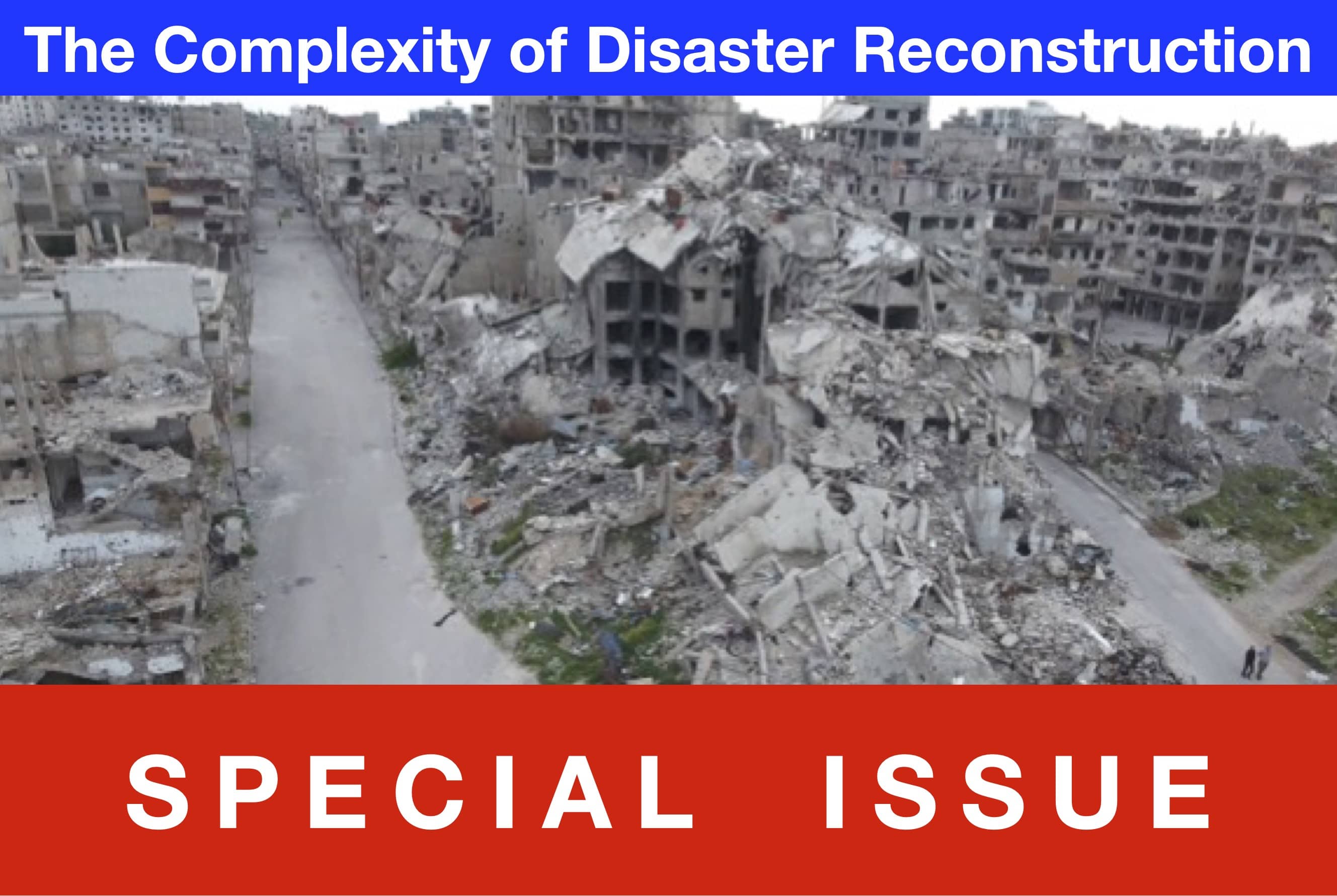
How can the complexity and challenges of physical reconstruction across diverse disciplines, stakeholders and governance be organised and synthesised?
This special issue examines how reconstruction after disasters is organised amongst many actors and an array of complex (and often competing) issues. Do current debates and practices on physical territorial reconstruction (i.e. after destruction by natural disasters, warfare, conflict or industrial accidents) reflect the scope required to address the whole range of complex issues?
The papers reveal that the increasing sophistication of reconstruction knowledge is paradoxically contributing to its fragmentation in both theory and practice. There may be a need for forms of synthesis capable of giving operational coherence to these otherwise separate efforts.
Guest editor: Paolo Tombesi
Each contribution approached reconstruction through different interpretations of the term and different objects: housing prototypes, temporary accommodation, engineering expertise, institutional memory, spatial justice, social capital, heritage, energy infrastructure, preparedness, supply chains and urban recovery. If the diversity might have immediately appeared to reproduce precisely the fragmentation that motivated the special issue, something else emerged as a common trait. Almost every contribution began from a relatively bounded problem, to subsequently discover that the problem could not be understood within those boundaries. Reconstruction, in other words, repeatedly forced the analysis beyond the disciplinary or sectoral territory in which it began.
This special issue substantially confirms the premise of the call whilst re-formulating its implied solution. Fragmentation is indeed a challenge; yet synthesis cannot mean dissolving disciplinary differences into overarching normative protocols. Reconstruction requires frameworks capable of connecting partial understandings without eliminating the specificity from which their in-depth explanatory value derives.
Reconstruction is not one problem imperfectly divided among different disciplines: it is a phenomenon constituted by the interaction of multiple problems. Physical rebuilding, social recovery, institutional reconstruction, economic production, cultural continuity and political transformation are not parallel processes that can simply be added together after separate analyses. They continually condition one another.
Table of contents
Technologies of reconstruction [editorial]
P. Tombesi
Critical Reconstruction Theory and the invention of post-disaster response
G. Lizarralde, D, Wachsmuth, F.
Özdoğan & M. Cossu
Negotiating expertise in Nepal’s post-earthquake disaster reconstruction
K. Rankin, M. Suji, B. Pandey, J. Baniya, D.V.
Hirslund, B. Limbu, N. Rawal & S. Shneiderman
Post-war reconstruction-as-knowledge practice: Fukui’s dual disaster recovery
A.Y.F. Urushima & K.
Yamaguchi
Post-disaster reconstruction and ethics: the power of social capital
B. Ubesingha, G. Ofori, G.
Agyekum-Mensah & D. Frings
Reframing disaster recovery through spatial justice: an integrated framework
M.A. Gasseloğlu & J.E.
Gonçalves
Creating resilient cities: advocacy and planning for equity-based recovery
A. Paidakaki
Post-disaster reconstruction: infill housing prototypes for Kathmandu
J. Bolchover & K. Mundle
Rethinking the second life of post-disaster and post-conflict temporary housing
N. Akdede, B.Ö. Ay & İ.
Gürsel Di̇no
Reconstruction in post-war Rome: transnational flows and national identity
J. Jiang
Disaster reconstruction: practitioner insights improve outcomes [commentary]
R. Potangaroa, K. Zuo & S.
Wilkinson
Rebuilding energy infrastructure after war [commentary]
M.N. Binetti
Disaster reconstruction: rebuilding trust in fragile states [commentary]
T.N. Haddad & T. Sakr
Preparedness for recovery [commentary]
K. MacAskill & L. Dalziel
Lessons from disaster recovery: build better before [commentary]
M.C. Comerio
The search for urban recovery in Lebanon [commentary]
H. al-Harithy


Latest Peer-Reviewed Journal Content

Moving homes and energy poverty: residents’ concerns, capabilities and responses
M Jalas, J Rinkinen, S Numminen & E Valkealahti
Reference study for biogenic carbon storage in the residential building stock
O Iliescu, I Talvitie, A Amiri & S Junnila
Building space heating and cooling in NDCs 4.0
T P Lützkendorf
Building component reuse as sociomaterial interaction: lessons from precast concrete
J Uusikartano, L Alkki & V Capitani
Validating national reuse indicators from regional demolition data: a Swedish example
F Ericsson, K Mjörnell & U Janson
Climate change risk and decision-making [editorial]
S Foxell & I Cooper
Technologies of reconstruction [editorial]
P Tombesi
Urban form metrics for building occupancy modelling: applications and impacts
D Reiter, M Jehling & R Hecht
Retrofit realism: affordable low-carbon policies for existing homes
N Eyre & R Khosla
Join Our Community

The most important part of any journal is our people – readers, authors, reviewers, editorial board members and editors. You are cordially invited to join our community by joining our mailing list. We send out occasional emails about the journal – calls for papers, special issues, events and more.
We will not share your email with third parties. Read more
Latest Commentaries
Practitioners’ Views of POE
Post-occupancy evaluation (POE) is widely valued but weakly embedded in practice. Ant Marsh, Kate van Someren, Lara Clarke and Tom Randall (Arup Building Performance and Commissioning Services) explain the findings from a survey and focus groups with UK construction industry practitioners. They identified fragmented responsibility, split commercial incentives and a persistent fear of “bad news”. Making POE routine requires a shift from producing reports to a focus on improving outcomes by owning and acting on learning.
Who is Responsible for Climate Change?
Ian Cooper (Eclipse Research) explores the questions of responsibility raised in the recent Buildings & Cities special issue ‘Climate Change Risk and Decision-Making’. Focusing here on carbon emissions and mitigation, global responses will require grounding in what can work locally. New responsibilities arise for the wide range of built environment decision-makers: clients, professionals and their institutions, central and local governments, product suppliers, financiers, insurers, etc. A framework is needed to manage the complexity of responsibilities especially for variety of actors, the time frames and spatial scales.