
www.buildingsandcities.org/insights/reviews/constructing_building_integrity.html
Constructing Building Integrity: Raising Standards through Professionalism
Edited by Katja Cooper, Hugh Breakey, Charles Stamford, Peter Gow & Keith Hampson. Routledge, 2026, ISBN: 9781041043720
Is professionalism in crisis? Are the standards and rules fit for purpose? This book on professionalism in Australia highlights shortcomings and argues for radical changes in the oversight and fulfilment of professional practice. Simon Foxell reviews this book and places these concerns in a wider context.
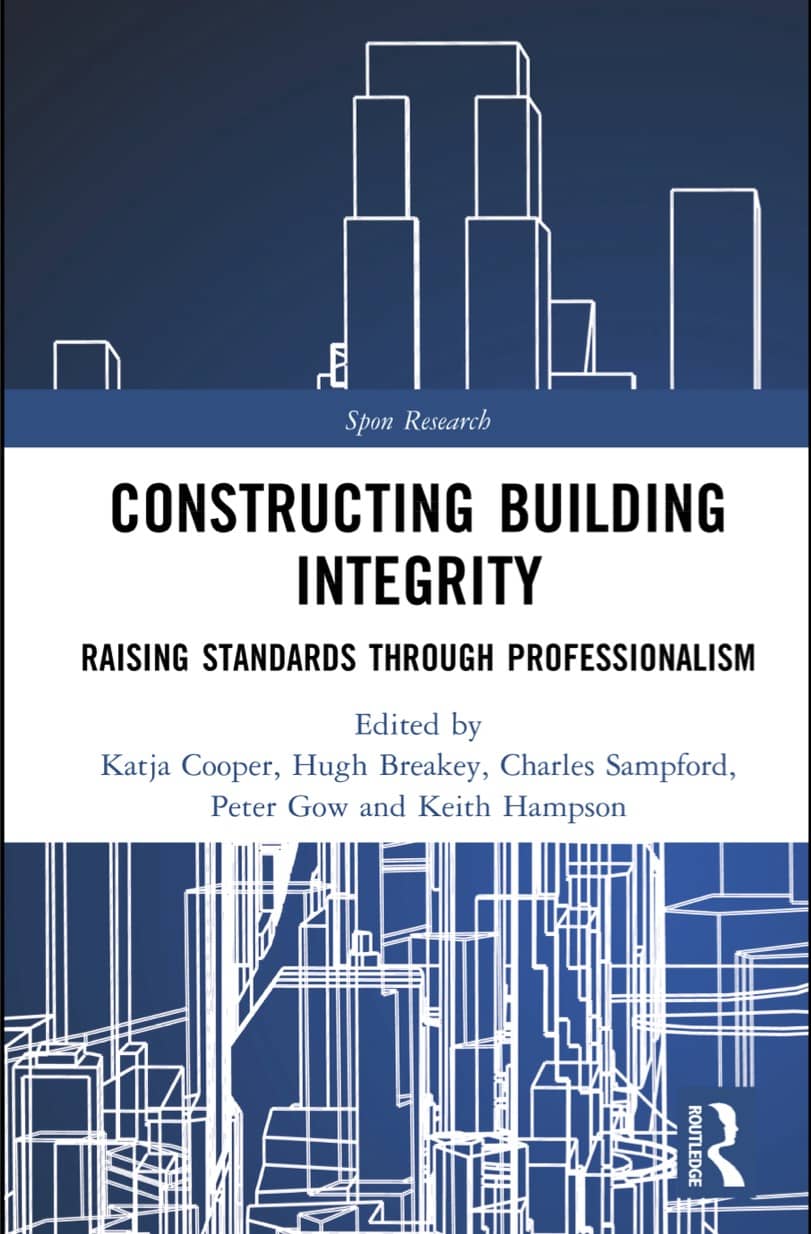
There is a persistent narrative running through the halls of governments, professional bodies and academia that the idea, practice and governance of professionalism in the built environment sector are collectively in crisis. In the UK this was brought to a focus by the 2017 fire in Grenfell Tower, which cost 72 lives as the result of multiple failures during and following the refurbishment and recladding of the structure. The tragedy was blamed in the subsequent inquiry report (Moore-Bick et al. 2024) on government, the tenant management organisation, professional consultants, product suppliers and the construction industry – but, above all else, on a culture of incompetence, complaisance and greed.
This book by a wide range of Australian academics, building professionals and former regulators examines the concern over professional sufficiency in the context of practice and evidence in the Australian residential apartment sector, including its own building failures and resulting reports. Links are made to Grenfell, but the strong relationship of the UK to Australian professional practice is also noted, given the shared presence of several professional organisations, including the Royal Institution of Chartered Surveyors (RICS) and the Chartered Institute of Building (CIOB) with their large memberships in both jurisdictions. But while the UK-Australia link is emphasised, the pan-global discussion in the book does not extend to other professional systems and variants across the world – a missed opportunity in an otherwise strong analysis.
The book takes the form of a curated set of 18 papers generated by the Australian Research Council’s (ARC) Linkage Project 'Constructing Building Integrity: Raising Standards through Professionalism'. These examine professionalism through the lens of ten occupational groups in the built environment sector, from architects to property managers [1], with varying degrees of formal organisation. Starting from examinations of the current state of play, in part derived from structured interviews with selected representatives of the relevant professions, the book examines ethical tensions and organisational issues before finishing on recommendations for reform of the sector.
The introduction to the volume starts with the proposition that, due to a series of
'high profile building disasters [that] have proliferated in recent decades,' (p. 4)
the ethical and professional standards of building professionals are under the spotlight and are, by implication and at least, questionable. The book asks whether professionalism in the sector needs to be reformed to allow it to be far more effective than at present. This then begs the question of whether professionalism in these two countries has really changed significantly for the worse; or, is it business as usual for a sector that has endlessly ridden out scandals and previously taken major economic and political upheavals in its stride?
The perceived state of crisis that has long preoccupied the built environment professions has generated report after report recommending reform – the book names 9 major UK and 7 Australian reports into the 'construction industry' since 1944 – with their findings being inevitably and comprehensively ignored. What has undoubtedly happened in that period is a progressive weakening of the system from its post-war heyday to the present, and perhaps it is the overall fraying of the fabric of professionalism in the face of late-stage capitalism that is really causing concern. Certainly, some of the early chapters examining professional and non-professional practice in individual disciplines reveal deep unhappiness amongst practitioners about the current state of affairs.
In part this may be due to the jarring contrast experienced between the model definition for professionalism provided at the start of the book and reiterated thereafter, and day-to-day experience of practice. The definition involves:
- A commitment to the public good
- A code of conduct/ethics where the public comes first, the client second, the profession third, and the professional last
- A body of specialised knowledge and expertise
- A commitment to self-regulation through a professional body that upholds ethical standards.
This strong ethical position is largely presented by the book as a place that the professions have fallen from, rather than one that they need to attain through deepening professional sodality, collaboration and communication. The definition is, nonetheless, good [2]. A strong collegiate ethical/professional stance has always been a matter of placing hope over expectation, but I suspect the professional bodies themselves would struggle to see items 1 and 2 of the above list as an accurate interpretation of their current codes of conduct/ethics.
The book lays out a typology of ethical tensions that impact the built environment sector, in Australia as much as anywhere else. These include the inevitable tensions between the parties to any agreement: the public, clients, professionals, employees and end-users; as well as the commercial pressures of operating in financially and socially constrained environments, where the 'race to the bottom' is an ever-present temptation, as is cheating on ethical principles for short-term gain, or even basic survival.
There is a claim in the book that the roles of professionals
'have become more complex and fragmented and that this has given rise to new or more intractable tensions' (p. 34)
between duties owed to different parties. While most professionals in the sector would recognise these tensions and even confirm the veracity of the claim, there is nothing new about their existence and the pressures they inflict. Professional systems were established in the early- to mid-nineteenth century to attempt to contain and channel them and, although they may change in perceived importance and urgency from period to period, they have never entirely gone away. The question is whether, as promoted by the content in this book, a reinvigorated programme of professional integrity can find extended life within the existing regime of experts (and their professional organisations) to make the built environment sector a better place through an upright and principled application of mission and purpose, or whether more governmental regulation is the inevitable and correct answer to our, and society’s, present predicament.
These questions have, of course, been asked before. In her incisive series of 2002 Reith lectures – A Question of Trust – the philosopher Onora O’Neill concluded that the answer lays in greater accountability, in 'intelligent accountability', requiring 'more attention to good governance and fewer fantasies about total control' (O’Neill 2002). We appear to be back in the midst of this eternal discussion, with now an even greater need to address the governance of professional structures, including their ability to deliver both competence and ethical integrity from their members. Critically, any progress on this will need to involve professionals taking both society and clients with them; raising the bar of understanding and expectation, particularly on how such competence and integrity will and can be achieved.
Constructing Building Integrity contains an insightful chapter (Chapter 16) on the analysis of different forms of governmental regulation of the professions ranging from an occupational registration by bodies in the different states and territories to a single legislative entity acting as a national regulator. Looking at a hugely diverse system with multiple bodies with overlapping responsibilities and controls, there is an inevitable call for greater consistency and for
'a single system confined to assessing and accrediting professional competence and ethics that is linked to separate systems that control what an accredited person can or must do.' (pp. 274-5)
This plays out in detailed descriptions of hybrid systems of co- and meta-regulation that combine elements of both self and national governance; systems that are capable of building trust between parties with perhaps different agendas, rather than setting them against each other.
This raises questions about what precisely should be regulated and for what purpose? The book barely spells it out. The focus on Grenfell Tower and structural failures in the 36-storey Opal Tower in Sydney in 2018-19 imply, not unreasonably, that the principal concern is the immediate safety of end-users and the public. But there is little concern regarding other issues ranging from the social and health benefits of good housing design and placemaking, the environmental issues causing and resulting from climate change and pollution, or even where will the current enthusiasm for all things AI will take professionalism and professional values. Does one type of professional structure and/or regulation cover all these issues or are the acute and chronic challenges we face sufficiently different to need thinking through separately, or at least in parallel? A short chapter at the end of the book (Chapter 17, Timely interventions) begins to address some of these issues through a discussion of anticipatory governance; a process involving moving away from opportunistic and self-serving behaviour, though familiar mechanisms such as foresight, networking, knowledge feedback, continuity, risk management and participatory co-creation; but this feels awkwardly appended to the end of the text.
Reading a description of a similar, but different, system to the one you are used to is always fascinating and ever-so slightly uncanny. There is an issue of differentiating between what is real and what has an element of wish-fulfilment, but the parallel problems are concrete enough and it helps reduce notions of exceptionalism if you recognise that challenges on the other side of the planet are pretty much those you experience at home. Solutions and alternative ways of doing things, while often being less immediately applicable, are also of great value.
The final chapters of Constructing Building Integrity concern reforming the system, including: implementing better and more consistent regulation of the professions, mandating broader protection of function, reigning in damaging procurement practices though model guidance, the use of pan-sectoral Centres of Excellence to bring together developers, designers, builders and building managers in the residential apartment sector with a common commitment to best practice and the use of practical research through building prototypes. Above all is the recommendation for greater collaboration between the various parties – government, clients, professionals and their regulators – with the aim of creating a single consistent approach. All good and correct, but there is no mention at this stage of tackling the much thornier issue of changing the industry’s overall culture. One respondent quoted in Chapter 9 warns that 'culture eats strategy for breakfast' (p. 147). This points to the ultimate tension in professional practice: maintaining strong social and environmental values while bending to the impatient culture of a world beyond the professional enclosure that demands you behave otherwise.
Notes
[1] Including a category, possibly unique to Australia, of strata managers; this category is much discussed and the subject of a full chapter.
[2] I share a great deal of ground with the description of the contents of an effective code, although in my work with the Edge there are six duties; adding one to the wider world and the natural environment and another to those in the workplace, to the above list (the Edge 2019).
References
the Edge. (2019). Joint code of professional conduct. the Edge. https://edgedebate.com/s/JointCodeOfProfessionalConduct.pdf
Moore-Bick, M., Akbor, A. & Istephan, T. (2024). Grenfell Tower inquiry: Phase 2 report overview. Report of the public inquiry into the fire at Grenfell Tower on 14 June 2017.
O’Neill, O. (2002). A question of trust, the BBC Reith Lectures 2002. Lecture 3. Cambridge University Press.
Latest Peer-Reviewed Journal Content
Moving homes and energy poverty: residents’ concerns, capabilities and responses
M Jalas, J Rinkinen, S Numminen & E Valkealahti
Reference study for biogenic carbon storage in the residential building stock
O Iliescu, I Talvitie, A Amiri & S Junnila
Building space heating and cooling in NDCs 4.0
T P Lützkendorf
Building component reuse as sociomaterial interaction: lessons from precast concrete
J Uusikartano, L Alkki & V Capitani
Validating national reuse indicators from regional demolition data: a Swedish example
F Ericsson, K Mjörnell & U Janson
Climate change risk and decision-making [editorial]
S Foxell & I Cooper
Technologies of reconstruction [editorial]
P Tombesi
Urban form metrics for building occupancy modelling: applications and impacts
D Reiter, M Jehling & R Hecht
Retrofit realism: affordable low-carbon policies for existing homes
N Eyre & R Khosla
Join Our Community

The most important part of any journal is our people – readers, authors, reviewers, editorial board members and editors. You are cordially invited to join our community by joining our mailing list. We send out occasional emails about the journal – calls for papers, special issues, events and more.
We will not share your email with third parties. Read more
Latest Commentaries
Who is Responsible for Climate Change?
Ian Cooper (Eclipse Research) explores the questions of responsibility raised in the recent Buildings & Cities special issue ‘Climate Change Risk and Decision-Making’. Focusing here on carbon emissions and mitigation, global responses will require grounding in what can work locally. New responsibilities arise for the wide range of built environment decision-makers: clients, professionals and their institutions, central and local governments, product suppliers, financiers, insurers, etc. A framework is needed to manage the complexity of responsibilities especially for variety of actors, the time frames and spatial scales.
Professional Ethics in a Climate Crisis
The climate crisis has progressed into a dangerous phase with tragic consequences often counted in numbers of excess deaths, but also by powerful economic impacts of rising food prices, the increased costs of insurance and lending, costly damage to the built environment. Celia Davies, Director of Impact at the UK’s Town and Country Planning Association (TCPA) and Hugh Ellis, Director of Policy at TCPA, consider the responsibilities of professionals in shaping a built environment which is fit not just for today's climate risks but for the dramatic increase in severe and unpredictable weather which is now locked into our climate systems.