
www.buildingsandcities.org/insights/reviews/routledge_handbook_degrowth.html
Routledge Handbook of Degrowth
Edited by Anitra Nelson. Routledge, 2025, ISBN: 9781032650159
Anna Pagani applauds this book for providing readers with the tools to understand degrowth and put it into practice through imagination and collaborative experimentation, thereby prompting activists, researchers, professionals and policymakers in the built environment to question and collectively transform the way we inhabit the world.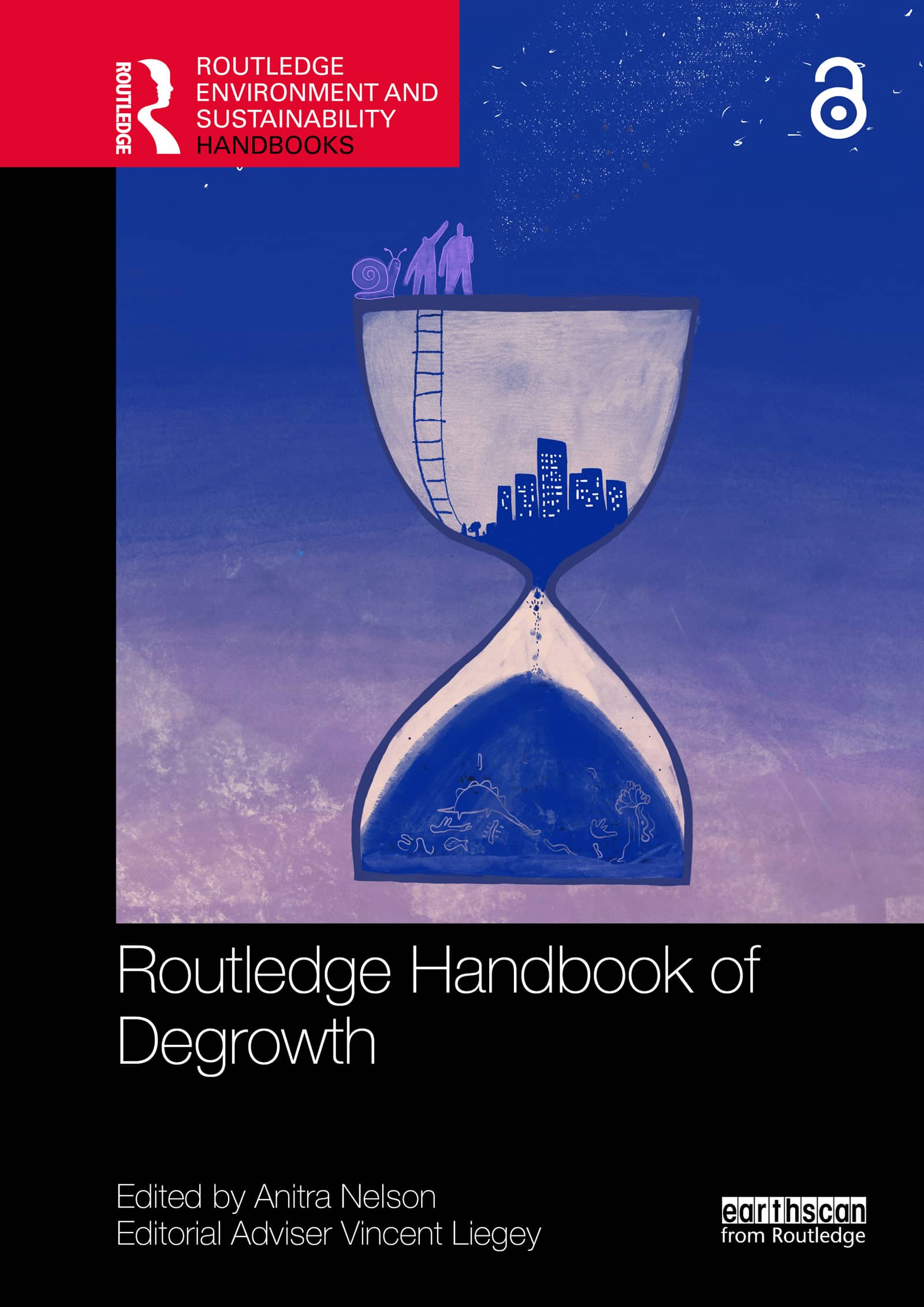
In 2022, a report by the Intergovernmental Panel on Climate Change cited the potential of the degrowth movement to 'speed up' much-needed transformations (IPCC 2022). Last month, a major study published on The Lancet Planetary Health journal reported a substantial support by the public in growth-oriented countries such as the UK and US, when full degrowth proposals are presented alongside (or not) the label (Krpan et al. 2025).
As Nelson & Liegey elegantly articulate in the first chapter of this book:
'[d]egrowth is an invitation to embrace emancipation, to creatively explore new ways of living based on social and ecological values, and to establish decommodified economic systems embedded and maintained within deliberative and direct democracies.' (p. 3)
By accepting this invitation, the built environment could harness the potential of degrowth to bring together voices that, under various banners (e.g. Right to the City, housing justice movements), have long rejected economic development as the dominant ideology in favour of justice, convivial practices, ecological sustainability, and participatory living.
In this framework, the book is precisely what the title suggests: a handbook. It offers a priceless resource to answer the very question of what degrowth stands against (Part I: The current growth conjuncture) and for (Part II: Degrowth: Origins and steppingstones), how to put it into practice (Part III: Degrowth practices: Concepts in action), and what comes next (Part IV: Degrowth futures: Perspectives and strategies).
By traveling through 35 standalone chapters, the reader will be able to shape their own degrowth thread – whether by following a theory of change (from top-down to grassroot approaches), the ramifications of country-specific degrowth definitions, or the declination and application of concepts across countries, genders and ages.
The context needed to understand the 'why' of degrowth is set in the first chapters: the unequal trajectories of an urbanising world and the interrelated capitalist crisis. In doing so, the authors debunk a series of myths around growth. For instance, alongside a series of frightening graphs showing acceleration in extraction and accumulation of resources, in chapter 2 Pineault argues how:
'the nature and scale of the throughput flow and its ecological consequences at the extractive and dissipative frontiers of the economic process are a contested reality produced by the encounter of different logics of accumulation, rather than a passive expression of the equilibrium between supply and demand for raw materials or waste management.' (p. 23; emphasis added)
These logics of accumulation pervade the urban realm. In chapter 31, Savini draws on existing research to argue that some large cities have a material demand that can rival that of entire nation-states, which is satisfied by 'a handful of corporate giants' (p. 421; see IRP 2018; Rutkowski et al. 2024). In this chapter, policymakers and planners will find a well-grounded criticism of 'the growth cycle of urbanisation'. Although largely presented as the silver-bullet strategy for achieving sustainability, climate resilience, or adaptation, this mechanism locks cities into further growth to cope with the resulting social and ecological damages. Advocates of quick and 'green' solutions such as renewables and circularity will gain a better understanding of the feedback loops they reinforce. On the one hand, the impact of renewables and electrification on land, biodiversity and extraction contributes to rural depopulation, de-skilling and migration to urban centres. On the other hand, circularity offers no escape route within a growth-driven framework, fuelling an extractivist cycle of 'perpetual growth and dispossession' through economic innovation and new cycles of investment, renewal and consumption (p. 417).
While bioregionalism, autonomy and habitability are introduced as possible alternative ways forward, readers will be able to jump to other chapters addressing a series of related concepts from different disciplines and traditions. Conviviality and commoning, autonomy and freedom, the degrowth doughnut, frugal abundance, and affective alternatives – all these concepts are rapidly entering the built environment, often without sufficient foundations. What could a 'convivial technology' look like for housing providers and residents? What if the notions of 'connectedness', 'accessibility', 'adaptability', 'bio-interaction', and 'appropriateness' were to guide the sector towards alternative ways of being together and 'having' (Vetter & Fersterer, chapter 14)? How can architects translate the notion of 'frugal abundance' (Plomteux, chapter 17) in space? What is the role of planners in prefigurative practices grounded in horizontalidad, direct democracy and self-organisation, and how do they differ between Europe and the US, Africa, Latin America and Asia (Sitrin, chapter 4)?
Navigating these concepts might be an adventurous, surprising journey as the core dimensions of degrowth are too often superficially understood. This book offers a novel and unique overview of the definitions, stepping stones, and state of the art of the concept in different world regions, reflecting its holistic and pluriversal ambition, while warning against possible distortions and the risks they entail (e.g. Fitzpatrick, chapter 11).
While reading the sequence of regional chapters, readers may discover previously-unknown allies within their own countries or wonder where to start. In chapter 23, Lazányi, Liegey, Schneider and Strenchock offer a glimpse of how real-world collaborations can be set up to put these definitions and concepts into practice, in a space where activists and academics can engage fruitfully in shared practices that aim to transform the way we live, eat and work together across the urban-rural divide.
More than 20 years after the term 'degrowth' was coined, this book represents a clear effort to provide an insight into the numerous discussions revolving around it, as well as their translations into various prefigurative practices around the world. What stands out is the editors' ability to orchestrate an indirect dialogue between different authors and ultimately integrate them into an overview of possible future directions for the movement, research, and politics, reflecting on the complex and hostile context in which they operate (Nelson & Liegey, chapter 35).
As a result, rather than calling for one desirable future, this book opens the door to imagination. While certainly not new to architects, designers, activists, infrastructure providers or policymakers, imagination is too often sacrificed in what is perceived as a system with no viable alternatives. For an increasingly disillusioned built-environment sector, the greatest potential of this book lies in its response to the pressing question 'yes, but how?', and its renewed invitation to collaboratively experiment and actually build the nowtopias we desperately need.
References
IPCC. (2022). Climate change 2022: Mitigation of climate change. Working Group III Contribution to the Sixth Assessment Report of the Intergovernmental Panel on Climate Change. Accessed 24 December 2025. https://www.ipcc.ch/rep ort/sixth-assessment-report-working-group-3/
IRP. (2018). The Weight of Cities: Resource Requirements of Future Urbanization. Swilling, M., Hajer, M., Baynes, T., Bergesen, J., Labbé, F., Musango, J.K., Ramaswami, A., Robinson, B., Salat, S., Suh, S., Currie, P., Fang, A., Hanson, A. Kruit, K., Reiner, M., Smit, S., Tabory, S. A Report by the International Resource Panel. United Nations Environment Programme, Nairobi, Kenya. https://www.resourcepanel.org/reports/weight-cities#report
Krpan, D., Basso, F., Hickel, J. E., & Kallis, G. (2025). Assessing public support for degrowth: Survey-based experimental and predictive studies. The Lancet Planetary Health, 9(11), 101326. https://doi.org/10.1016/j.lanplh.2025.101326
Rutkowski, E., Pitt, H., & Larsen, K. (2024). The global cement challenge, Rhodium Group, 21 March 2024, viewed 8 April 2025, https://rhg.com/research/the-global-cement-challenge/

Latest Peer-Reviewed Journal Content
Building space heating and cooling in NDCs 4.0
T P Lützkendorf
Building component reuse as sociomaterial interaction: lessons from precast concrete
J Uusikartano, L Alkki & V Capitani
Validating national reuse indicators from regional demolition data: a Swedish example
F Ericsson, K Mjörnell & U Janson
Climate change risk and decision-making [editorial]
S Foxell & I Cooper
Technologies of reconstruction [editorial]
P Tombesi
Urban form metrics for building occupancy modelling: applications and impacts
D Reiter, M Jehling & R Hecht
Retrofit realism: affordable low-carbon policies for existing homes
N Eyre & R Khosla
Inside offsite: everyday dwelling in factory-built apartments
L Dorignon & R Horne
MMC for housing: sectoral perception on governance challenges
J Morgan, C Goodier, R Schmidt-III & K Ayinla
Reorganising specification practice for component reuse: an exploratory study
S Gao, K Jones, J Xu & J Glass
Kitchen retrofits to support food practices and wellbeing
F J Andrews, A Sal Moslehian, E Warner & R Tucker
From strategy to delivery: a comparative analysis of MMC roadmaps
G Goldman, D Sorokine, F Suerich-Gulick, C Carbone & M Jemtrud
Thermal comfort, ventilation and mosquito-borne disease risk in Zanzibar hospitals
O Sloan Wood, J B Knudsen, K L Schiøler, E Lupenza, M Msellem & F Saleh
Reusing precast concrete elements in construction: assessing the economic conditions
O Vigren, H Westerlind & T Malmqvist
Institutional readiness for industrialised social housing in Vietnam
T Q Nguyen, B N Nguyen, T H Q To & Z Aziz
Prefabrication for housing retrofit: governance, innovation and resident experience
E Pikas, K Kuusk, P Pihelo, R Liias, J Pukk & T Kalamees
Reframing heat pump transitions: a care perspective
J van der Haer, R Schelwald & F de Haan
Urban informal settlements in Africa: transforming adaptation governance
K Buyana & H Sseviiri
Reusing concrete products in indoor environments: chemical hazard assessment
K Tähtinen, A Helin, E Parshintsev & H Hovi
Negotiating net-zero carbon: an ANT analysis of two buildings
L Schweber & M Green
Design for disassembly: a review of public policy proposals
O Vorobjev, U Uotila, T Joensuu & A Saari
Retrofitting Norwegian residential buildings: an archetype-based dynamic stock model
L S A Rousseau, S Amini, S Akin & E G Hertwich
Decolonising time: vernacular villages and the politics of heritage temporality
R Al-Rabady
Commutes to alternative workplaces: GHG emissions and physical activity
J Taylor, L Thoen, A Espinosa Mireles De Villafranca, P Anashin, J Vanhatalo, D Milián
Bernal & I Okkonen
Nine ‘myths’ about the building stock of Great Britain
S Evans, P Steadman, A Neto-Bradley, D Humphrey, R Liddiard,H Shamsi, J Palmer & G Simons
Join Our Community

The most important part of any journal is our people – readers, authors, reviewers, editorial board members and editors. You are cordially invited to join our community by joining our mailing list. We send out occasional emails about the journal – calls for papers, special issues, events and more.
We will not share your email with third parties. Read more
Latest Commentaries
Who is Responsible for Climate Change?
Ian Cooper (Eclipse Research) explores the questions of responsibility raised in the recent Buildings & Cities special issue ‘Climate Change Risk and Decision-Making’. Focusing here on carbon emissions and mitigation, global responses will require grounding in what can work locally. New responsibilities arise for the wide range of built environment decision-makers: clients, professionals and their institutions, central and local governments, product suppliers, financiers, insurers, etc. A framework is needed to manage the complexity of responsibilities especially for variety of actors, the time frames and spatial scales.
Professional Ethics in a Climate Crisis
The climate crisis has progressed into a dangerous phase with tragic consequences often counted in numbers of excess deaths, but also by powerful economic impacts of rising food prices, the increased costs of insurance and lending, costly damage to the built environment. Celia Davies, Director of Impact at the UK’s Town and Country Planning Association (TCPA) and Hugh Ellis, Director of Policy at TCPA, consider the responsibilities of professionals in shaping a built environment which is fit not just for today's climate risks but for the dramatic increase in severe and unpredictable weather which is now locked into our climate systems.