
www.buildingsandcities.org/insights/reviews/architectural-thinking.html
Architectural Thinking in a Climate Emergency
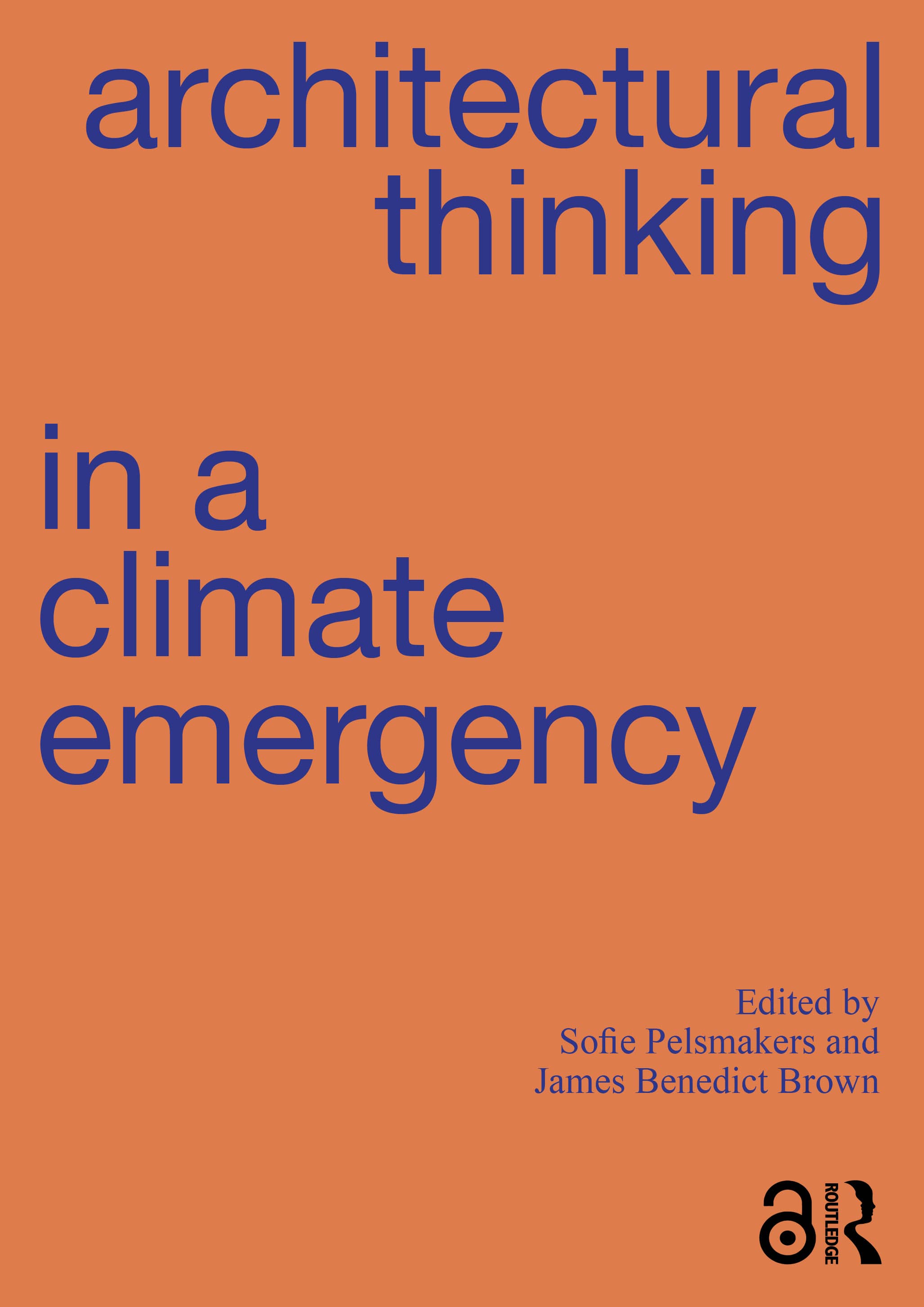
Edited by Sofie Pelsmakers and James Benedict Brown. Routledge, 2025, ISBN: 9781032277486
Carolina Vasilikou commends this book, which positions educational reform as the precondition for genuinely addressing the climate crisis, envisioning a future in which architecture excellence is judged by how well it supports repair, redistribution, collaboration and long-term ecological care.
The book's authors collectively make a valid, critical claim: the climate emergency cannot be resolved through better metrics and performance alone. The issues of justice, care, biodiversity and spatial equity all belong in the same frame – strategies that are essential to architectural thinking and practice. Architecture's complicity in ecological and social harm is rooted in a 'signature pedagogy' (as Felicity Atekpe puts it in Chapter 6; see also Shulman 2005) that trains architects as individual authors of non-contextual objects, competing for authorship and aesthetic novelty, rather than as facilitators that embed themselves thoughtfully in communities, ecosystems and longer planet- and place-specific timelines. One of the book's most significant achievements is refusing to separate ecology from justice. Climate change is presented as a distributional problem, as much as an environmental one: carbon emissions, heat exposure during extreme climate events, flooding and poor air quality impact unevenly, and the most vulnerable communities are often those least responsible for the damaging impact (Nixon 2011). Moving onwards from the ways of technological reduction of carbon, the question remains about who gets protected, who gets heard and whose everyday lives are treated as expendable in the name of efficiency or growth.
My reading is that the book asks about what kind of world architecture helps to normalise. Through the lens of repair, reuse and endurance, circularity moves away from a technical fix to a cultural shift in how architectural value is judged. Ageing materials, disassembly and visible reuse are particularly convincing vehicles of meaningful change because they challenge a still-dominant aesthetic of constant novelty and perfection (Puig de la Bellacasa 2017). If architecture is to become less extractive, should it become more tolerant of adaptation, material memory and accept the incompleteness of being in flux – a natural state in architectural practice? The authors of this edited volume suggest that the answer is yes, and the book as a whole extends this logic into both practice and pedagogy.
The question of coexistence with wider living systems is also prevalent. Running alongside the justice argument, and considerably less resolved, is an ecological-ethical claim: that architecture's client base must be extended beyond the human altogether. In Chapter 4 Myllymäki et al.'s reframing of the crisis as the 'Capitalocene' rather than the Anthropocene (see also Moore 2015) is the book's clearest articulation of this position. The authors posit that the problem is not humanity but a specific economic logic that renders land, materials and non-human life as extractable inputs. Their proposed alternative, built on radical inclusivity, biophilia and topophilia, asks architects to design as though mushrooms, compost, and cycling infrastructure were legitimate stakeholders alongside the paying client (Haraway 2016). It is an ambitious ethical move, and one that resonates with what is, to my reading, one of the book's most quietly persuasive chapters on this theme. Vidali's study of Kampos (Chapter 14) exemplifies this approach: land was historically valued according to what could be farmed and measured in labour time rather than fixed metric units. This represents a relational, more-than-human ethic embedded in everyday practice rather than declared as theory. McAleer-Harding et al.'s treatment of taonga (treasures) and wāhi tapu (sacred spaces) in Aotearoa extends this further still (Chapter 12), insisting that non-material and spiritual relationships to land are not sentimental additions to resilience planning but its actual substance. Along with Faith Chelang’at Ng'eno (Chapter 13), the editors together with the contributing authors challenge the definition of sustainability through imported Western standards and argue that resilience is inseparable from colonial violence and indigenous dispossession (Tuhiwai Smith 2008). A climate-aware architecture that does not confront colonial knowledge hierarchies is only partly climate-aware.
The book shows more confidence in asserting that non-human and ecological interests deserve priority than in explaining how a profession still governed by contracts, liability and paying clients might operationalise that principle. Extending empathy to 'the environment as client' (proposed in Chapter 4) is a compelling normative frame. More needs to be said about who arbitrates competing claims when a client's interests and an ecosystem's needs diverge, or about how such an ethic translates into enforceable professional obligation rather than aspiration. Not surprisingly, the book's strongest ethical grounding comes not from its more programmatic chapters but from its most place-based ones, where ecological and ethical claims are anchored in specific, lived relationships to land rather than at the level of the discipline in the abstract. As Chapter 11 claims, climate planning depends on better spatial data, but also on more democratic ways of valuing local knowledge.
The call of pedagogy chapters for a 'creaturely pedagogy' (atekpe) built on equity and ease is conceptually appealing, though more work is needed to specify how this can be implemented in practice. 'Ease' as the antidote to reactive, panicked design thinking is a useful provocation, while the gap still exists on how understaffed studios operating under rigid accreditation requirements might actually create the unhurried reflective space it calls for. Nisonen, Poutanen and Pelsmakers' (Chapter 7) account of design thinking as a corrective to the discipline's master–apprentice model is more operationally grounded, with its problem- and solution-space model of iterative divergence and convergence. Yet it inherits a familiar tension in design-thinking literature: participatory, empathy-centred methods are easiest to run in well-resourced elective studios, and hardest to institutionalise where accreditation bodies still reward polished individual authorship. Kroll, Galavan and Soebarto (Chapter 8) name the mechanism by which pedagogical reform stalls: sustainability is formally taught as an 'add-on' technical module while the real cultural values of the discipline are transmitted tacitly, through studio critique, precedent-worship, and the implicit hierarchy of what counts as 'good architecture', as a hidden curriculum. The University of Pretoria's case study (Chapter 9) locates the obstacle not in curriculum content but in the reward structures — crits, guest juries, portfolio culture — that shape what students learn to value regardless of what the syllabus says. In doing so, it provides substantial evidence that structural reform is possible: a four-stage curriculum moving students from 'my place in the world' to a self-assessed 'change agent' built on transformative learning theory and grounded in the department's own history within apartheid. The case study offers a rare example of an institution restructuring itself rather than layering sustainability content onto an unchanged core. Yet, even this chapter concedes that graduates struggle to carry the transformative mindset into a profession still organised around conventional practice norms. This resonates with the call put forward by Tyszczuk (Chapter 15) for attention, rehearsal and care rather than control. What if architectural futures are less about prediction and more about learning how to pay attention together?
As a whole, Architectural Thinking in a Climate Emergency makes a coherent and genuinely compelling case that the climate emergency is — at root — a pedagogical and epistemic emergency: a crisis in what architecture teaches its practitioners to value and whose knowledge it is willing to recognise as legitimate. The book is at its strongest where this claim is tied to concrete institutional mechanisms — studio culture, accreditation, assessment rubrics — and asks for more input from the wider architectural community where it rests on the more diffuse language of empathy and interconnectedness. Its case studies, although locally rich and situated, are too often left to stand in for systemic argument, leaving the reader to do the work of connecting a self-built skatepark, or a village honey festival, back to the 36% emissions figure the book opens with. What the reader ultimately learns is not a method but a diagnosis, worth stating plainly: no retrofit-first policy, no embodied-carbon target, and no circularity performance will hold if the profession beneath them continues to think, teach and reward itself exactly as it always has. Pedagogical reform is not a parallel track to decarbonisation and circular economy but its precondition. The argument is that architecture can no longer define excellence through form alone, nor rely on narrow notions of innovation, prestige or technical competence. Instead, this book points toward a more attention-based and more demanding future: one in which architecture is judged by how well it supports repair, redistribution, collaboration and long-term ecological care.
References
Haraway, D.J. (2016). Staying with the trouble: making kin in the Chthulucene. Duke University Press.
Moore, J.W. (2015). Capitalism in the web of life: ecology and the accumulation of capital. Verso.
Nixon, R. (2011). Slow violence and the environmentalism of the poor. Harvard University Press.
Puig de la Bellacasa, M. (2017). Matters of care: speculative ethics in more than human worlds. University of Minnesota Press.
Shulman, L.S. (2005). Signature pedagogies in the professions. Daedalus, 134(3), 52-59.
Tuhiwai Smith, L. (2008). Decolonising methodologies: research and indigenous peoples. Zed Books.
Latest Peer-Reviewed Journal Content
Moving homes and energy poverty: residents’ concerns, capabilities and responses
M Jalas, J Rinkinen, S Numminen & E Valkealahti
Reference study for biogenic carbon storage in the residential building stock
O Iliescu, I Talvitie, A Amiri & S Junnila
Building space heating and cooling in NDCs 4.0
T P Lützkendorf
Building component reuse as sociomaterial interaction: lessons from precast concrete
J Uusikartano, L Alkki & V Capitani
Validating national reuse indicators from regional demolition data: a Swedish example
F Ericsson, K Mjörnell & U Janson
Climate change risk and decision-making [editorial]
S Foxell & I Cooper
Technologies of reconstruction [editorial]
P Tombesi
Urban form metrics for building occupancy modelling: applications and impacts
D Reiter, M Jehling & R Hecht
Retrofit realism: affordable low-carbon policies for existing homes
N Eyre & R Khosla
Join Our Community

The most important part of any journal is our people – readers, authors, reviewers, editorial board members and editors. You are cordially invited to join our community by joining our mailing list. We send out occasional emails about the journal – calls for papers, special issues, events and more.
We will not share your email with third parties. Read more
Latest Commentaries
Who is Responsible for Climate Change?
Ian Cooper (Eclipse Research) explores the questions of responsibility raised in the recent Buildings & Cities special issue ‘Climate Change Risk and Decision-Making’. Focusing here on carbon emissions and mitigation, global responses will require grounding in what can work locally. New responsibilities arise for the wide range of built environment decision-makers: clients, professionals and their institutions, central and local governments, product suppliers, financiers, insurers, etc. A framework is needed to manage the complexity of responsibilities especially for variety of actors, the time frames and spatial scales.
Professional Ethics in a Climate Crisis
The climate crisis has progressed into a dangerous phase with tragic consequences often counted in numbers of excess deaths, but also by powerful economic impacts of rising food prices, the increased costs of insurance and lending, costly damage to the built environment. Celia Davies, Director of Impact at the UK’s Town and Country Planning Association (TCPA) and Hugh Ellis, Director of Policy at TCPA, consider the responsibilities of professionals in shaping a built environment which is fit not just for today's climate risks but for the dramatic increase in severe and unpredictable weather which is now locked into our climate systems.