
www.buildingsandcities.org/insights/reviews/designing_neuroinclusive_workplace.html
Designing Neuroinclusive Workplaces
By Kay Sargent. John Wiley & Sons, 2025, ISBN: 1394309337
Kerstin Sailer commends this book, as it fills an important gap for scholars, the design community and the workplace community. It provides understanding on how people with different sensory profiles can thrive in the work environment and insights for creating inclusive workplaces.
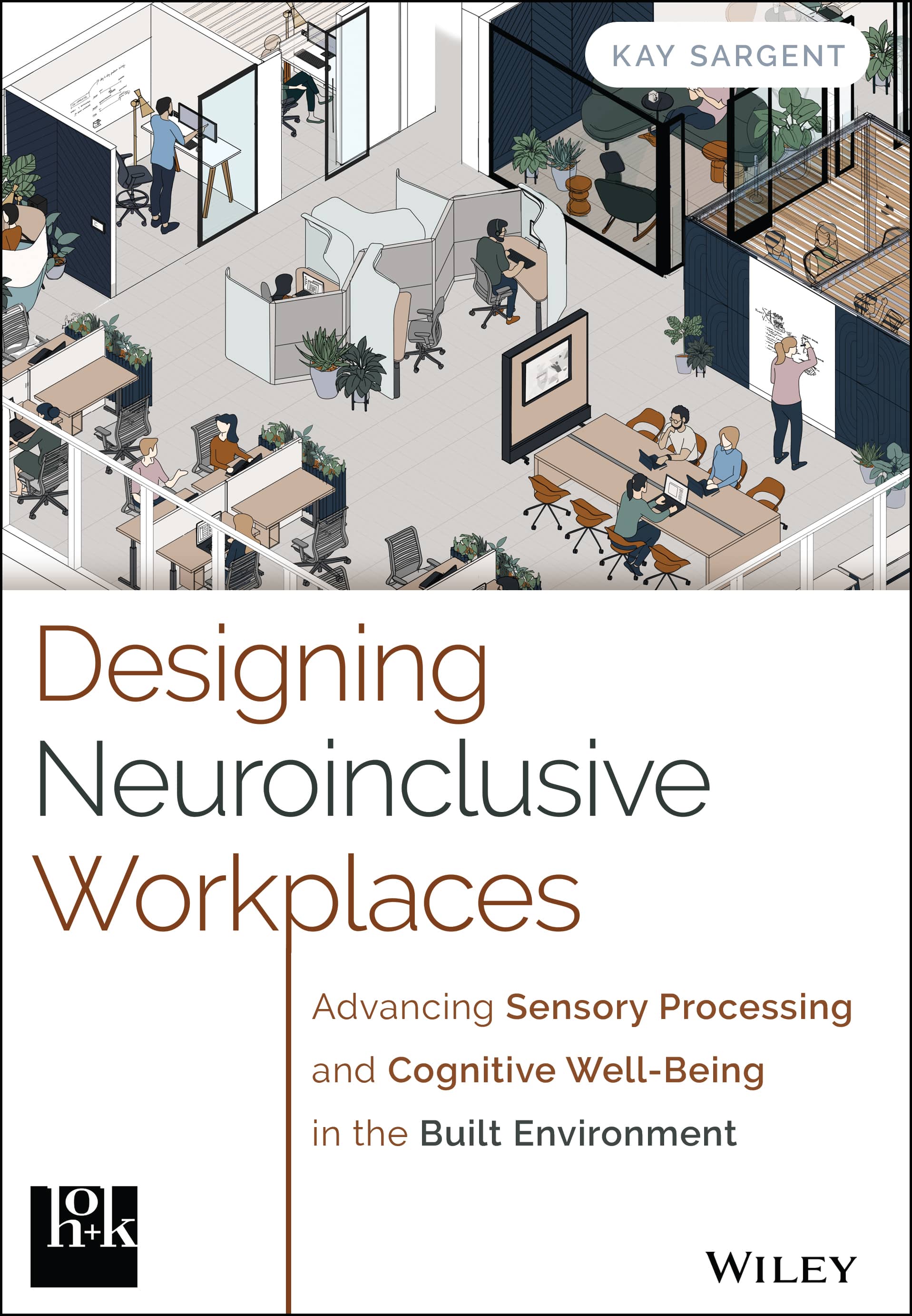
The built environment does not present itself in the same way to all people. Perceptions of buildings and spaces vary, yet design all too often assumes an average person as user and therefore might fail to accommodate people with distinct sensory profiles.
Taking up the challenge to understand how to design for neuroinclusion, this book takes the readers on a journey to explore what neurodivergence means; how it presents itself as a series of dynamic preferences for certain spaces and settings; and what designers of workplace environments should consider in order to create inclusive solutions that work for everyone.
Neurodivergence affects around 20% of the population and includes distinct diagnoses such as attention-deficit hyperactivity disorder (ADHD), autism, Asperger’s, dyslexia, dysgraphia, dyscalculia, dyspraxia, Tourette’s syndrome, obsessive-compulsive disorder (OCD) and synesthesia. Some workplaces may find that closer to 50% of their workforce are affected; for example in research-intensive industries, with many people never having received a formal diagnosis. Sargent explains that sensory profiles can be 'spiky', i.e. pronounced in some areas and not in others. An important distinction is made between hypersensitivity (seeking to reduce stimulation) and hyposensitivity (seeking out stimulation).
The built environment plays a significant role in mediating the sensory processing capacities of people:
'What might be merely annoying to neurotypicals could be debilitating to neurodivergents.' (p. 11)
But how would you, for example, design for someone with ADHD?
This seemingly innocent question posed to the author in 2016 marked the beginning of almost a decade of work, culminating eventually in the publication of this much needed book. At the time, little research or guidance existed on how to design workplaces for people with sensory differences and this persistent dedication to the topic possibly constitutes the biggest contribution made by Sargent: to raise awareness, to summarise what we know about neurodivergent characteristics, to apply this to workplace design principles, and thus to make it accessible to designers.
An academic literature search on neurodivergence in workplace design reveals less than a dozen texts, all published in the last two years. This highlights the foresight and pioneering nature of Sargent’s contribution.
The book tells the author’s story across fifteen, mostly short chapters that build on each other but can also be appreciated as standalone texts. For instance, business leaders who need convincing that designing for an apparent minority makes business sense will find chapter 3 relevant. Designers interested in concrete procedural advice can delve into chapter 12, which details a step-by-step process to follow for neuroinclusive design. It covers many actions to take before the actual design begins, including: consultation with professionals, education of design teams, an audit of existing client spaces, ensuring leadership buy-in and conducting employee interviews.
Chapter 13 provides a concrete design approach and zoning strategy for workplace environments that builds on activity-based working principles, whereby employees have choices of different settings to conduct their activities. This approach will be known to many workplace designers and strategists, but what is different here is a clear articulation of how to maximise diversity, flexibility and choice. For instance, not everyone will enjoy shifting positions regularly. For autistic individuals, a routine is key, so it should be possible for people to choose the exact same location every day. Context is also considered much more systematically than usual, so what is placed next to what can turn a space from overwhelming to accommodating. For example, rest spaces hidden away and only reachable via a loud and noisy corridor will not work well; likewise, rest spaces with overstimulating colours or materials might work for hyposensitive individuals but not for those with hypersensitivities. Examples are provided of many different floor plans and detailed diagrammatic drawings of neighbourhoods and zones that offer maximum choice for six different work modalities (concentrate, contemplate, communal, create, congregate, and convivial) and for both neurotypes (hypo- and hypersensitive).
The text presents itself as easily readable and is interspersed with personal stories, spotlight interviews with key stakeholders and profiles of important personalities in business and culture who convey neurodivergent traits, adding nuance and interest to the discussion.
The book will appeal to a variety of readers, yet in differentiated ways. The main anticipated audience – designers and architects – will appreciate the clear writing, design diagrams and concrete suggestions. Every designer and architect wishing to create more inclusive spaces should read the book. It is high time books like this were added to the curriculum of architecture schools to raise awareness for issues of inclusivity, how to design differently, and how to integrate user needs and preferences more systematically.
Organisations and HR professionals will find it interesting to consider how the design of spaces relates to organisational and operational issues. Inclusive hiring policies for instance will not achieve their results, if workspaces are designed in a way that make it impossible for people with different sensory profiles to succeed and perform well.
Individuals with neurodivergent traits can use the book to understand their own intuitive preferences better. Realising how design impacts your performance and well-being can be empowering and help affect change in workplaces.
For academic audiences, the book might be less compelling as some discussions lack the necessary depth scholars seek, although arguably they might not be the main anticipated readership. The book does not connect with the longer tradition of disability studies in architecture and design, with some contributions reaching back to the 1980s and 1990s (Hall & Imrie 1999) and a flourishing discussion emerging in the mid-2010s (Boys 2014; 2017). A lot of these contributions include invisible disabilities such as neurodivergence, and some select pieces (Cassidy 2018) as well as a recently published edited book (Illes et al. 2022) explicitly bring it in as a main focus. The relevant social model of disability, which maintains that individuals are not disabled because of their bodies but because the environment is disabling them is only mentioned briefly almost towards the end of the book. In my view, it would have deserved a more prominent place in the overall framing of neurodivergence as a disability.
Nonetheless, this book is an invaluable contribution providing useful information and practical advice to both the design community and the workplace community. It deserves wide acclaim. Given the dearth of rigorous research on the topic, the book fills an important gap for scholars of the workplace and can be seen as a major contribution that raises relevant further research questions to explore.
References
Boys, J. (2014). Doing disability differently: An alternative handbook on architecture, dis/ability and designing for everyday life. Routledge.
Boys, J. (2017). Disability, space, architecture. Taylor & Francis.
Cassidy, M.K. (2018). Neurodiversity in the workplace: Architecture for autism (Master's thesis, University of Cincinnati).
Hall, P. & Imrie, R. (1999). Architectural practices and disabling design in the built environment. Environment and Planning B: Planning and Design, 26(3), 409-425.
Illes, J., Clarke, A., Boys, J. & Gardner, J. (2022). Neurodivergence and architecture (Vol. 5). Academic Press.


Latest Peer-Reviewed Journal Content
Urban form metrics for building occupancy modelling: applications and impacts
D Reiter, M Jehling & R Hecht
Retrofit realism: affordable low-carbon policies for existing homes
N Eyre & R Khosla
Inside offsite: everyday dwelling in factory-built apartments
L Dorignon & R Horne
MMC for housing: sectoral perception on governance challenges
J Morgan, C Goodier, R Schmidt-III & K Ayinla
Reorganising specification practice for component reuse: an exploratory study
S Gao, K Jones, J Xu & J Glass
Kitchen retrofits to support food practices and wellbeing
F J Andrews, A Sal Moslehian, E Warner & R Tucker
From strategy to delivery: a comparative analysis of MMC roadmaps
G Goldman, D Sorokine, F Suerich-Gulick, C Carbone & M Jemtrud
Thermal comfort, ventilation and mosquito-borne disease risk in Zanzibar hospitals
O Sloan Wood, J B Knudsen, K L Schiøler, E Lupenza, M Msellem & F Saleh
Reusing precast concrete elements in construction: assessing the economic conditions
O Vigren, H Westerlind & T Malmqvist
Institutional readiness for industrialised social housing in Vietnam
T Q Nguyen, B N Nguyen, T H Q To & Z Aziz
Prefabrication for housing retrofit: governance, innovation and resident experience
E Pikas, K Kuusk, P Pihelo, R Liias, J Pukk & T Kalamees
Reframing heat pump transitions: a care perspective
J van der Haer, R Schelwald & F de Haan
Urban informal settlements in Africa: transforming adaptation governance
K Buyana & H Sseviiri
Reusing concrete products in indoor environments: chemical hazard assessment
K Tähtinen, A Helin, E Parshintsev & H Hovi
Negotiating net-zero carbon: an ANT analysis of two buildings
L Schweber & M Green
Design for disassembly: a review of public policy proposals
O Vorobjev, U Uotila, T Joensuu & A Saari
Retrofitting Norwegian residential buildings: an archetype-based dynamic stock model
L S A Rousseau, S Amini, S Akin & E G Hertwich
Decolonising time: vernacular villages and the politics of heritage temporality
R Al-Rabady
Commutes to alternative workplaces: GHG emissions and physical activity
J Taylor, L Thoen, A Espinosa Mireles De Villafranca, P Anashin, J Vanhatalo, D Milián
Bernal & I Okkonen
Nine ‘myths’ about the building stock of Great Britain
S Evans, P Steadman, A Neto-Bradley, D Humphrey, R Liddiard,H Shamsi, J Palmer & G Simons
Join Our Community

The most important part of any journal is our people – readers, authors, reviewers, editorial board members and editors. You are cordially invited to join our community by joining our mailing list. We send out occasional emails about the journal – calls for papers, special issues, events and more.
We will not share your email with third parties. Read more
Latest Commentaries
Professional Ethics in a Climate Crisis
The climate crisis has progressed into a dangerous phase with tragic consequences often counted in numbers of excess deaths, but also by powerful economic impacts of rising food prices, the increased costs of insurance and lending, costly damage to the built environment. Celia Davies, Director of Impact at the UK’s Town and Country Planning Association (TCPA) and Hugh Ellis, Director of Policy at TCPA, consider the responsibilities of professionals in shaping a built environment which is fit not just for today's climate risks but for the dramatic increase in severe and unpredictable weather which is now locked into our climate systems.
Living Labs: Maturity, Impact and the Role of Researchers
Living labs are blossoming more than ever. Their first appearances in academic literature were roughly 25 years ago. Dimitri Schuurman (Ghent University) responds to the recent Buildings & Cities special issue “Living Labs: Agents for Change” and focuses on two important drawbacks that also come with living labs booming in practice as well as in the literature.