
www.buildingsandcities.org/insights/commentaries/cop30-report.html
COP30 Report
No further climate ambition, promises for affordable housing
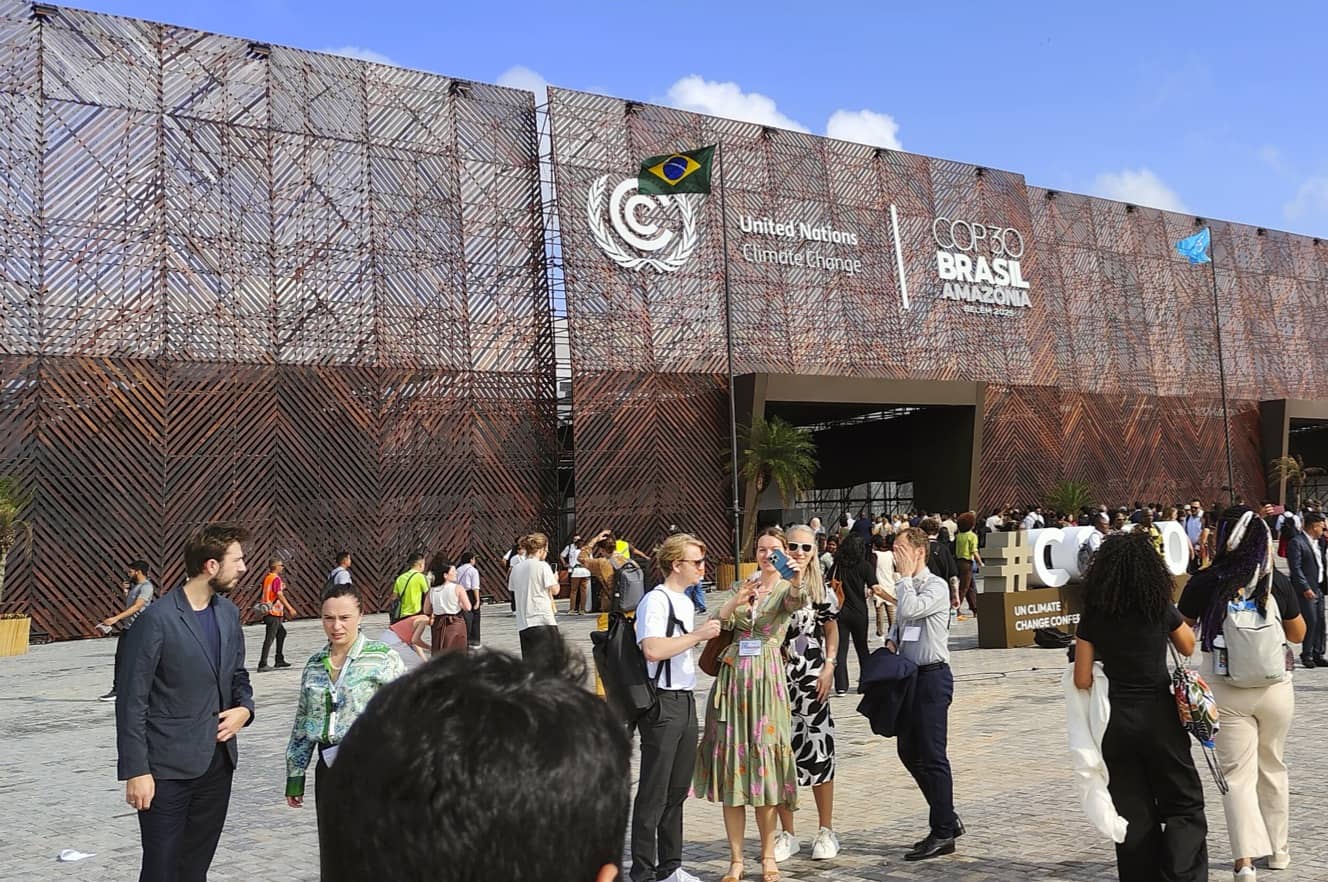
Matti Kuittinen (Aalto University) reflects on his experience of attending the 2025 UN Conference of the Parties in Belém, Brazil. The roadmaps and commitments failed to deliver the objectives of the 2025 Paris Agreement. However, 2 countries - Japan and Senegal - announced they are creating roadmaps to decarbonise their buildings. An international group of government ministers put housing on the agenda - specifying the need for reduced carbon and energy use along with affordability, quality and climate resilience.
Scorching heat, intense humidity, streets turned to rivers, flanked by colourful shacks. This is Belém, gateway to the Amazon. Brazil chose a distant, underdeveloped city on the equator for the 2025 Climate COP for a reason: here, the climate emergency is clearly evident. The realities communities face in a changing climate are impossible to ignore.
Despite the demonstrative setting, world leaders failed to agree more ambitious goals. The main formal outcome of COP30 was a call to unite in a global mutirão, a collective effort against climate change. Crucial decisions – the phasing out of fossil fuels, for instance – remain unresolved. The parties are splitting into two camps: over 80 countries calling for greater ambition, and the reluctant, who still see fossil fuels as central to their economic livelihood.
Although COP28 in 2023 produced a joint declaration to end fossil fuel use, the world now seems more divided and less determined. Of the 194 countries and entities represented at COP30, around 80 did not submit additional commitments to curb emissions. The countries which did update their Nationally Declared Contribution (NDC) offered weaker‑than‑expected reductions. This level of dedication is insufficient to deliver the Paris Agreement to keep global heating under 2oC.
Emissions continued to grow after 2024
At COP29 in Baku, there was cautious optimism. 2025 was expected to be the first year in which emissions would stop rising and finally level off. Instead, they grew by 1.1% in 2025, leaving a remaining emission quota for 1.5°C of warming of around 170 GtCO2e, and approximately 1,055 GtCO2e for 2°C. Even though emissions from land‑use change have declined steadily, fossil fuels and cement will push past the 1.5°C limit within four years. The new COP30 commitments do little to alter that trajectory. The world is moving decisively towards planetary tipping points.
Ice loss = global damage
With inadequate emission‑reduction pledges, the state of the world’s glaciers and permafrost looks grim. The 2025 State of the Cryosphere report, published at COP30, signals accelerated melting that could cast a long shadow over humanity’s future, especially for coastal settlements.
A key topic among researchers at COP30 was the potential fading or collapse of the Atlantic Meridional Overturning Circulation (AMOC). This system warms north‑western Europe and connects to the Southern Hemisphere climate through the Antarctic Overturning Circulation (AOC), and indirectly to the El Niño–La Niña pattern. As ice melts – particularly in Greenland – AMOC is showing increasing signs of slowing. The science continues to evolve, uncertainties remain, but recent evidence suggests AMOC is weakening even more than earlier models predicted.
The 2025 Cryosphere report also underscores AMOC’s strong influence on sea‑level rise. Even if countries met the NDCs for limiting warming to 1.5°C – which they don’t – melting glaciers and ice sheets could still drive 1.5 metres of sea‑level rise by 2100 and over 10 metres in the centuries that follow. To avoid sea‑level rise that threatens millions in coastal settlements, a safe guardrail would be around 1°C. We are currently heading towards 2.6°C. The adaptation effort would demand vast resources. Responding to these findings, Iceland has recently designated a potential AMOC collapse a national security risk.
A weakening AMOC would also damage the Amazon rainforest. Shifts in weather and precipitation patterns could make the Amazon drier and more drought‑prone, with severe consequences for local communities. A drier Amazon in turn accelerates AMOC decline – a vicious feedback loop.
As Johan Rockström put it at the Planetary Science pavilion: if ministers understood that 2°C of warming could shut down AMOC completely, we would “see a totally different level of climate action”.
Promises of responsible use of materials
Amid concern over tipping points linked to the Amazon, COP30 launched the Tropical Forests Forever Facility (TFFF). This US$ 5 billion initiative, backed by over 50 countries, aims to protect and restore tropical forests. In the same spirit, the Forest Climate Leaders Partnership (FCLP) released the Principles of Responsible Timber Construction, emphasising longer service lives – and thus sustained carbon storage – for timber and bio-based buildings through circular construction. Despite commitments to sustainable sourcing and the benefits of biogenic carbon, much more is needed to strengthen forest carbon sinks.
Carbon sinks are vital for the concrete sector too. As reported by the Global Cement and Concrete Association, their industry’s route to carbon neutrality by 2050 leans heavily on technical solutions. The sector reports that a 20% reduction in GHG emissions per a tonne of cement since 1990 is possible by 2030. However, this requires decarbonisation through the global deployment of carbon capture and storage (CCS) at cement plants. Although technologically feasible, the roll out of CCS will be uneven. Still, some 36% of planned concrete sectors reductions are allocated to this technology. How those costs will affect housing affordability remains a central question.
In contrast, the steel industry’s COP commitments focused on harmonising standards for GHG measurement and classification. A new partnership between European (LESS) and Chinese (C2F Steel) low‑emission steel standards should improve interoperability and facilitate green procurement. Clearer purchasing rules are essential for countries and cities choosing the climate‑ambitious path.
Affordable and sustainable housing
Despite limited progress on emissions, COP30 was the first COP where ministers endorsed a call to action for sustainable and affordable housing. Facilitated by the Intergovernmental Council for Buildings and Climate (ICBC), it couples reductions in whole‑life carbon and energy use with affordability, quality and climate resilience.
To turn ambition into delivery, ministers asked multilateral development banks and international financial institutions to establish an “Affordable and Sustainable Housing Finance Alliance” to share knowledge, develop financial instruments and provide technical assistance. The financial needs may be substantial if housing for the next 2 billion people is to be low‑carbon and climate‑resilient. According to the International Energy Agency, investments to decarbonise cement production alone could result in a 30–125% price increase.
The ICBC call to action states that no housing should be “legally constructed in areas with known climate risks” without protective measures. Although the wording leaves out most of the informal settlements – an important share of the reality of construction – the idea itself is not new. Resilience is a basic principle of climate adaptation but there is a clear awakening to the serious threats that rising sea levels, slowing ocean currents, and thawing permafrost will cause over the coming centuries as a reaction to the already‑locked‑in global warming.
Next steps for the built environment
The next major milestone for the built environment’s role and mitigation potential is the forthcoming IPCC special report on climate change and cities, planned for 2027. But to head off the threats posed by melting ice and thawing permafrost, action must accelerate. Mitigation and adaptation – and the finance to support both – need to be mobilised now.
Researchers have repeatedly proposed specific national decarbonisation roadmaps for buildings and called for stronger collaboration with policymakers. These topics were discussed in Belém at several events organised by the Global ABC and the World Green Buildings Council. This year, Japan and Senegal reported positive developments. Japan is currently drafting regulations to set GHG limits for buildings, and Senegal – as the first African country – reported on early implementation of its recently published sustainable construction roadmap, launched the previous COP. As a significant share of Africa’s future building stock is yet to be built, a low-carbon approach to new construction is an important precedent for the continent.
Researchers in Belém called for an immediate halt to global warming to avoid high‑cost damage lasting hundreds of years. Ambition remains too low and emissions too high. After COP29, cities and industry stakeholders already looked essential to any effective mitigation; now the parties are clearly choosing different paths. If the coalition of 80+ countries pressing for higher ambition can attract followers – and if delivery follows in the construction sector – there is still a chance to keep warming below 2°C and avoid irreversible planetary tipping points. And it is far easier to negotiate with reluctant countries than with melting glaciers.


Latest Peer-Reviewed Journal Content

Building space heating and cooling in NDCs 4.0
T P Lützkendorf
Building component reuse as sociomaterial interaction: lessons from precast concrete
J Uusikartano, L Alkki & V Capitani
Validating national reuse indicators from regional demolition data: a Swedish example
F Ericsson, K Mjörnell & U Janson
Climate change risk and decision-making [editorial]
S Foxell & I Cooper
Technologies of reconstruction [editorial]
P Tombesi
Urban form metrics for building occupancy modelling: applications and impacts
D Reiter, M Jehling & R Hecht
Retrofit realism: affordable low-carbon policies for existing homes
N Eyre & R Khosla
Inside offsite: everyday dwelling in factory-built apartments
L Dorignon & R Horne
MMC for housing: sectoral perception on governance challenges
J Morgan, C Goodier, R Schmidt-III & K Ayinla
Reorganising specification practice for component reuse: an exploratory study
S Gao, K Jones, J Xu & J Glass
Kitchen retrofits to support food practices and wellbeing
F J Andrews, A Sal Moslehian, E Warner & R Tucker
From strategy to delivery: a comparative analysis of MMC roadmaps
G Goldman, D Sorokine, F Suerich-Gulick, C Carbone & M Jemtrud
Thermal comfort, ventilation and mosquito-borne disease risk in Zanzibar hospitals
O Sloan Wood, J B Knudsen, K L Schiøler, E Lupenza, M Msellem & F Saleh
Reusing precast concrete elements in construction: assessing the economic conditions
O Vigren, H Westerlind & T Malmqvist
Institutional readiness for industrialised social housing in Vietnam
T Q Nguyen, B N Nguyen, T H Q To & Z Aziz
Prefabrication for housing retrofit: governance, innovation and resident experience
E Pikas, K Kuusk, P Pihelo, R Liias, J Pukk & T Kalamees
Reframing heat pump transitions: a care perspective
J van der Haer, R Schelwald & F de Haan
Urban informal settlements in Africa: transforming adaptation governance
K Buyana & H Sseviiri
Reusing concrete products in indoor environments: chemical hazard assessment
K Tähtinen, A Helin, E Parshintsev & H Hovi
Negotiating net-zero carbon: an ANT analysis of two buildings
L Schweber & M Green
Design for disassembly: a review of public policy proposals
O Vorobjev, U Uotila, T Joensuu & A Saari
Retrofitting Norwegian residential buildings: an archetype-based dynamic stock model
L S A Rousseau, S Amini, S Akin & E G Hertwich
Decolonising time: vernacular villages and the politics of heritage temporality
R Al-Rabady
Commutes to alternative workplaces: GHG emissions and physical activity
J Taylor, L Thoen, A Espinosa Mireles De Villafranca, P Anashin, J Vanhatalo, D Milián
Bernal & I Okkonen
Nine ‘myths’ about the building stock of Great Britain
S Evans, P Steadman, A Neto-Bradley, D Humphrey, R Liddiard,H Shamsi, J Palmer & G Simons
Join Our Community

The most important part of any journal is our people – readers, authors, reviewers, editorial board members and editors. You are cordially invited to join our community by joining our mailing list. We send out occasional emails about the journal – calls for papers, special issues, events and more.
We will not share your email with third parties. Read more
Latest Commentaries
Who is Responsible for Climate Change?
Ian Cooper (Eclipse Research) explores the questions of responsibility raised in the recent Buildings & Cities special issue ‘Climate Change Risk and Decision-Making’. Focusing here on carbon emissions and mitigation, global responses will require grounding in what can work locally. New responsibilities arise for the wide range of built environment decision-makers: clients, professionals and their institutions, central and local governments, product suppliers, financiers, insurers, etc. A framework is needed to manage the complexity of responsibilities especially for variety of actors, the time frames and spatial scales.
Professional Ethics in a Climate Crisis
The climate crisis has progressed into a dangerous phase with tragic consequences often counted in numbers of excess deaths, but also by powerful economic impacts of rising food prices, the increased costs of insurance and lending, costly damage to the built environment. Celia Davies, Director of Impact at the UK’s Town and Country Planning Association (TCPA) and Hugh Ellis, Director of Policy at TCPA, consider the responsibilities of professionals in shaping a built environment which is fit not just for today's climate risks but for the dramatic increase in severe and unpredictable weather which is now locked into our climate systems.