
www.buildingsandcities.org/insights/news/sustainable-buildings-construction.html
Sustainable Buildings & Construction Summit
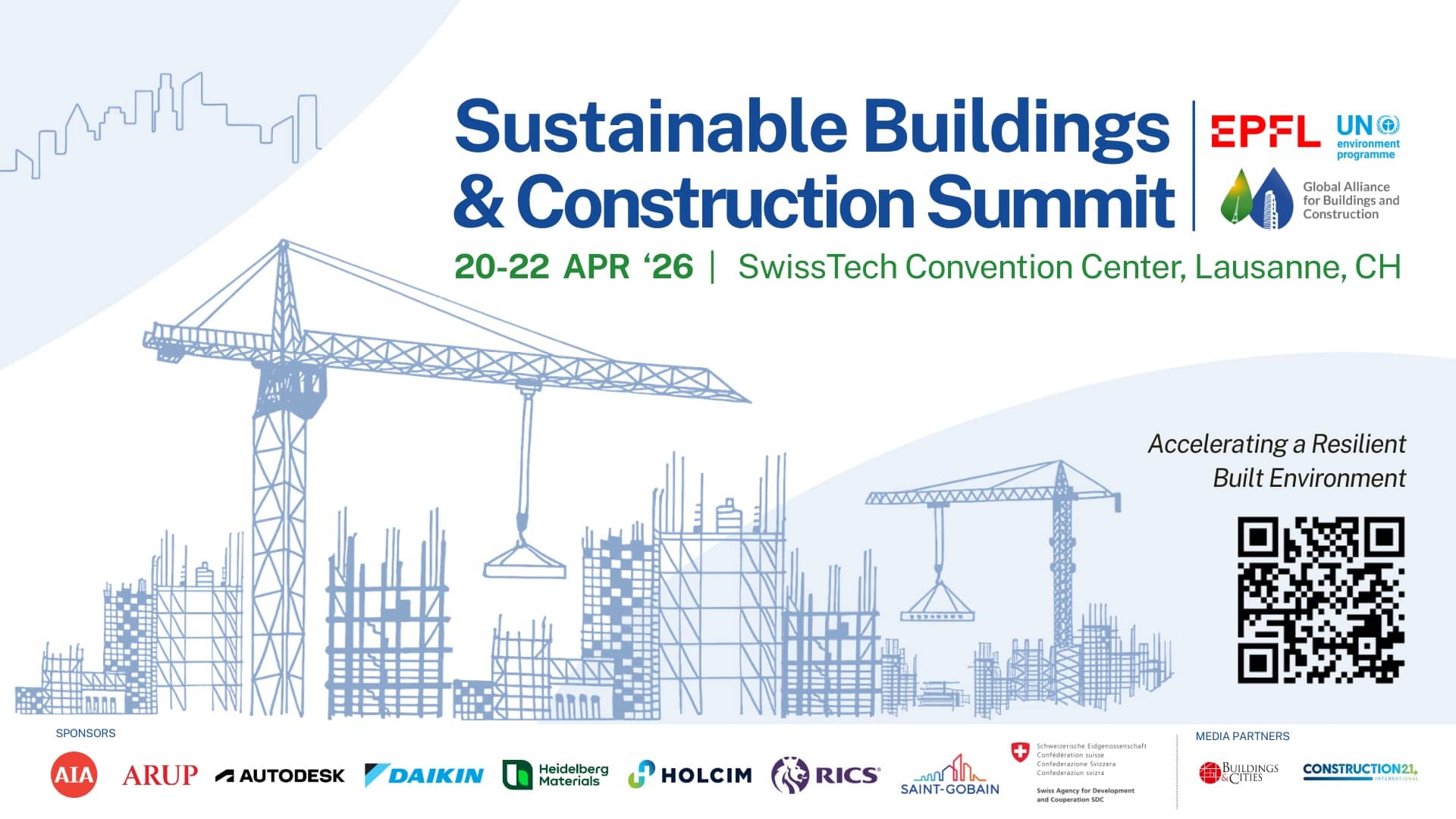
EVENT: 20-22 April 2026
The Sustainable Buildings and Construction Summit 2026 in Lausanne, Switzerland convenes government officials, academics, private sector leaders, financiers, and civil society to advance climate action in the building sector. Its aim is to accelerate the transition to a resilient built environment worldwide, with particular focus on emerging markets and developing economies.
https://sustainable-construction.org/
Building on the success of the 2024 Global Forum on Buildings and Climate held in Paris, the Summit is co-organised by EPFL's Centre for Worldwide Sustainable Construction and the UN Environment Programme as host of the Global Alliance for Buildings and Construction (GABC) secretariat.
The Summit will focus on emerging markets and developing economies—where built environment growth will be greatest—driving action to transform the sector into a driver of environmental sustainability through holistic approaches that seamlessly integrate resilience and socio-economic factors.
The three-day programme features high-level plenaries with government and industry leaders from Africa, Asia, Europe, and Latin America; the Intergovernmental Council for Buildings and Climate (ICBC) Technical Meeting advancing international cooperation on national climate commitments; academic showcases; and cross-disciplinary workshops addressing implementation barriers in urgent housing needs, self-construction, climate-resilient design, circularity, digital solutions and AI, building electrification, gender equity, and urban planning.
The Workshops form the interactive core of the Programme, bringing together policymakers, industry leaders, researchers, and practitioners to collaboratively explore solutions for accelerating sustainable buildings and construction. Through interdisciplinary dialogue, hands-on sessions, and shared expertise, the workshops are designed to bring out immediately actionable pathways that support climate-resilient, inclusive, and low-carbon development across the built environment. Workshop topics include:
- Self-construction in developing countries: housing within and beyond formal systems
- Extreme weather-resilient construction
- Procurement to accelerate sustainable buildings and construction
- Sustainable accounting for the built environment - one model doesn't fit all
- Renovation refurbishment (energy and embodied emissions)
- Urban design and urban planning
- Scaling building electrification for climate impact
- Delivering affordable housing that lasts
- Culture and social sustainability as the base for sustainable construction
- Buildings and infrastructure: designing sustainable, connected system
- Digital solutions and AI for sustainable built environment
- Circularity: reduce/optimise, re-use and recycle, repurpose
- Govenance: NDC vs SDG
- Gender and the built environment
Latest Peer-Reviewed Journal Content
Embodied carbon impacts of residential development siteworks: new assessment framework
P Comerford, O Kinnane, R O’Hegarty & P Crowe
Horizontal building extensions: potential in Finnish blocks of flats
J Tarpio & P Lehtovuori
Post-disaster reconstruction and ethics: the power of social capital
B Ubesingha, G Ofori, G Agyekum-Mensah & D Frings
Towards net zero: sectoral ambitions and global trends in building decarbonisation
C E Caballero-Güereca, J Vogel, N Alaux, C M Ouellet-Plamondon, J Silva Santana, G Foliente, T Lützkendorf & A Passer
Climate literacy and labour agency in vocational education and training
J Calvert, V Price, C Winch, L Clarke, M Sahin-Dikmen, P-L Bilodeau & E Dionne
Towards a new neighbourhood-scale climate risk-adaptation approach
C Rigoni, S Oliveira, O Romice, A Moreno-Rangel & A Chatzimichali
Sharing energy renovations know-how through citizen–professional knowledge networks
C Foulds, S Royston, A Aggeli, A Crowther & R Robison
Environmental impacts of reclaimed bricks: comparing different deconstruction methods
E Salmio & S Huuhka
eCOMBINE: framework for energy, comfort, behaviour and a multi-domain environment
V M Barthelmes, C Karmann, V Gonzalez Serrano, K Lyu, J Wienold, M Andersen, D Licina & D Khovalyg
Living labs as ‘agents for change’ [editorial]
N Antaki, D Petrescu & V Marin
Post-disaster reconstruction: infill housing prototypes for Kathmandu
J Bolchover & K Mundle
Urban verticalisation: typologies of high-rise development in Santiago
D Moreno-Alba, C Marmolejo-Duarte, M Vicuña del Río & C Aguirre-Núñez
A public theatre as a living lab to create resilience
A Apostu & M Drăghici
Reconstruction in post-war Rome: transnational flows and national identity
J Jiang
Reframing disaster recovery through spatial justice: an integrated framework
M A Gasseloğlu & J E Gonçalves
Tracking energy signatures of British homes from 2020 to 2025
C Hanmer, J Few, F Hollick, S Elam & T Oreszczyn
Spatial (in)justice shaping the home as a space of work
D Milián Bernal, J Laitinen, H Shevchenko, O Ivanova, S Pelsmakers & E Nisonen
Working at home: tactics to reappropriate the home
D Milián Bernal, S Pelsmakers, E Nisonen & J Vanhatalo
Living labs and building testing labs: enabling climate change adaptation
J Hugo & M Farhadian
Energy sufficiency, space temperature and public policy
J Morley
Living labs: a systematic review of success parameters and outcomes
J M Müller
Towards a universal framework for heat pump monitoring at scale
J Crawley, L Domoney, A O’Donovan, J Wingfield, C Dinu, O Kinnane, P O’Sullivan
Living knowledge labs: creating community and inclusive nature-based solutions
J L Fernández-Pacheco Sáez, I Rasskin-Gutman, N Martín-Bermúdez, A Pérez-Del-Campo
A living lab approach to co-designing climate adaptation strategies
M K Barati & S Bankaru-Swamy
Mediation roles and ecologies within resilience-focused urban living labs
N Antaki, D Petrescu, M Schalk, E Brandao, D Calciu & V Marin
Negotiating expertise in Nepal’s post-earthquake disaster reconstruction
K Rankin, M Suji, B Pandey, J Baniya, D V Hirslund, B Limbu, N Rawal & S Shneiderman
Designing for pro-environmental behaviour change: the aspiration–reality gap
J Simpson & J Uttley
Lifetimes of demolished buildings in US and European cities
J Berglund-Brown, I Dobie, J Hewitt, C De Wolf & J Ochsendorf
Expanding the framework of urban living labs using grassroots methods
T Ahmed, I Delsante & L Migliavacca
Youth engagement in urban living labs: tools, methods and pedagogies
N Charalambous, C Panayi, C Mady, T Augustinčić & D Berc
Co-creating urban transformation: a stakeholder analysis for Germany’s heat transition
P Heger, C Bieber, M Hendawy & A Shooshtari
Placemaking living lab: creating resilient social and spatial infrastructures
M Dodd, N Madabhushi & R Lees
Church pipe organs: historical tuning records as indoor environmental evidence
B Bingley, A Knight & Y Xing
A framework for 1.5°C-aligned GHG budgets in architecture
G Betti, I Spaar, D Bachmann, A Jerosch-Herold, E Kühner, R Yang, K Avhad & S Sinning
Net zero retrofit of the building stock [editorial]
D Godoy-Shimizu & P Steadman
Co-learning in living labs: nurturing civic agency and resilience
A Belfield
Join Our Community
The most important part of any journal is our people – readers, authors, reviewers, editorial board members and editors. You are cordially invited to join our community by joining our mailing list. We send out occasional emails about the journal – calls for papers, special issues, events and more.
We will not share your email with third parties. Read more
Latest Commentaries
COP30 Report
Matti Kuittinen (Aalto University) reflects on his experience of attending the 2025 UN Conference of the Parties in Belém, Brazil. The roadmaps and commitments failed to deliver the objectives of the 2025 Paris Agreement. However, 2 countries - Japan and Senegal - announced they are creating roadmaps to decarbonise their buildings. An international group of government ministers put housing on the agenda - specifying the need for reduced carbon and energy use along with affordability, quality and climate resilience.
Building-Related Research: New Context, New Challenges
Raymond J. Cole (University of British Columbia) reflects on the key challenges raised in the 34 commissioned essays for Buildings & Cities 5th anniversary. Not only are key research issues identified, but the consequences of changing contexts for conducting research and tailoring its influence on society are highlighted as key areas of action.