
www.buildingsandcities.org/insights/commentaries/cop26-illusions.html
COP-26: Stopping Climate Change and Other Illusions
By William E. Rees (Professor Emeritus, University of British Columbia, CA)
Do not expect significant progress from COP-26 on climate change mitigation. There are fundamental barriers that prevent the deep and rapid changes that scientists advocate. Most countries adhere to economic growth policies - which create ecological overshoot. Unless and until we accept that we must live within ecological limits, then climate change will not be adequately tackled. Energy and resource consumption must be addressed through controlled economic contraction.
The world in 2021 was buffeted by an unprecedented barrage of extreme weather events. This is the leading edge of the climate catastrophe that lies ahead should world governments remain fixed on our present global 'development' trajectory.
The good news is that the recent uptick in violent weather has increased pressure on participants in COP-26 finally to implement the kind of determined measures that will dramatically lower GHG emissions and put global heating on hold; the bad news is that whatever is agreed to at COP-26 is unlikely to make any positive difference.
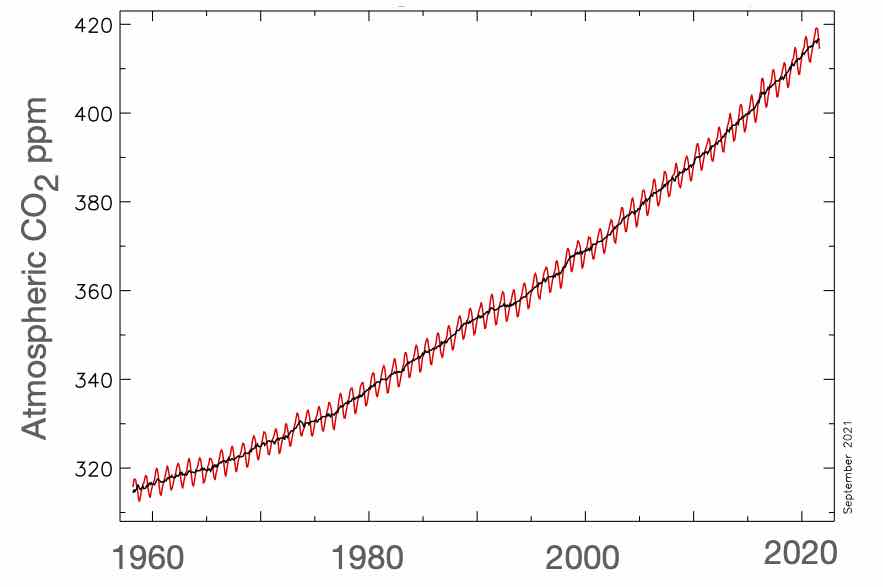
There have been 25 COP meetings on climate change since 1995 and several international agreements to reduce carbon emissions, including the 'legally binding' 1997 Kyoto Protocol and the Paris Agreement of 2015. Nevertheless, atmospheric GHG concentrations have increased unabated during this entire 25 year period - CO2, the principal anthropogenic GHG, has ballooned exponentially from ~360ppm in 1995 to almost 420 ppm in 2020 - and mean global temperature has risen by ~1 oC. History suggests that what should emerge from COP26 cannot emerge from COP26.
There are two fundamental barriers. First, participants in the COP meetings - government negotiators, political and scientific advisors, etc. - constitute a self-referencing cabal whose 'solutions' to climate change draw on the same set of beliefs, values, assumptions and facts that created the problem in the first place. In particular, they are dedicated to unconstrained economic growth propelled by continuous technological development, the beating heart and lungs of capitalism and neoliberal economics. Acceptable approaches to emissions reductions therefore include wind turbines, solar photovoltaic panels, hydrogen technologies, electric vehicles and as yet unproved carbon capture and storage technologies - i.e., any solution that involves the massive capital investment and profit-making potential necessary to sustain growth and the current socio-economic system.
My expectation is that COP26 will maintain the tradition. The latest emissions reduction strategy advanced by many COP participants is Net Zero 2050. NZ2050 implies achieving a balance between carbon emissions and extractions from the atmosphere by mid-century. Indeed, climate models already depend on so-called negative emissions technologies, particularly 'bio-energy with carbon capture and storage' (BECCS), to achieve the Paris target of limiting global heating to under 1.5 oC.
BECCS assumes we can gradually displace fossil fuels by growing biofuel crops to extract large quantities of CO2 from the atmosphere, and then capture and sequester the CO2 emitted when the biomass is burned. The problem is that BECCS is as yet unproved at scale and highly controversial. For one thing, the massive cropland requirement would generate crisis-level conflict with both food production and biodiversity conservation. Some climate scientists see NZ2050 as yet another in a series of "magical yet unworkable" technical (non)solutions to the climate conundrum (Dyke et al., 2021). They argue that the idea of net zero simply continues what has proved to be a "recklessly cavalier 'burn now, pay later' approach" which has seen carbon emissions continue to soar. Spratt and Dunlop (2021) characterize NZ2050 as "not just a goal, but a strategy for COP-26 to lock in many decades of unnecessary fossil fuels use well past 2050... [and creating] unacceptable risks of unstoppable climate warming." These characterizations depict a world in desperation, willing to risk catastrophic climate change in service of a perceived need to maintain growth-oriented business-as-usual-by-alternative-means. Perversely, then, mainstream climate disaster policy seems designed to serve modern techno-industrial society and the capitalist growth economy so the latter appears to be "the solution to (not the cause of) the [problem]" (Spash, 2016, p. 931).
Second, climate change is not even the real problem; ecological overshoot is (Rees, 2020). 'Overshoot' occurs when humanity consumes bio-resources faster than ecosystems can regenerate and waste production exceeds nature's assimilative capacity (see GFN, 2021). In effect, the growing human enterprise is literally consuming and polluting the biophysical basis of its own existence.
Overshoot is a meta-problem: climate change; plunging biodiversity; pollution of land, air and waters; tropical deforestation; soil/land degradation etc., etc., are all co-symptoms of overshoot. Climate change is an excess waste problem - CO2 is the greatest waste by weight of modern techno-industrial (MTI) economies. We cannot solve any major symptom of overshoot in isolation. Indeed, the mainstream approach to emissions reductions will not only fail to subdue climate change but, by promoting material growth, will exacerbate overshoot (Seibert and Rees, 2021). On the other hand, if we eliminate overshoot we simultaneously relieve its various symptoms. The problem is, the only way to eliminate overshoot is, by definition, through some combination of absolute reductions in energy and material consumption and smaller populations, i.e., through controlled economic contraction.
This is why we cannot expect COP-26 to address the human eco-predicament.
References
Dyke, J., Watson, R. & Knorr, W. (2021). Climate scientists: concept of net zero is a dangerous trap. The Conversation (22 April 2021), https://theconversation.com/climate-scientists-concept-of-net-zero-is-a-dangerous-trap-157368
GFN. (2021). Media Backgrounder: Earth Overshoot Day. Global Footprint Network, https://www.overshootday.org/newsroom/media-backgrounder/
Rees, W.E. (2020). Ecological economics for humanity's plague phase. Ecological Economics, 169 (March 2020), https://doi.org/10.1016/j.ecolecon.2019.106519
Seibert, M.K. and Rees, W.E. (2021). Through the eye of a needle: an eco-heterodox perspective on the renewable energy transition. Energies 14(15): 4508, https://doi.org/10.3390/en14154508
Spash, C. (2016). This changes nothing: the Paris Agreement to ignore reality. Globalizations, 13(6), 928-33.
Spratt, D. and Dunlop, I. (2021). "Net zero 2050": a dangerous illusion. Breakthrough Briefing Note (July 2021), https://52a87f3e-7945-4bb1-abbf-9aa66cd4e93e.filesusr.com/ugd/148cb0_714730d82bb84659a56c7da03fdca496.pdf

Latest Peer-Reviewed Journal Content

Validating national reuse indicators from regional demolition data: a Swedish example
F Ericsson, K Mjörnell & U Janson
Climate change risk and decision-making [editorial]
S Foxell & I Cooper
Technologies of reconstruction [editorial]
P Tombesi
Urban form metrics for building occupancy modelling: applications and impacts
D Reiter, M Jehling & R Hecht
Retrofit realism: affordable low-carbon policies for existing homes
N Eyre & R Khosla
Inside offsite: everyday dwelling in factory-built apartments
L Dorignon & R Horne
MMC for housing: sectoral perception on governance challenges
J Morgan, C Goodier, R Schmidt-III & K Ayinla
Reorganising specification practice for component reuse: an exploratory study
S Gao, K Jones, J Xu & J Glass
Kitchen retrofits to support food practices and wellbeing
F J Andrews, A Sal Moslehian, E Warner & R Tucker
From strategy to delivery: a comparative analysis of MMC roadmaps
G Goldman, D Sorokine, F Suerich-Gulick, C Carbone & M Jemtrud
Thermal comfort, ventilation and mosquito-borne disease risk in Zanzibar hospitals
O Sloan Wood, J B Knudsen, K L Schiøler, E Lupenza, M Msellem & F Saleh
Reusing precast concrete elements in construction: assessing the economic conditions
O Vigren, H Westerlind & T Malmqvist
Institutional readiness for industrialised social housing in Vietnam
T Q Nguyen, B N Nguyen, T H Q To & Z Aziz
Prefabrication for housing retrofit: governance, innovation and resident experience
E Pikas, K Kuusk, P Pihelo, R Liias, J Pukk & T Kalamees
Reframing heat pump transitions: a care perspective
J van der Haer, R Schelwald & F de Haan
Urban informal settlements in Africa: transforming adaptation governance
K Buyana & H Sseviiri
Reusing concrete products in indoor environments: chemical hazard assessment
K Tähtinen, A Helin, E Parshintsev & H Hovi
Negotiating net-zero carbon: an ANT analysis of two buildings
L Schweber & M Green
Design for disassembly: a review of public policy proposals
O Vorobjev, U Uotila, T Joensuu & A Saari
Retrofitting Norwegian residential buildings: an archetype-based dynamic stock model
L S A Rousseau, S Amini, S Akin & E G Hertwich
Decolonising time: vernacular villages and the politics of heritage temporality
R Al-Rabady
Commutes to alternative workplaces: GHG emissions and physical activity
J Taylor, L Thoen, A Espinosa Mireles De Villafranca, P Anashin, J Vanhatalo, D Milián
Bernal & I Okkonen
Nine ‘myths’ about the building stock of Great Britain
S Evans, P Steadman, A Neto-Bradley, D Humphrey, R Liddiard,H Shamsi, J Palmer & G Simons
Join Our Community

The most important part of any journal is our people – readers, authors, reviewers, editorial board members and editors. You are cordially invited to join our community by joining our mailing list. We send out occasional emails about the journal – calls for papers, special issues, events and more.
We will not share your email with third parties. Read more
Latest Commentaries
Who is Responsible for Climate Change?
Ian Cooper (Eclipse Research) explores the questions of responsibility raised in the recent Buildings & Cities special issue ‘Climate Change Risk and Decision-Making’. Focusing here on carbon emissions and mitigation, global responses will require grounding in what can work locally. New responsibilities arise for the wide range of built environment decision-makers: clients, professionals and their institutions, central and local governments, product suppliers, financiers, insurers, etc. A framework is needed to manage the complexity of responsibilities especially for variety of actors, the time frames and spatial scales.
Professional Ethics in a Climate Crisis
The climate crisis has progressed into a dangerous phase with tragic consequences often counted in numbers of excess deaths, but also by powerful economic impacts of rising food prices, the increased costs of insurance and lending, costly damage to the built environment. Celia Davies, Director of Impact at the UK’s Town and Country Planning Association (TCPA) and Hugh Ellis, Director of Policy at TCPA, consider the responsibilities of professionals in shaping a built environment which is fit not just for today's climate risks but for the dramatic increase in severe and unpredictable weather which is now locked into our climate systems.