
www.buildingsandcities.org/insights/reviews/rethinking_urban_green_spaces.html
Rethinking Urban Green Spaces
By Cecil Konijnendijk, Edgar Elgar Publishing Limited, 2024, ISBN: 9781803925486
Nadja Kabisch reviews this book, which makes a powerful, experience- and evidence-based case for reimagining urban green spaces as critical infrastructure. The book introduces shared principles to guide cities and relevant actors in creating healthy, just, resilient, biodiverse and genuinely enjoyable places.
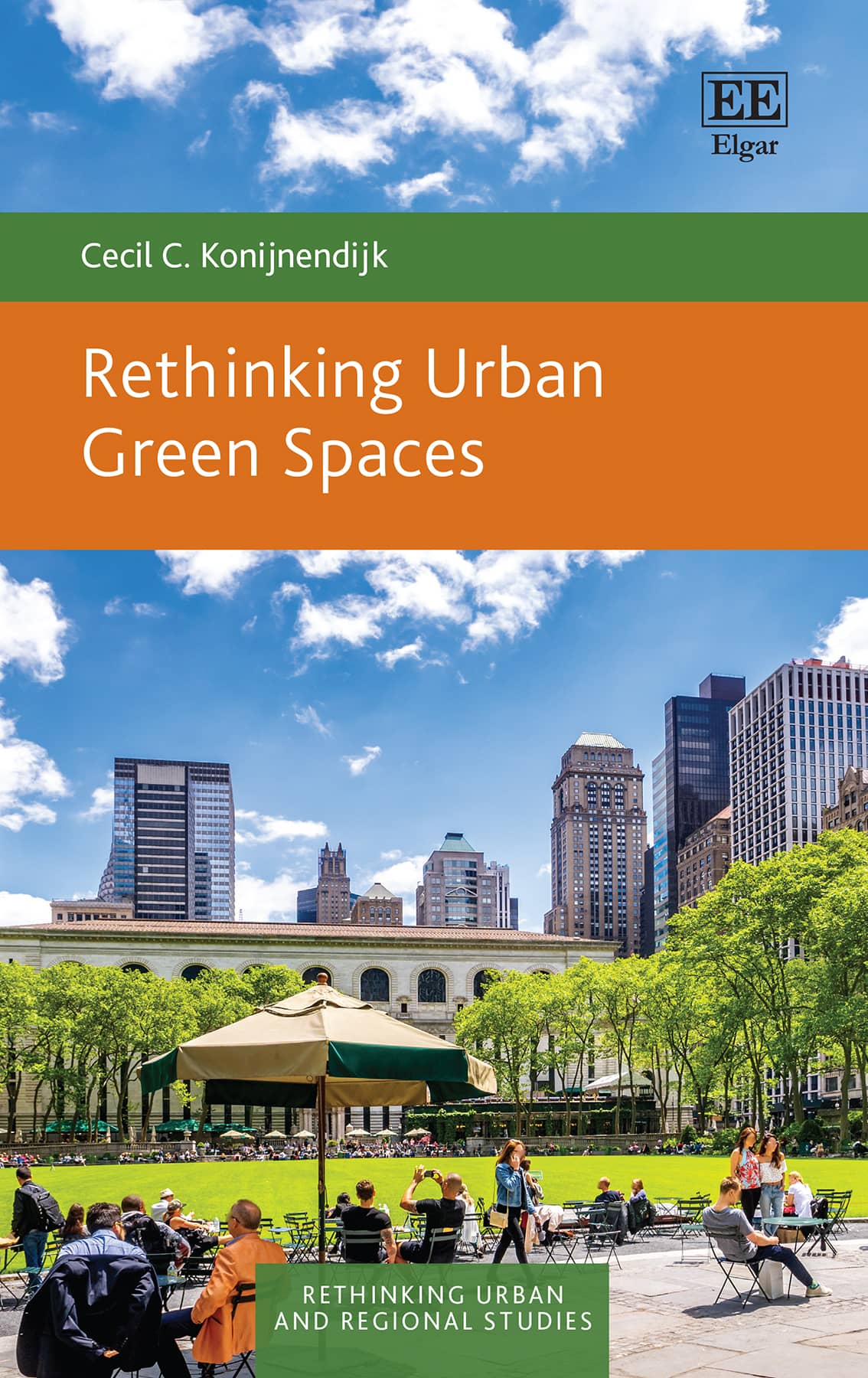
Rethinking Urban Green Spaces is a timely, practice-oriented book. It argues why urban greenspaces are essential more than ever to cities and how such spaces can be planned, designed, governed and financed so that nature, people, ecosystems and biodiversity can thrive together. The author, Cecil Konijnendijk, builds his arguments through a very personal narrative based on his own research, life and work experience, drawing examples from 'home cities' (p. 9) and urban green spaces in Hong Kong, Heidelberg, Barcelona, Amsterdam, Berlin, Beijing, Copenhagen, New York, Singapore and Riyadh to name a few. He asks how urban green spaces can be reimagined to prepare existing ones and develop new ones for the current and upcoming challenges of the 21st century. In particular, the author asks: how different types of urban green spaces can be designed, managed and transformed to serve different people’s demands and uses today and in the future, under evolving societal challenges and socio-ecological conditions? How should urban green spaces be planned and integrated into green networks, different cities, built-up contexts and infrastructure at multiple scales? What collaborative and inclusive governance and funding models work for long-term management for resilient futures?
Drawing on Konijnendijk’s research and practice across diverse geographical and socio-ecological contexts, the book frames urban green spaces as multifunctional and argues that these spaces are critical infrastructure essential to health, climate adaptation and disaster response – with implications for budgeting, regulation and inter-agency coordination.
The book’s central theme is that urban green spaces are dynamic, negotiated and contextual. Urban green spaces are never just 'parks': they are infrastructures, cultural places and habitats whose purposes evolve with social needs and environmental and climatic pressures. The author illustrates this multifunctionality by starting each chapter with an example of a nature encounter in a given city and then expanding the discussion to the broader topic that the place raises. Hong Kong was introduced as a seemingly 'ultra dense and crowded city', yet green elements such as pocket parks, beautiful green balconies, large trees and a country park are reclaiming urban space (Chapter 1). A walk in Heidelberg prompts the idea of historical landscape park developments to today’s drought- and heat-prone savannah approaches (Chapter 2). Barcelona’s superblock model becomes a lens on multifunctionality and the transformation of traffic-dominated urban areas into climate-adaptive, recreational public realms (Chapter 3). Amsterdam’s Vondelpark supports a discussion of design for purpose, resilience and inclusion (Chapter 4). Berlin’s Südgelände – a biodiverse rewilded park developed on a former railway brownfield site – was used to illustrate management models that accept 'urban wildness' as a legitimate quality with biodiversity at its core (Chapter 5). Afforestation in Beijing’s Guangyanggu Park shows inherent complexities in hierarchical governance structures, while simultaneously demonstrating noteworthy progress, including the integration of scholarly expertise in policy decisions and the advancement towards biodiversity-conscious park development practices (Chapter 6). The case of Copenhagen exemplifies cross-departmental collaboration in climate-adaptive green space development and management as a direct outcome of the 2011 cloudburst event, which flooded large parts of the city and catalysed integrated urban resilience initiatives (Chapter 7). The point that urban green spaces belong to a city’s critical infrastructure is important here. The examples of Bryant Park and Central Park in New York City show how non-for-profit conservancies and business-led alliances can help bringing a park 'back to life', sustain green space quality, and find novel ways of overcoming financial constraints (Chapter 8). The author’s experience in Singapore with the Gardens by the Bay helps us imagine a large (100 ha), futuristic park combining 'vegetation and technology' (Chapter 9). Finally, the Green Riyadh program raises questions about possible forms of urban nature in arid environments and desert cities (Chapter 10).
This journey across the globe yields a compact synthesis grounded in lived experiences and scientific evidence, equipping readers with clear planning and design principles, actionable rules, and honest acknowledgement of future complexities.
Frameworks for urban green space planning principles are established drawing from the case studies. For example, Chapter 7 outlines four planning principles - proximity (and visibility), diversity, connectivity, and equity - that define what a just, resilient urban green space network should offer. Konijnendijk’s 3-30-300 framework is also articulated: every resident should be able to see at least three trees from their home, school or workplace; neighbourhoods should possess at least 30% canopy cover; and all residents should live within 300 m of a high-quality green space of at least 0.5 ha (following WHO guidelines). The author emphasises that these metrics should be regarded as flexible, simple to communicate guidelines rather than rigid targets in urban green space planning and governance.
Additionally, more detailed design principles are presented (p. 54 and following pages) for green spaces to be fit-for-purpose, resilient and adaptive, nature-based, inclusive, evidence-based and multisensory. Such principles call for management that is adaptive, recognises novel ecosystems, and encourages local stewardship. To address this complexity, the book introduces novel governance approaches: 'mosaic governance' and 'hybrid governance' arrangements where public agencies, private partnerships, NGOs and communities collaborate to access resources and flexibility transparently, accountably and justly.
This book is aimed at a wide range of stakeholders involved in rethinking urban green spaces. For researchers, it offers testable frameworks, practical metrics and governance examples grounded in rich comparative cases spanning decades of scholarship. The personal narratives add contextual detail that helps formulate hypotheses about planning, designing and governing urban green space for the 21st century, which consider multiple social, environmental and climate justice frameworks. The book serves as an exciting invitation for researchers to move beyond distribution towards more interactional and procedural justice achievements. More empirical and comparative cases may validate the 3-30-300 guideline across climates, urban forms and socio-economic contexts, and evaluate how the design principles translate into measurable justice, health, climate and biodiversity outcomes. Such future research requires long-term monitoring data, mixed methods and interdisciplinary work, drawing on expertise from urban ecology, public health, urban planning, sociology and economics to build robust evidence.
For policymakers, the book is a call to embed clear, equity-centred green infrastructure targets into statutory plans and budgets. That call means adopting canopy and access standards tailored to local ecology, mapping need and prioritising investments in underserved neighbourhoods, and requiring cross-departmental coordination (planning, transport, water, health, education) so parks, streets and schools contribute to a coherent network and classifying urban green spaces as critical infrastructure to secure stable, long-horizon maintenance funding. Governance innovations – such as conservancies, public-private partnerships, community agreements – can be valuable if governed transparently with clear accountability, open performance data, and mechanisms to prevent displacement when amenities improve. The book grounds these ideas in real institutions like Bryant Park and the Central Park Conservancy, offering templates adaptable to different legal and fiscal systems. Valuation tools like i-Tree are presented to exemplify how they may support budget negotiations, but policy should avoid reducing nature to financial benefits only. Ethical and justice considerations must remain explicit in decision criteria.
For practitioners (planners, designers, managers) the book provides actionable guidance rooted in evidence, yet sensitive to different places. The design principles may be used as a brief for site and network planning: i) audit visibility, proximity and canopy at the street and block scale, not citywide averages alone; ii) design for multifunctionality through nature-based solutions that deliver co-benefits, including trees and understory for cooling and habitat, bioswales and rain gardens for precipitation management, tree lined streets and park canopy for shade and social life, edible landscapes for social cohesion; iii) co-design with communities from the outset, accommodating different cultural values and multisensory needs, and embed stewardship into design through, e.g. maintenance partnerships, citizen gardeners and school programs; iv) crucially, adopt adaptive management: accept seasonal variation, tolerate spaces for wilderness where biodiversity can thrive and adjust as climate, use patterns and needs change.
Finally, for communities and the general public, the book provides an accessible evidence-based case for why green spaces nearby home, school and work matter for mental and physical health, thermal comfort, and everyday social interaction – not as luxuries but as necessities. The book explains how residents can influence green space justice outcomes by articulating their needs effectively and participating in co-design planning processes. The 3-30-300 rule is memorable and the different narratives are recognisable across contexts. Readers in smaller towns or in the Global South may find fewer contextually similar examples, but the underlying logics and principles (e.g. proximity, diversity, connectivity and equity) translate well to different social, environmental and governance contexts.
In summary, this book synthesises what we know about urban green spaces into a shared language and a set of principles that help cities and the multiple actors who plan, design and develop their green spaces into healthy, just, resilient, biodiverse and enjoyable places. The book makes a strong, experience- and evidence-based case that: i) urban green spaces should be conceived and funded as critical infrastructure; ii) design and management must be adaptive, inclusive and multifunctional; and iii) governance should be collaborative, transparent and justice-focused. The book’s emphasis on prominent Global North cases and its light touch on non-human species can be regarded as invitations for exciting future avenues towards cases from the Global South, smaller cities and villages or multi-species justice frameworks.
Latest Peer-Reviewed Journal Content
Validating national reuse indicators from regional demolition data: a Swedish example
F Ericsson, K Mjörnell & U Janson
Climate change risk and decision-making [editorial]
S Foxell & I Cooper
Technologies of reconstruction [editorial]
P Tombesi
Urban form metrics for building occupancy modelling: applications and impacts
D Reiter, M Jehling & R Hecht
Retrofit realism: affordable low-carbon policies for existing homes
N Eyre & R Khosla
Inside offsite: everyday dwelling in factory-built apartments
L Dorignon & R Horne
MMC for housing: sectoral perception on governance challenges
J Morgan, C Goodier, R Schmidt-III & K Ayinla
Reorganising specification practice for component reuse: an exploratory study
S Gao, K Jones, J Xu & J Glass
Kitchen retrofits to support food practices and wellbeing
F J Andrews, A Sal Moslehian, E Warner & R Tucker
From strategy to delivery: a comparative analysis of MMC roadmaps
G Goldman, D Sorokine, F Suerich-Gulick, C Carbone & M Jemtrud
Thermal comfort, ventilation and mosquito-borne disease risk in Zanzibar hospitals
O Sloan Wood, J B Knudsen, K L Schiøler, E Lupenza, M Msellem & F Saleh
Reusing precast concrete elements in construction: assessing the economic conditions
O Vigren, H Westerlind & T Malmqvist
Institutional readiness for industrialised social housing in Vietnam
T Q Nguyen, B N Nguyen, T H Q To & Z Aziz
Prefabrication for housing retrofit: governance, innovation and resident experience
E Pikas, K Kuusk, P Pihelo, R Liias, J Pukk & T Kalamees
Reframing heat pump transitions: a care perspective
J van der Haer, R Schelwald & F de Haan
Urban informal settlements in Africa: transforming adaptation governance
K Buyana & H Sseviiri
Reusing concrete products in indoor environments: chemical hazard assessment
K Tähtinen, A Helin, E Parshintsev & H Hovi
Negotiating net-zero carbon: an ANT analysis of two buildings
L Schweber & M Green
Design for disassembly: a review of public policy proposals
O Vorobjev, U Uotila, T Joensuu & A Saari
Retrofitting Norwegian residential buildings: an archetype-based dynamic stock model
L S A Rousseau, S Amini, S Akin & E G Hertwich
Decolonising time: vernacular villages and the politics of heritage temporality
R Al-Rabady
Commutes to alternative workplaces: GHG emissions and physical activity
J Taylor, L Thoen, A Espinosa Mireles De Villafranca, P Anashin, J Vanhatalo, D Milián
Bernal & I Okkonen
Nine ‘myths’ about the building stock of Great Britain
S Evans, P Steadman, A Neto-Bradley, D Humphrey, R Liddiard,H Shamsi, J Palmer & G Simons
Join Our Community

The most important part of any journal is our people – readers, authors, reviewers, editorial board members and editors. You are cordially invited to join our community by joining our mailing list. We send out occasional emails about the journal – calls for papers, special issues, events and more.
We will not share your email with third parties. Read more
Latest Commentaries
Who is Responsible for Climate Change?
Ian Cooper (Eclipse Research) explores the questions of responsibility raised in the recent Buildings & Cities special issue ‘Climate Change Risk and Decision-Making’. Focusing here on carbon emissions and mitigation, global responses will require grounding in what can work locally. New responsibilities arise for the wide range of built environment decision-makers: clients, professionals and their institutions, central and local governments, product suppliers, financiers, insurers, etc. A framework is needed to manage the complexity of responsibilities especially for variety of actors, the time frames and spatial scales.
Professional Ethics in a Climate Crisis
The climate crisis has progressed into a dangerous phase with tragic consequences often counted in numbers of excess deaths, but also by powerful economic impacts of rising food prices, the increased costs of insurance and lending, costly damage to the built environment. Celia Davies, Director of Impact at the UK’s Town and Country Planning Association (TCPA) and Hugh Ellis, Director of Policy at TCPA, consider the responsibilities of professionals in shaping a built environment which is fit not just for today's climate risks but for the dramatic increase in severe and unpredictable weather which is now locked into our climate systems.