
www.buildingsandcities.org/insights/research-pathways/rethinking-ieq-beyond-comfort.html
Rethinking IEQ: Beyond Comfort
RESEARCH PATHWAY: personal reflections on a career in research
Philomena M. Bluyssen (Delft University of Technology) reflects on her research career which explored how indoor environmental quality (IEQ) impacts on human health and wellbeing. Her pioneering work asked what is needed to go beyond the mainly comfort-based guidelines based on effect modelling of single dose-response relationships? Her work led to the development of a more comprehensive research model for IEQ, accounting for integrated effects of all stressors and different preferences and needs of occupants in different scenarios and situations, based on situation modelling.
From idea to concept
When I started my building engineering studies, I became increasingly interested in how occupants respond to indoor environmental conditions, as well as in how these conditions can be assessed. I was inspired first by the lectures of Joop Vorenkamp on physiological thermal models at Eindhoven University of Technology, and then by Ole Fanger during my PhD at Technical University of Denmark (DTU).
My research began with studies of individual environmental stressors, particularly thermal conditions and air quality, to develop more energy-efficient ways of heating and to contribute to IAQ-guidelines that prevent Sick Building Syndrome, respectively. I spent over two decades expanding my expertise from indoor air quality (IAQ) and thermal quality to indoor environmental quality (IEQ), including lighting and acoustics. At TNO (the Netherlands organisation for applied science research), my interest in both people and the indoor environment, led to the development of the Building-Cause-Effect Diagnosis (BCD) method (Bluyssen et al. 1992). The first research questions focused mainly on identifying the sources of pollution that could be responsible for sick building symptoms, followed by projects (such as EPIQR and TOBUS) that addressed tools to optimize IEQ and energy efficiency during refurbishment of buildings. It became clear to me that exposure to air, noise, light and thermal stressors indoors, all contribute to diseases (such as mental illnesses, diabetes, obesity, cardiovascular and chronic respiratory diseases, cancer, myopia (and recently COVID-19)) and to other effects (e.g. on learning ability, productivity, sleep quality, comfort indoors, etc.). These stressors interact with each other both at environment and human level.
A keynote given by Wiliam S. Cain (Cain 2002) and a friendly talk with him at the Indoor Air 2002 conference, fuelled this realisation: our guidelines are not dealing with interactions or changes over time, not at human level and not at environment level, and not with anything else but the four modalities, separately. To successfully model comfort or health, all modalities, and the differences among occupants as well as the context and history of exposure need to be accounted for. He emphasized that I should go beyond (perceived) air quality in my research and not to be afraid to include the other modalities.
My research showed that while indoor environmental conditions seem to comply with current guidelines and those conditions seem ‘comfortable’ enough, staying indoors is not good for human health. This discrepancy might be accounted for by the fact that the guidelines aim to prevent short-term discomfort (e.g. ventilation rate, temperature ranges, lighting and sound levels) and are mainly based on single-dose response relationships (i.e. effect modelling using dose-related indicators) for the physical stressors (e.g. temperature, light, sound, and odour) determined for an average adult person. They ignore key factors, such as situation-related aspects, different preferences and the needs of occupants, and interactions between the different stressors both at environment and human level. I wrote the book I wished I had during my studies: the Indoor Environment Handbook (Bluyssen 2009) addressing the four factors and highlighting the need for another approach, an integrated approach that includes all factors.
From concept to ‘new’ model
Inspired by the outcome of different European and national studies I was involved in during my time at TNO, indicating the need for more knowledge on how people get sick from exposure to environmental stressors, I wrote the Healthy Indoor Environment (Bluyssen 2014). This book is an attempt to describe the stress mechanisms our bodies have. The book considers the different methods and indicators that are applied to assess whether conditions in buildings are healthy and/or comfortable from the perspectives of different disciplines. Additionally, I proposed the first model in this book. It was clear to me that there is a need for an integrated analysis approach: an approach in which for different scenarios, possible stressors, interactions, people and effects are all accounted for, focusing on situations rather than single components. This integrated analysis approach requires a different research model than the current single dose-response model on which our guidelines are based.
The research that followed, at TU Delft, focussed on validating that model. This showed that people are different (but can be clustered into groups with similar profiles), health effects cannot be explained by one single, often comfort-based, dose-related indicator for an average adult occupant (but can be caused by patterns of stressors), and that both people and indoor environments change over time. I introduced an improved model for the integrated analysis approach (Bluyssen 2020; Altomonte et al. 2020), including the human model (leading to preferences and needs (profiles)) and the environment model (leading to patterns and stressors (positive and negative)) (Figure 1). The latter article was an important sign of acceptance of the ‘new’ model by my peers.
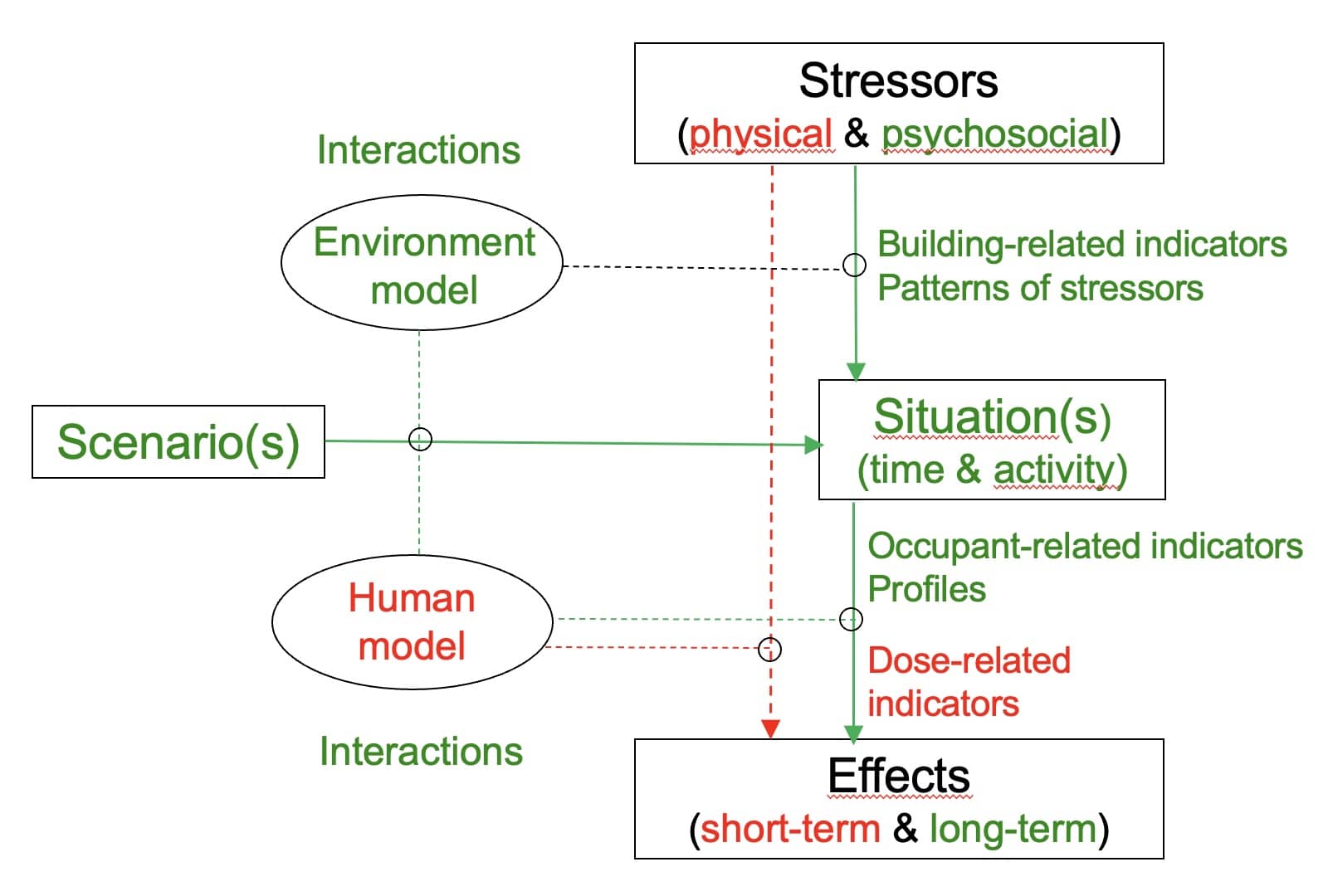
Note: red colour = the old model, green colour = parts that have been added in the new model.
Source: Bluyssen (2025).
While the ‘old’ model is focused on effect (mainly discomfort) modelling of a single stressor for an average adult, the ‘new’ model accounts for the combined effects of environmental stressors in buildings and their occupant profiles and provides a basis for identifying requirements (to prevent negative effects) and preferences (to stimulate positive experiences) in the (re)design of healthy and comfortable buildings. The ‘new’ model acknowledges that IEQ is more than the sum of its parts, environments and people’s preferences and needs change, and interactions and adaptations occur.
The ‘new’ model makes it possible to match profiles of people with patterns of positive and negative stressors for a certain situation. However, key questions remained unresolved:
- How do the number of clusters vary?
- How do the profiles of these clusters change over time?
- How dependent are these profiles and patterns on the scenario and situation (context)?
SenseLab and the human model
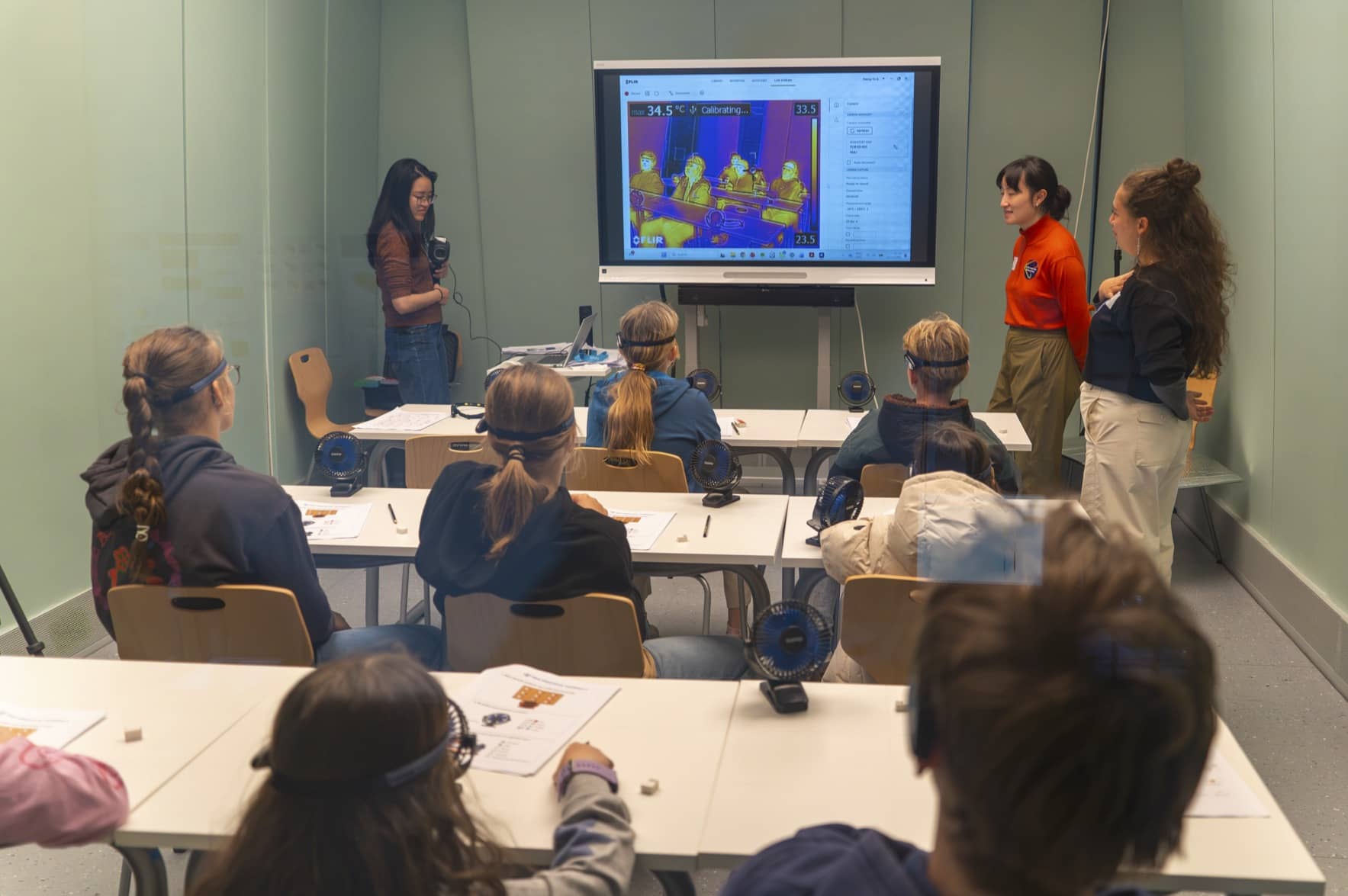
In parallel to the validation studies, I initiated and created the SenseLab, which officially opened in 2016 (Bluyssen et al. 2018) This facility enabled people to learn about and experience different environmental conditions and how those conditions can affect them, as well as doing research with people for people. The SenseLab comprises the Experience room and four test chambers. In the Experience room tests can be performed with people under different environmental conditions (air, light, acoustics and thermal), and in different settings (classroom, office, etc.). In the four test chambers, tests for the individual senses (smell, sound, vision, warm/cold) can be performed.
The field studies that were performed to validate the ‘new’ model also showed that interactions take place at human level, which might affect perceptual assessments but also health effects over time. Unfortunately, traditional field studies are focused on relatively ‘short-term’ self-reported effects and single situation scenarios, which makes it difficult to study stressors in relation to (integrated) long-term health effects.
Cross-modal and interaction effect studies performed in the SenseLab provided the insight needed to further detail the human model. First with primary school children in 2018 and continued after the COVID-19 pandemic in 2023 with students (Bluyssen et al. 2019; Bluyssen et al. 2025).
The SenseLab studies showed that both the perceptual and physiological interactions at the human level can affect our responses and can differ per person, leading to integrated effects, direct and/or over time. To identify which indicators we can use at human level to give insight into these effects, a more in-depth study on how our body copes with the different stressors we are exposed to over time is required.
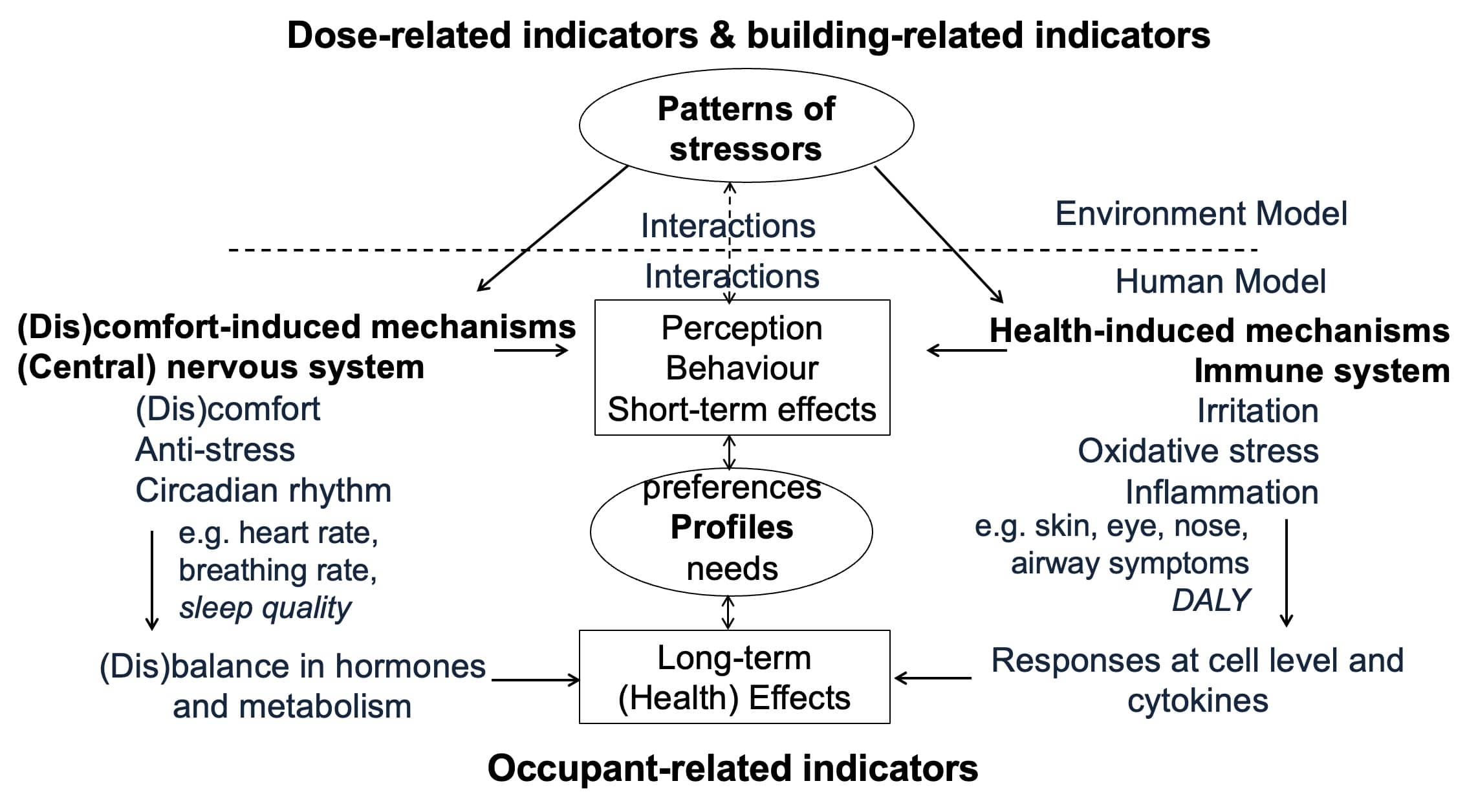
Source: Bluyssen (2025).
I came to the insight that stressors can be divided into those that trigger the (dis)comfort stress mechanisms and those that trigger the health-induced stress mechanisms (Figure 2). With (dis)comfort induced stress our nervous system responds first, followed by our endocrine system and when our body fails or can no longer cope with ‘(dis)comfort’ induced stress, a disbalance in hormones can occur. Indicators for (dis)comfort induced stress are therefore lower and/or higher levels of hormones (e.g. cortisol in blood or saliva) or responses of our nervous system (for example an increase in heart rate, breathing rate, and/or blood pressure). With health-induced stress our immune system responds at cell level and by production of substances to deal with the stressors. Coping fails when damage to cells prevents the immune and/or endocrine system from working properly. Next to indicators in blood and urine, several skin, eye, and airway symptoms have been correlated with exposure to health-induced stressors.
Epilogue
COVID-19 showed the importance of protecting ourselves from health effects caused by staying indoors. It confirmed that the current guidelines for IEQ do not account for (integrated) health effects of different exposures; they are mainly focussed on creating “comfortable” conditions for an average adult person. To reduce the risk of these long-term health effects under evolving climate and health threats, research must go beyond the comfort-based indicators. Moreover, to create and design consistently healthy indoor environments for all occupants, it is important to realize that we need to design for both visual and non-visual needs, a ‘healthy’ thermal indoor environment over time during all seasons, ‘noise’ free environments (especially at night), and ‘air pollution’ free indoor environments. The ‘new’ research model was introduced to help meet these challenges.
Looking back, there are several lessons I learned. First, follow your instinct and don’t let anyone intimidate you when your ideas call for a radical change. There will always be resistance against new ideas. Second, think ‘out of the box’ and go beyond your own research field. It was vital to go beyond my training as a building engineer. My curiosity to understand and redefine IEQ led to the in-depth study of the physiological mechanisms our body uses to cope with environmental stressors and their indicators, and also the extensive study of methods and indicators to assess health and comfort indoors from the point of view of different disciplines. Third, actively communicate your ideas through whatever means you have available. My books, publications and lectures not only helped to spread my ideas, but also helped me to develop them. Finally, I want to acknowledge all the people who supported, inspired, and accepted me over the years. Without their presence I don’t think I would have come this far.
References
Altomonte S., Allen J, Bluyssen P.M., Brager G., Heschong L., Loder A., Schiavon S., Veitch J., Wang L. & Wargocki P. (2020). Ten questions concerning well-being in the indoor environment. Building and Environment, 180:106949.
Bluyssen, P.M. (2009). The Indoor Environment Handbook: How to Make Buildings Healthy and Comfortable. London:Earthscan. ISBN: 9781844077878
Bluyssen, P.M. (2014). The Healthy Indoor Environment: How to Assess Occupants’ Wellbeing in Buildings. Abingdon: Routledge. ISBN: 9781032099088
Bluyssen, P.M. (2025). The need to go beyond the comfort-based dose-related indicators in our IEQ-guidelines. Building and Environment, 283:113349. https://doi.org/10.1016/j.buildenv.2025.113349
Bluyssen, P.M., Cox, C.W. & van Drunen, T.S. (1992). Evaluation of the indoor environment in problem buildings. International Conference Quality of the Indoor Environment, Athens, Greece, 28-30 April 1992
Bluyssen, P.M., Hamida, A. & D’Amico, A. (2025). How different sounds affect bodily responses and the perception of odour, light and temperature: a pilot study on interaction effects within IEQ domains. Intelligent Buildings International, 2508233. https://doi.org/10.1080/17508975.2025.2508233
Bluyssen, P.M., van Zeist, F., Kurvers, S., Tenpierik, M., Pont, S., Wolters, B., van Hulst, L. & Meertins, D. (2018). The creation of Senselab: A laboratory for testing and experiencing single and combinations of indoor environmental conditions.Intelligent Buildings International, 10:1, 5-18.
Bluyssen, P.M., Zhang, D., Kim, D.H., Eijkelenboom A., Ortiz, M. (2019). First SenseLab studies with primary school children: exposure to different environmental configurations in the Experience room. Intelligent Buildings International, 13(4):275-292. https://doi.org/10.1080/17508975.2019.1661220
Cain, W.S. (2002). The construct of comfort: a framework for research. Indoor Air 2002 conference, Syracuse.

Latest Peer-Reviewed Journal Content

Timing matters: life cycle embodied GHG emissions of circular building strategies
A Wöhler, L Rosado, H Abu Ghaida, H Wallbaum & A Hollberg
Scaling up retrofit: regional challenges and opportunities for MMC
H Dörr, P Späth & I Goñi
Design as communicative activity: implications for sustainability assessment software
T Säwén, A Sasic Kalagasidis & A Hollberg
Indoor temperature and office work performance in a temperate climate
T Kramer & S Schiavon
Moving homes and energy poverty: residents’ concerns, capabilities and responses
M Jalas, J Rinkinen, S Numminen & E Valkealahti
Reference study for biogenic carbon storage in the residential building stock
O Iliescu, I Talvitie, A Amiri & S Junnila
Building space heating and cooling in NDCs 4.0
T P Lützkendorf
Building component reuse as sociomaterial interaction: lessons from precast concrete
J Uusikartano, L Alkki & V Capitani
Validating national reuse indicators from regional demolition data: a Swedish example
F Ericsson, K Mjörnell & U Janson
Climate change risk and decision-making [editorial]
S Foxell & I Cooper
Technologies of reconstruction [editorial]
P Tombesi
Urban form metrics for building occupancy modelling: applications and impacts
D Reiter, M Jehling & R Hecht
Retrofit realism: affordable low-carbon policies for existing homes
N Eyre & R Khosla
Join Our Community

The most important part of any journal is our people – readers, authors, reviewers, editorial board members and editors. You are cordially invited to join our community by joining our mailing list. We send out occasional emails about the journal – calls for papers, special issues, events and more.
We will not share your email with third parties. Read more
Latest Commentaries
Practitioners’ Views of POE
Post-occupancy evaluation (POE) is widely valued but weakly embedded in practice. Ant Marsh, Kate van Someren, Lara Clarke and Tom Randall (Arup Building Performance and Commissioning Services) explain the findings from a survey and focus groups with UK construction industry practitioners. They identified fragmented responsibility, split commercial incentives and a persistent fear of “bad news”. Making POE routine requires a shift from producing reports to a focus on improving outcomes by owning and acting on learning.
Who is Responsible for Climate Change?
Ian Cooper (Eclipse Research) explores the questions of responsibility raised in the recent Buildings & Cities special issue ‘Climate Change Risk and Decision-Making’. Focusing here on carbon emissions and mitigation, global responses will require grounding in what can work locally. New responsibilities arise for the wide range of built environment decision-makers: clients, professionals and their institutions, central and local governments, product suppliers, financiers, insurers, etc. A framework is needed to manage the complexity of responsibilities especially for variety of actors, the time frames and spatial scales.