
www.buildingsandcities.org/insights/research-pathways/housing-poe-bpe.html
Housing that Really Works: From Post-Occupancy to Building Performance
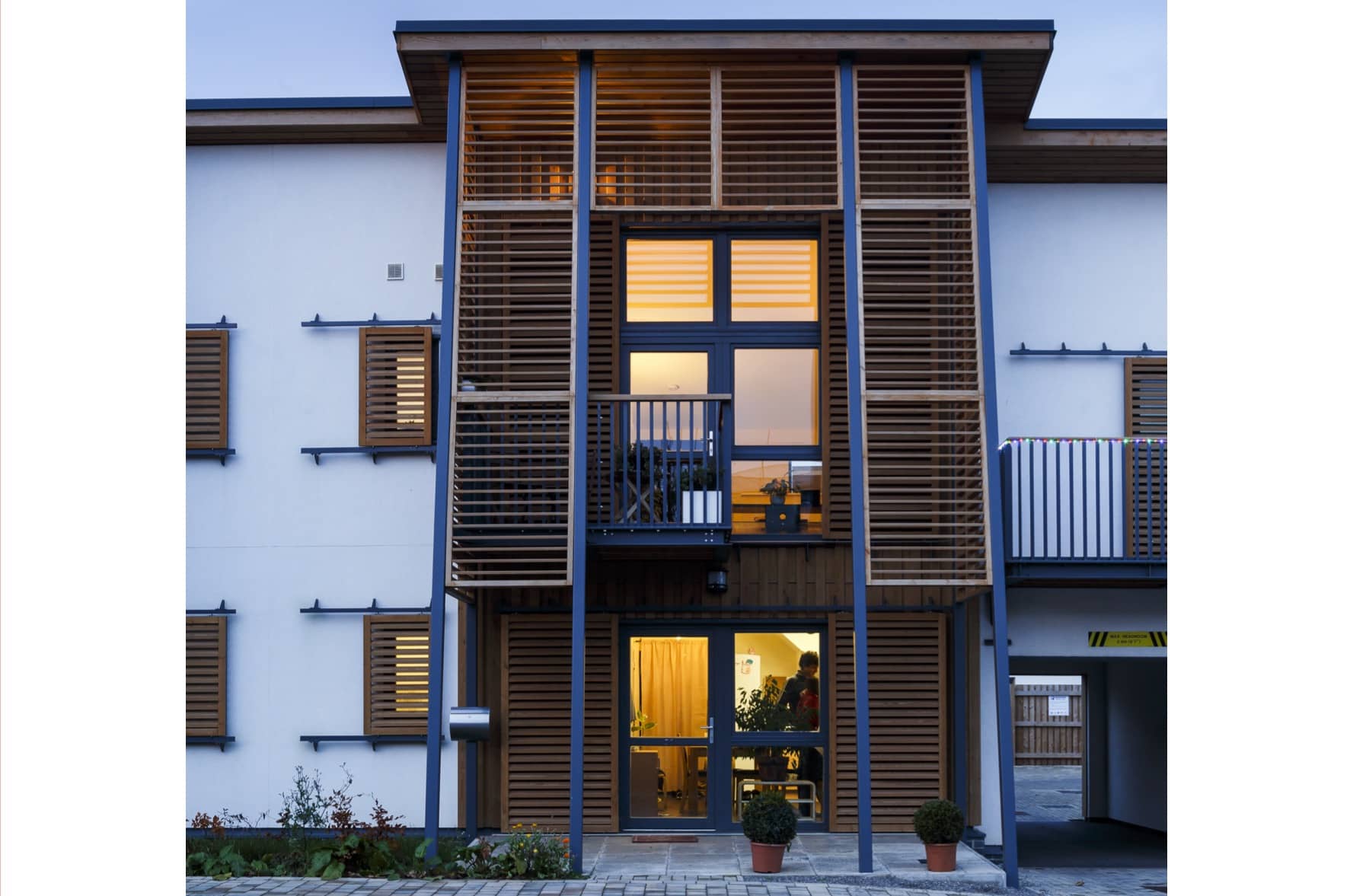
RESEARCH PATHWAY: personal reflections on a career in research
Fionn Stevenson (independent scholar) explains key moments in her architectural career that shifted from practice to research. A driving curiosity in how people actually use buildings and how buildings perform led to research on post-occupancy evaluation and efforts to mainstream this process and knowledge more widely.
People in their homes
When I was an architecture student, the influence of Dean Hawkes’s environmental teaching and Robert and Brenda Vale’s eco-home ideas propelled me into becoming a housing architect. A research turning point came in the late 1980s, when my award-winning James Nisbet Street retrofit housing project in Glasgow did not perform as intended in everyday use. Tenants were covering over the vital thermal mass floor in their new conservatories with carpet! They were also not using them as an intended heat buffer space, but as literal extensions to their living room space. This led to a further realisation that buildings only work if we design buildings with people and not for them, engendering a mutual understanding of how to design something fit for purpose. This was effectively my first introduction to the need for post-occupancy evaluation (POE) as a form of design research. I was hooked. If this was happening with my housing project, with plenty of tenant consultation involved, what was happening with other sustainable housing projects, and how could we improve their performance?
In response, I wrote the Sustainable Housing Design Guide for Scotland together with Nick Williams, a geographer and planner. Published in 2000 by the Scottish Government, it included 13 innovative housing POE case studies and sold out rapidly. The next expanded edition, in 2007, had 22 POE studies. Simultaneously, I completed my part-time PhD, now as an academic, comparing indigenous people’s perceptions of local materials against transient folk living in the same place, which gave my later POE studies a strong Critical Realist basis, drawing also on Gibsonian environmental “affordance” theory (what place and buildings “offer” to people for understanding and interaction) and Polyani’s “tacit knowledge” concepts related to what people deeply know about where they live.
Fortuitously, I met Bill Bordass and Adrian Leaman in 2004: they opened many doors for me. We realised that housing POE was still massively understudied and I developed the first Building Use Studies housing questionnaire with them to help expand this area. This helped me to focus on the interaction between occupants and their homes in a detailed and systematic manner, particularly in relation to environmental controls in housing. The analysis of powerful quali-quantitative data often revealed a major mismatch between design intentions related to the environmental performance of a home, and the users experience and perception of it, subsequently. I used my experience as a designer, as well as an academic, to further interrogate the design intentions. As mentors, Bill and Adrian also encouraged me to publish my housing POE studies in more rigorous academic journals.
Difficulties and overcoming them
By now I realised that my POE studies weren’t really making much difference to practice, despite co-leading a strong POE research group at Oxford Brookes University with Rajat Gupta. POE studies were still seen as an afterthought for many clients. To make a real world impact, an involvement in at the beginning of the design process was necessary.
In 2007 I pitched to a UK national house builder (Stewart Milne Group) the idea of using an intensive POE method as part of their innovative design process for a pioneering Net Zero house prototype - “The Sigma Home”. A volunteer family lived in this exhibition house temporarily at the Building Research Establishment in Watford, UK. I developed several new housing POE methods, including an evaluation of the occupant guide and induction process, videos made by the occupants (including their children), daily logs by the occupants and an evaluation of the usability of “key touchpoints” in the home (Stevenson & Rijal 2010). Numerous physical measurements and social performance evaluations over a year were integrated and emergent patterns were identified based on the occupants’ “interactive adaptivity” with their temporary home, i.e. how they adapted to the home, and the home was adapted to them through mutual learning (Cole et al. 2008). This research then informed the developer’s revised version of their prototype.
Finally, my housing performance evaluation work was becoming more “sticky”,influencing the design of homes from the outset, and reaching the all-important client team. From this research it became clear that a new, more strategic definition of POE was needed – Building Performance Evaluation (BPE). This is a virtuous circle of evaluation that continues throughout the whole lifecycle of the design and construction process – as developed by Wolfgang Preiser and Jacqueline Vischer (2005).
Subsequently, I became interested in Schatzki’s practice theory to understand people/building interactions in terms of occupants’ know-how and embodied habits, institutionalized knowledge, engagements, and technologies, as developed by Gram-Hanssen (2010). Adding this approach enabled ways to analyse ergonomic issues in in relation to practices embedded within and beyond the home (Stevenson et al. 2013). Latour’s actor network theory was then added to further understand who really had control of these practices, in terms of what was revealed or hidden within them by the regulation, design, specification, construction, installation and commissioning processes that conditioned the home prior and during occupation (Ziyad & Stevenson 2017).
One of my greatest difficulties with housing BPE research was getting it funded. The clients couldn’t see the need for it, and academic research funders didn’t count it as “real research”. They also found its interdisciplinary nature difficult to understand. In the end, it was funding from the more open-minded European Union, government agencies and business organisations that enabled me to progress the work. It often helped to go straight to housing developers and pitch directly to them as potential research partners. Another challenge was gaining appropriate access to the residents and properties in terms of the practicalities and the ethics involved. I had to carefully develop new and more comprehensive ethical protocols and processes to ensure that the residents and the client were protected, even while giving significant disclosures.
A further challenge was how to ensure that housing BPE was routinely embedded in practice. This was tackled in two ways. First, funding was sought that allowed me to embed researchers directly into practice – either within housing developers or within design practices. Sometimes the researcher was a PhD student, and sometimes a research fellow, or a Knowledge Transfer Partnership researcher. Second, a focus on combining BPE with organisational learning processes was used to show businesses how to strategically change their internal processes. This led to BPE becoming integrated into their work cycles. The long term impact of these approaches was that these organisations were able to grow their own approaches to BPE and develop organisational tools that embedded BPE methods within their policies and protocols to provide continuous performance improvement. The hope was that professional institutions, client organisations and professional practices might embrace this BPE model.
Embedding evaluation practice
All this led to me being commissioned in 2010 by the UK government’s Technology Strategy Board (TSB), working with Bill Bordass, Rod Bunn and other BPE experts, to help design an £8m four-year national housing BPE research programme. This would result in 52 innovative housing BPE projects (each comprising multiple new homes) being evaluated by numerous BPE evaluators. I co-designed a new BPE tool with the engineering and design firm Arup: DomEARM (Domestic Energy Assessment and Reporting Methodology) as well as designing the training for the evaluators to use various other domestic BPE tools I had helped to develop. We were excited, but despite the huge amount of data analysed, this project did not achieve its aim – namely to embed BPE routinely into the housing sector.
I decided to gain more traction by spreading our BPE ideas internationally. An EU Marie Curie Fellowship grant in 2013 enabled me to mentor Magdalena Barborska-Narozny from Poland. We further developed the area of usability evaluation in housing BPE by inventing a new “usability tool” (Baborska-Narozny & Stevenson 2019), along with building in ideas about resilience and co-production into the BPE process. She took this knowledge back to Poland where she pioneered new BPE research there. Working with the MORA team at the Federal University of Uberlandia in Brazil opened up a new area of housing BPE in relation to resilience (Garrefa et al. 2021). Both of these projects felt like they were making a real difference in other countries. So what was happening in the UK?
It was clear to our TSB BPE team that BPE was still not routine and that two major issues were i) a lack of regulatory requirements and ii) a national BPE standard that could inform these. Thus, a British Standard 40101 BPE was proposed, and a committee set up to produce it, with Kerry Mashford as chair and myself as vice chair. Published in 2022, this Standard is currently being revised, as it, too, has not gained traction yet, without any UK regulatory or professional requirements, and vested insurance interests preventing BPE from becoming mandatory.
My final effort in academia was to produce a monograph on housing BPE to distill all my theory and know-how in an attempt to provide a simple guide to carrying out this type of practice-based research, effectively and cheaply (Stevenson 2019) – something no other BPE researcher had done at that stage. My sense, however, is that BPE will remain a “nice to have” rather than “need to know” activity, until there is a political consensus for regulatory change.
How to promote BPE effectively
Carrying out meaningful action research that makes a difference is a risky business, particularly in the world of BPE, and yet it is more vital than ever. Looking back, the best advice I can offer to early career researchers is this: create your own research opportunities with business organisations that can help provide you with the fieldwork and funding you need. This takes guts, but it is surprising how receptive organisations can be to a well-argued and well-presented case for research funding – particularly if you can show them that there’s something in it for them, too.
The formal academic research system is still stacked against practice-based interdisciplinary BPE research, which is seen as routine “consultancy” rather than an area for creating new knowledge. It is therefore vital that any research proposal demonstrates to the research funders something innovative to add to BPE theory and/or methodology, or that it is establishing a new field area for BPE. The researcher also needs to be well versed in the relevant built environment policy landscape in order to understand how to “pitch” their proposal appropriately, clearly identifying where their work will impact on policy development and advocating for change.
I am not a natural academic. I started out as an architect and got drawn into academia through an insistent itch to improve eco-housing. Producing academic journal papers was challenging for me: I often produced 12 versions of a manuscript before it was submitted. But journals are not the only way to get noticed. Increasingly, social media can be used to describe and disseminate our BPE research, and allow others to judge it directly. We can write our own blogs, substacks and post our draft papers online – and others notice and give us useful feedback. This helps builds confidence when approaching that all important journal article. We also need to continuously challenge the publishing funding model to allow more BPE voices to be heard.
BPE is not an easy area to work in. I was fortunate to meet some great mentors and then find others interested in the same BPE issues as me via conferences and NGO associations (e.g. the Good Homes Alliance in the UK) which bring designers, developers and academics together. Looking back, the most important lesson from this pathway is that interdisciplinary Communities of Practice working between academia and practice can really develop BPE through action research and help researchers to grow through this process.
References
Baborska-Narozny, M. & Stevenson, F. (2019). Service controls interfaces in housing: usability and engagement tool development. Building Research and Information, 47 (3) 290-304. https://doi.org/10.1080/09613218.2018.1501535
Cole, R.J., Robinson, J., Brown, Z. & O’Shea, M. (2008). Recontextualizing the notion of comfort. Building Research & Information, 36(4), 323–336. https://doi.org/10.1080/09613210802076328
Garrefa, F., Villa, S.B., Bortoli, K.C.R. de, Stevenson, F., & Vasconcellos, P.B. (2021).Resilience in social housing developments through post-occupancy evaluation and co-production. Ambiente Construído, Porto Alegre,v. 21 (2) 151-175. http://dx.doi.org/10.1590/s1678-86212021000200519
Gram-Hanssen, K. (2010). Standby consumption in households analyzed with a practice theory approach. Journal of Industrial Ecology, 14(1), 150–165. https://doi.org/10.1111/j.1530-9290.2009.00194
Preiser, W. & Vischer, J., editors (2005). Assessing Building Performance. Routledge.
Stevenson, F. (2019). Housing Fit for Purpose: Performance, Feedback and Learning. RIBA Publishing.
Stevenson, F., Carmona- Andreu, I. & Hancock, M. (2013). The usability of control interfaces in low-carbon housing. Architectural Science Review, 56 (1) 70-82. https://doi.org/10.1080/00038628.2012.746934
Stevenson, F. & Rijal, H.B. (2010). Developing occupancy feedback from a prototype to improve housing production. Building Research and Information, 38 (5), 549-563. https://doi.org/10.1080/09613218.2010.496182
Ziyad, F. & Stevenson, F. (2017). End-user governance of photovoltaic systems: the influences of professional procurement. Building Research and Information, 46 (1) 23-41. https://doi.org/10.1080/09613218.2017.1313661
Latest Peer-Reviewed Journal Content
Reuse of cast-in-place concrete: overcoming industry barriers
M Romann & M Bastien-Masse
Timing matters: life cycle embodied GHG emissions of circular building strategies
A Wöhler, L Rosado, H Abu Ghaida, H Wallbaum & A Hollberg
Scaling up retrofit: regional challenges and opportunities for MMC
H Dörr, P Späth & I Goñi
Design as communicative activity: implications for sustainability assessment software
T Säwén, A Sasic Kalagasidis & A Hollberg
Indoor temperature and office work performance in a temperate climate
T Kramer & S Schiavon
Moving homes and energy poverty: residents’ concerns, capabilities and responses
M Jalas, J Rinkinen, S Numminen & E Valkealahti
Reference study for biogenic carbon storage in the residential building stock
O Iliescu, I Talvitie, A Amiri & S Junnila
Building space heating and cooling in NDCs 4.0 [briefing note]
T P Lützkendorf
Building component reuse as sociomaterial interaction: lessons from precast concrete
J Uusikartano, L Alkki & V Capitani
Validating national reuse indicators from regional demolition data: a Swedish example
F Ericsson, K Mjörnell & U Janson
Climate change risk and decision-making [editorial]
S Foxell & I Cooper
Technologies of reconstruction [editorial]
P Tombesi
Urban form metrics for building occupancy modelling: applications and impacts
D Reiter, M Jehling & R Hecht
Retrofit realism: affordable low-carbon policies for existing homes [briefing note]
N Eyre & R Khosla
Join Our Community

The most important part of any journal is our people – readers, authors, reviewers, editorial board members and editors. You are cordially invited to join our community by joining our mailing list. We send out occasional emails about the journal – calls for papers, special issues, events and more.
We will not share your email with third parties. Read more
Latest Commentaries
Two Key Messages for COP31
Space Heating & Cooling in NDCs 4.0: Nationally Determined Constributions (NDCs) are at the heart of the UNFCCC Paris Agreement. NDCs embody each country's efforts to reduce their emissions and adapt to the impacts of climate change. So it is essential to include the building stock (particularly space heating and cooling) in the next NDCs.
Realistic Retrofit: Residential buildings are major users of energy and emitters of CO2. What constitutes realistic retrofit? Affordable, practical low-carbon policies for homes are described for both the Global North and Global South.
Thomas Lützkendorf and Nick Eyre send their messages to COP31: prioritise the building stock in NDCs and implement policies for practical retrofit. Watch their videos - for links to the videos click on "More" below:
Practitioners’ Views of POE
Post-occupancy evaluation (POE) is widely valued but weakly embedded in practice. Ant Marsh, Kate van Someren, Lara Clarke and Tom Randall (Arup Building Performance and Commissioning Services) explain the findings from a survey and focus groups with UK construction industry practitioners. They identified fragmented responsibility, split commercial incentives and a persistent fear of “bad news”. Making POE routine requires a shift from producing reports to a focus on improving outcomes by owning and acting on learning.