
www.buildingsandcities.org/insights/research-pathways/evidence-adaptive-comfort.html
Creating the Evidence for Adaptive Comfort
RESEARCH PATHWAY: personal reflections on a career in research
Richard de Dear (University of Sydney and Tsinghua University) explains the key moments in his research career that challenged existing notions of thermal comfort and helped to develop the evidence base for an alternative approach “adaptive comfort” which led to its wider acceptance in policy and practice.
Early influences
In 1981 I launched my PhD candidature at the University of Queensland in Brisbane, Australia under the supervision of two colourful and hugely entertaining eccentrics: Andris Auliciems and Steve Szokolay. Auliciems was a self-confessed climatic determinist whose core conviction was that our climatic environment plays a much larger role in human affairs and the course of history than was deemed to be politically correct back then in the closing decades of the 20th century1 (Taylor et al. 2022). Szokolay was a much more “nuts-and-bolts” kind of guy, particularly focused on building physics and climatically responsive architecture. Somehow these persuasive personalities managed to nudge me towards the topic of thermal comfort as it related to built environments, energy, and climate. As the scope of my reading spiraled outwards from building physics, biometeorology, and HVAC, I was struck by the dearth of psychologists contributing to our understanding of “that state of mind that expresses satisfaction with the thermal environment.” To the naïve first-year doctoral candidate this universally agreed definition of thermal comfort seemed to be all about perceptual psychology and yet the field was almost completely dominated by mechanical engineers and the preferred outlet for their research was the American Society of Heating, Refrigerating, and Airconditioning Engineers’ Transactions (ASHRAE Trans). The most prominent name in the literature at that time was a Danish engineering professor, Per Ole Fanger, who had reduced the human thermal comfort problem to a classical thermodynamic equation. His heat balance comfort formula could be solved with the input of just six basic “comfort parameters” – four describing the indoor thermal environment and the other two relating to the occupant (clothing and metabolic heat).
Searching for a research question
Fanger’s elegant thermal comfort model (Predicted Mean Vote - PMV) has had enduring popularity and application across the HVAC sector, probably more due to its ease-of-use in engineering practice than the rigour of its evidentiary basis. In fact, when I first encountered it in my PhD literature review, I was struck by the paucity of rigorous field validation of the PMV model. The closest thing to a reality check was the pioneering work of Michael Humphreys2, 3 and Fergus Nicol at the UK's Building Research Establishment (BRE) in the 1970s. Their meta-analyses of comfort field studies, drawn from diverse climate zones around the world, flatly contradicted Fanger’s claim of PMV universality. Their conclusion was simple and made intuitive sense to me: the indoor temperatures that people find most comfortable in warmer climates tend to be warmer than those in buildings located in cold climates. Moreover, the relationship between indoor comfort temperature and outdoor climate (monthly temperature) was highly statistically significant and linear. Humphreys' and Nicols' hypothesis for this relationship was neatly summarized as “the adaptive principle” that goes like this: when building occupants find themselves uncomfortable, they make appropriate adaptations of themselves and/or their building in such a way that restores thermal comfort.
Having spotted the incompatibility between Fanger’s comfort theory and Humphreys and Nicols’ field observations, my idea for PhD research question began to crystalize. A universal PMV model and the adaptive comfort principle were logically irreconcilable – something had to give. One of Michael Humphreys’ favourite anecdotes which he was happy to share with anyone who would care to listen, involved a presentation of his early adaptive comfort meta-analysis at a conference with Fanger sitting attentively in the audience. In the question time at the end of Michael’s presentation Fanger brought the house down with one of his characteristically dry quips: “I have two fundamental problems with your graph Michael; the X axis and the Y axis!” The gist of the critique was that Humphreys’ analysis had overlooked the effects of five confounding variables, i.e. the remaining inputs to Fanger’s PMV model. Upon hearing this debate my mind was clear; settling the dispute between these two giants in the pantheon of modern thermal comfort research would become the core mission of my PhD thesis. I spent the next four years (1981 through 1985) conducting the first field validation of the PMV model across a sample of air-conditioned and naturally ventilated office buildings located in diverse Australian climate zones (Darwin in the wet-dry tropics, subtropical Brisbane, and temperate mid-latitude Melbourne), and populated by “real people” doing “real jobs” (i.e. not university students twiddling their thumbs in a climate chamber).
Research method innovation
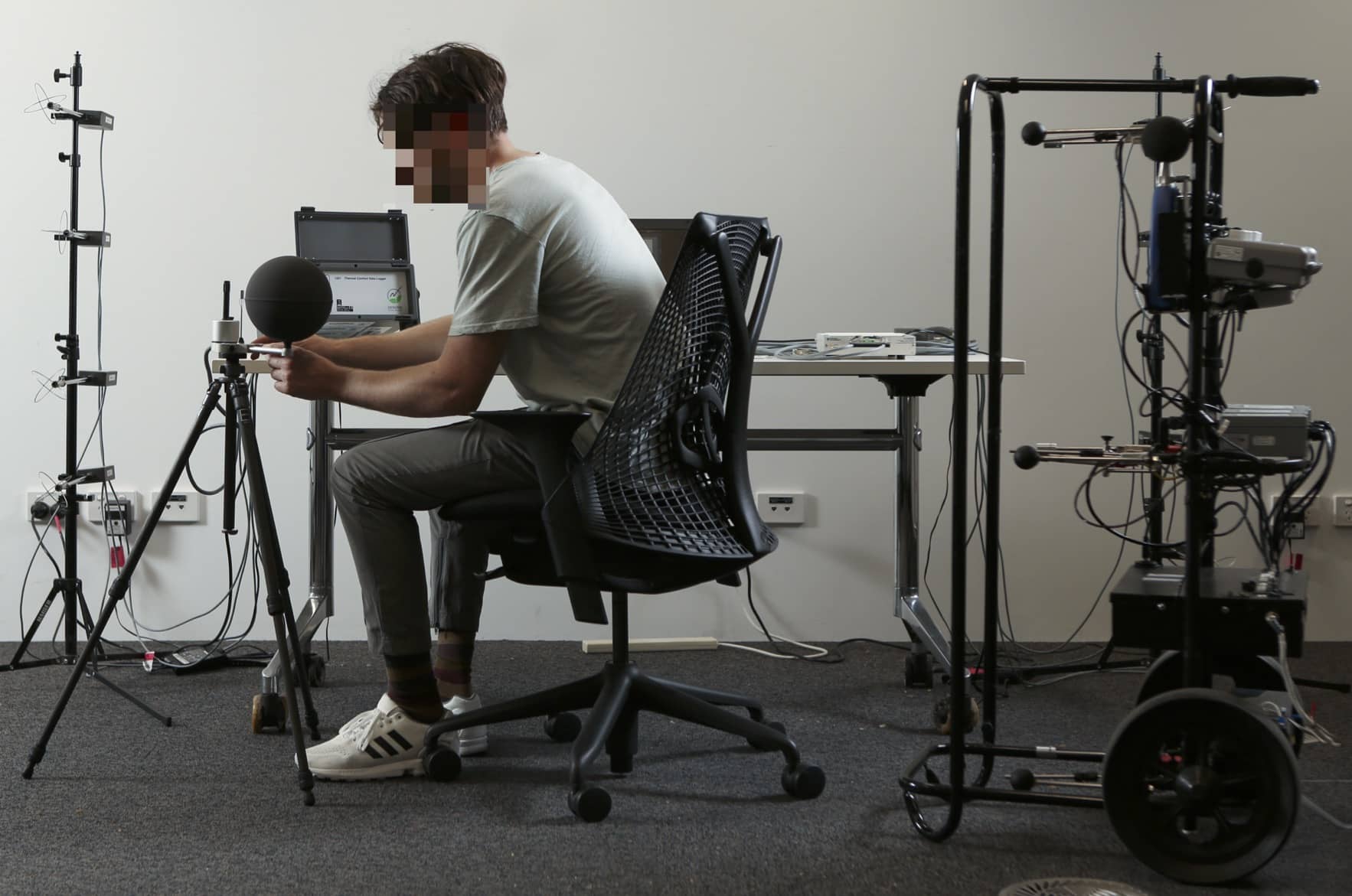
The examiners of my PhD all noted the originality of my research design, in particular, the “right-here-right-now” synchronization and co-location of survey respondents’ subjective thermal comfort votes with research-grade instrumental measurements of all of the inputs to Fanger’s PMV model. Such a design logically rendered any adaptive comfort evidence unassailable. It seems so obvious in retrospect, but at that time virtually no-one had joined the dots, probably because the key adaptive protagonists had been made redundant during the early years of Margaret Thatcher’s premiership. Since then my right-here-right-now research design has become a de facto template, applied in hundreds of papers spanning virtually every climate zone on the planet, across diverse building typologies, from offices, to schools, hospitals, aged-care facilities, and of course the ultimate sample-of-convenience, the university lecture theatre.
Open source databases
As is usually the case for PhDs, the initial impact of my doctoral publications in the mid-1980s was quite disappointing. The urgency of the oil crises in the seventies had dissipated, and the grave implications of fossil fuels for global climate change would take another decade to fully sink in. But by the mid-nineties the nexus between energy and climate was widely accepted and in response, ASHRAE commissioned Gail Brager (University of California Berkeley) and I to take a closer look at the adaptive model of thermal comfort. The logic of my right-here-right-now research design was re-purposed to the task of assembling a global database of thermal comfort field studies and PMV calculations. I inveigled high quality raw datasets out of the world’s leading comfort research groups on the promise that the ensuing quality-assured database would become an openly accessible research resource on the newfangled World Wide Web. In this era of open-source repositories, this may not sound so remarkable, but the ASHRAE Global Thermal Comfort Database (de Dear 1998) was the first of its kind in our research community, and since its inception circa 1997 it’s been used for literally hundreds of third party research papers in the peer reviewed literature. The idea proved to be so useful in fact that it’s since been updated and expanded (Földváry Ličina et al. 2018) and reproduced in the parallel universe that is China (Zhai et al. 2023).
The missing psychological piece in the thermal comfort puzzle
If nothing else has been learnt since Fanger’s contribution of PMV half a century ago, there seems now to be widespread acceptance that comfort is much more than a simple heat-balance problem. Layered on top of the physics are physiological, perceptual, and ultimately, behavioural processes in intertwined in a complex feedback system. Adaptive comfort “theory” as encapsulated in Humphreys' and Nicols' “adaptive principle” is not really a theory as such, but rather a description of a cause-and-effect relationship. Remarkably few psychologists have had any significant impact on our field, and this probably accounts for the paucity of any psychological theory necessary to flesh out our understanding of the psychological construct of thermal comfort. At the risk of lapsing into dilettantism, the closest thing to a theoretical framework for adaptive thermal comfort that I’ve come across is Harry Helson’s adaptation-level (AL) theory in psychometrics (Edwards 2018). The gist of AL theory is that there are no absolutes when it comes to sensory stimuli. Everything we see, hear, smell, taste, and feel is evaluated against the baseline established by our previous experiences. The “horrendous traffic jam” resulting from a break-down on Sydney Harbour Bridge at 8:15am on Monday would be described as “business as usual” on Delhi’s arterial Ring Road. In short, we are all calibrated by our past experiences, and as a result, everything is relative. I think that fits the notion of adaptive thermal comfort like a hand in a glove. A daily maximum temperature that gets declared as a “heatwave” in London would be dismissed as nothing untoward whatsoever in Sydney. And so it’s for this reason that the independent (causal) variable in adaptive comfort models is usually some sort of metric of recent thermal exposure. The running mean of outdoor temperatures, often inversely weighted by elapsed time, is a familiar example.
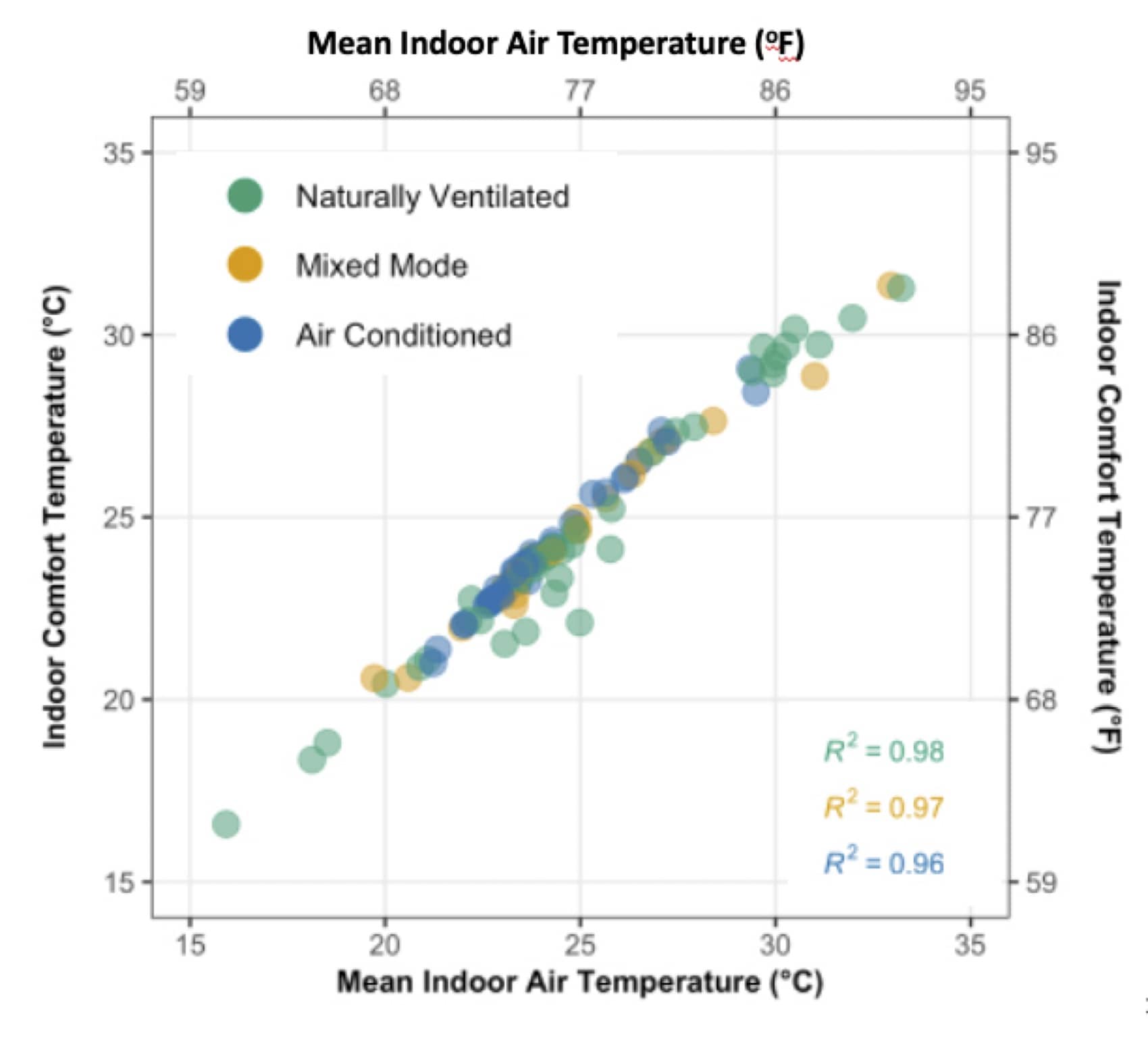
But in the Global North we’ve become an indoor species that spends >90% of its day-to-day life inside built environments. Recognition of this fact calls into question the relevance of outdoor temperature as a proxy for the baseline of our exposure database. This glitch in the Adaptation-Level logic has been a persistent irritant for me over the years, but the penny finally dropped in a recent analysis of the 2nd ASHRAE Global Comfort Database (Parkinson et al. 2020). In Figure 1 we can see an extraordinarily strong linear dependence of indoor thermal neutralities (i.e. comfort temperatures) on the mean indoor climate prevailing in those buildings. Each dot represents a single office building in the database. I had seen something like this in one of Humphreys’ BRE technical notes in the late 1970s, but what really shocked me when I first saw Figure 1 was that the relationship applied not only to naturally ventilated buildings, but also to mixed-mode ventilation and fully air-conditioned buildings as well. Previously we had believed that the concept of adaptive comfort was only relevant in free-running or naturally ventilated settings, but that was simply because we were using the wrong metric for our Adaptation-Level exposure baseline i.e. prevailing outdoor instead of indoor temperature. While our physiology may have evolved in the tropical and subtropical savannahs of East Africa 300,000 years ago, by the 21st century we have evolved into indoor creatures.
Notes
1. The pervasive impacts of this climate crisis unfolding in the 21st century has probably vindicated climatic determinists like Auliciems
2. The timing of the invitation to write this essay for Buildings and Cities coincided with the arrival of some sad news about the passing of one of the most influential researchers in the field of thermal comfort, Michael Humphreys. His impact on my four-and-a-half decade research career can’t be overstated, so in many ways this research pathway essay is as much about his legacy as it is about my own.
3. ‘Creating Adaptive Comfort”, an essay by Michael Humphreys describing his research career and the difficulties with mainstreaming the ideas associated with adaptive comfort can be read here: https://www.buildingsandcities.org/insights/research-pathways/creating-adaptive-thermal-comfort.html
References
Edwards, J. (2018). Harry Helson adaptation-level theory, happiness treadmills, and behavioral economics. Journal of the History of Economic Thought. 40,.1-22. https://doi.org/10.1017/S1053837216001140
de Dear, R.J. (1998). A global database of thermal comfort field experiments, ASHRAE Transactions, 104(1b), 1141-1152.
Földváry Ličina,V., Cheung,T., Zhang,H., Dear,R., Parkinson,T., Arens,E.A., Chun,C., Schiavon,S., Luo,M., Brager,G., Li,P., Kaam,S., Adebamowo,M.A., Andamon,M.M., Babich,F., Bouden,C., Bukovianska,H., Candido,C., Cao,B., Carlucci,S., Cheong,D.K.W., Choi,J-H., Cook,M., Cropper,P., Deuble,M., Heidari,S., Indraganti,M., Jin,Q., Kim,H., Kim,J., Konis,K., Singh,M.K., Kwok,A., Lamberts,R., Loveday,D., Langevin,J., Manu,S., Moosmann,C., Nicol,F., Ooka,R., Oseland,N.A., Pagliano,L., Petráš,D., Rawal,R., Romero,R., Rijal,H.B., Sekhar,C., Schweiker,M., Tartarini,F., Tanabe,S., Tham,K.W., Teli,D., Toftum,J., Toledo,L., Tsuzuki,K., De Vecchi,R., Wagner,A., Wang,Z., Wallbaum,H., Webb,L., Yang,L., Zhu,Y., Zhai,Y., Zhang,Y., Zhou,X. (2018). Development of the ASHRAE Global Thermal Comfort Database II, Building and Environment, 142,.502-512. https://doi.org/10.1016/j.buildenv.2018.06.022
Parkinson, T., de Dear, R., Brager, G. (2020). Nudging the adaptive thermal comfort model. Energy and Buildings, 206, 109559. https://doi.org/10.1016/j.enbuild.2019.109559
Taylor, N.A.S., Taylor, E.A., Maloney, S.K., de Dear, R.J. (2022). Contributions from a Land Down Under: The Arid Continent. In: Blatteis, C.M., Taylor, N., Mitchell, D. (eds) Thermal Physiology: Perspectives in Physiology. New York:Springer. pp.357-404. https://doi.org/10.1007/978-1-0716-2362-6_6
Zhai, Y., Yang, L., Zhao, S., Gao, S., Wang, F., Lian, Z., Duanmu, L, Zhang, Y., Zhou, X., Cao, B., Wang, Z., Yan, H., Zhang, H., Arens, E., and de Dear, R. (2023). The Chinese thermal comfort dataset. Nature - Scientific Data, 10, 662. https://doi.org/10.1038/s41597-023-02568-3
Latest Peer-Reviewed Journal Content

Building space heating and cooling in NDCs 4.0
T P Lützkendorf
Building component reuse as sociomaterial interaction: lessons from precast concrete
J Uusikartano, L Alkki & V Capitani
Validating national reuse indicators from regional demolition data: a Swedish example
F Ericsson, K Mjörnell & U Janson
Climate change risk and decision-making [editorial]
S Foxell & I Cooper
Technologies of reconstruction [editorial]
P Tombesi
Urban form metrics for building occupancy modelling: applications and impacts
D Reiter, M Jehling & R Hecht
Retrofit realism: affordable low-carbon policies for existing homes
N Eyre & R Khosla
Inside offsite: everyday dwelling in factory-built apartments
L Dorignon & R Horne
MMC for housing: sectoral perception on governance challenges
J Morgan, C Goodier, R Schmidt-III & K Ayinla
Reorganising specification practice for component reuse: an exploratory study
S Gao, K Jones, J Xu & J Glass
Kitchen retrofits to support food practices and wellbeing
F J Andrews, A Sal Moslehian, E Warner & R Tucker
From strategy to delivery: a comparative analysis of MMC roadmaps
G Goldman, D Sorokine, F Suerich-Gulick, C Carbone & M Jemtrud
Thermal comfort, ventilation and mosquito-borne disease risk in Zanzibar hospitals
O Sloan Wood, J B Knudsen, K L Schiøler, E Lupenza, M Msellem & F Saleh
Reusing precast concrete elements in construction: assessing the economic conditions
O Vigren, H Westerlind & T Malmqvist
Institutional readiness for industrialised social housing in Vietnam
T Q Nguyen, B N Nguyen, T H Q To & Z Aziz
Prefabrication for housing retrofit: governance, innovation and resident experience
E Pikas, K Kuusk, P Pihelo, R Liias, J Pukk & T Kalamees
Reframing heat pump transitions: a care perspective
J van der Haer, R Schelwald & F de Haan
Urban informal settlements in Africa: transforming adaptation governance
K Buyana & H Sseviiri
Reusing concrete products in indoor environments: chemical hazard assessment
K Tähtinen, A Helin, E Parshintsev & H Hovi
Negotiating net-zero carbon: an ANT analysis of two buildings
L Schweber & M Green
Design for disassembly: a review of public policy proposals
O Vorobjev, U Uotila, T Joensuu & A Saari
Retrofitting Norwegian residential buildings: an archetype-based dynamic stock model
L S A Rousseau, S Amini, S Akin & E G Hertwich
Decolonising time: vernacular villages and the politics of heritage temporality
R Al-Rabady
Commutes to alternative workplaces: GHG emissions and physical activity
J Taylor, L Thoen, A Espinosa Mireles De Villafranca, P Anashin, J Vanhatalo, D Milián
Bernal & I Okkonen
Nine ‘myths’ about the building stock of Great Britain
S Evans, P Steadman, A Neto-Bradley, D Humphrey, R Liddiard,H Shamsi, J Palmer & G Simons
Join Our Community

The most important part of any journal is our people – readers, authors, reviewers, editorial board members and editors. You are cordially invited to join our community by joining our mailing list. We send out occasional emails about the journal – calls for papers, special issues, events and more.
We will not share your email with third parties. Read more
Latest Commentaries
Who is Responsible for Climate Change?
Ian Cooper (Eclipse Research) explores the questions of responsibility raised in the recent Buildings & Cities special issue ‘Climate Change Risk and Decision-Making’. Focusing here on carbon emissions and mitigation, global responses will require grounding in what can work locally. New responsibilities arise for the wide range of built environment decision-makers: clients, professionals and their institutions, central and local governments, product suppliers, financiers, insurers, etc. A framework is needed to manage the complexity of responsibilities especially for variety of actors, the time frames and spatial scales.
Professional Ethics in a Climate Crisis
The climate crisis has progressed into a dangerous phase with tragic consequences often counted in numbers of excess deaths, but also by powerful economic impacts of rising food prices, the increased costs of insurance and lending, costly damage to the built environment. Celia Davies, Director of Impact at the UK’s Town and Country Planning Association (TCPA) and Hugh Ellis, Director of Policy at TCPA, consider the responsibilities of professionals in shaping a built environment which is fit not just for today's climate risks but for the dramatic increase in severe and unpredictable weather which is now locked into our climate systems.