
www.buildingsandcities.org/insights/news/national-buildings-database.html
New UK National Buildings Database
This is a step-change in the evidence available for analysis of energy demand, decarbonisation and retrofit across the building stock.
The UK Department of Energy Security and Net Zero (DESNZ) has announced the completion of the National Buildings Database, developed for the Department by the UCL Energy Institute. This new database covers all buildings in England, Wales and Scotland, both domestic (houses and flats) and non-domestic (offices, shops, factories, warehouses etc), plus mixtures of the two (e.g. flats over shops).
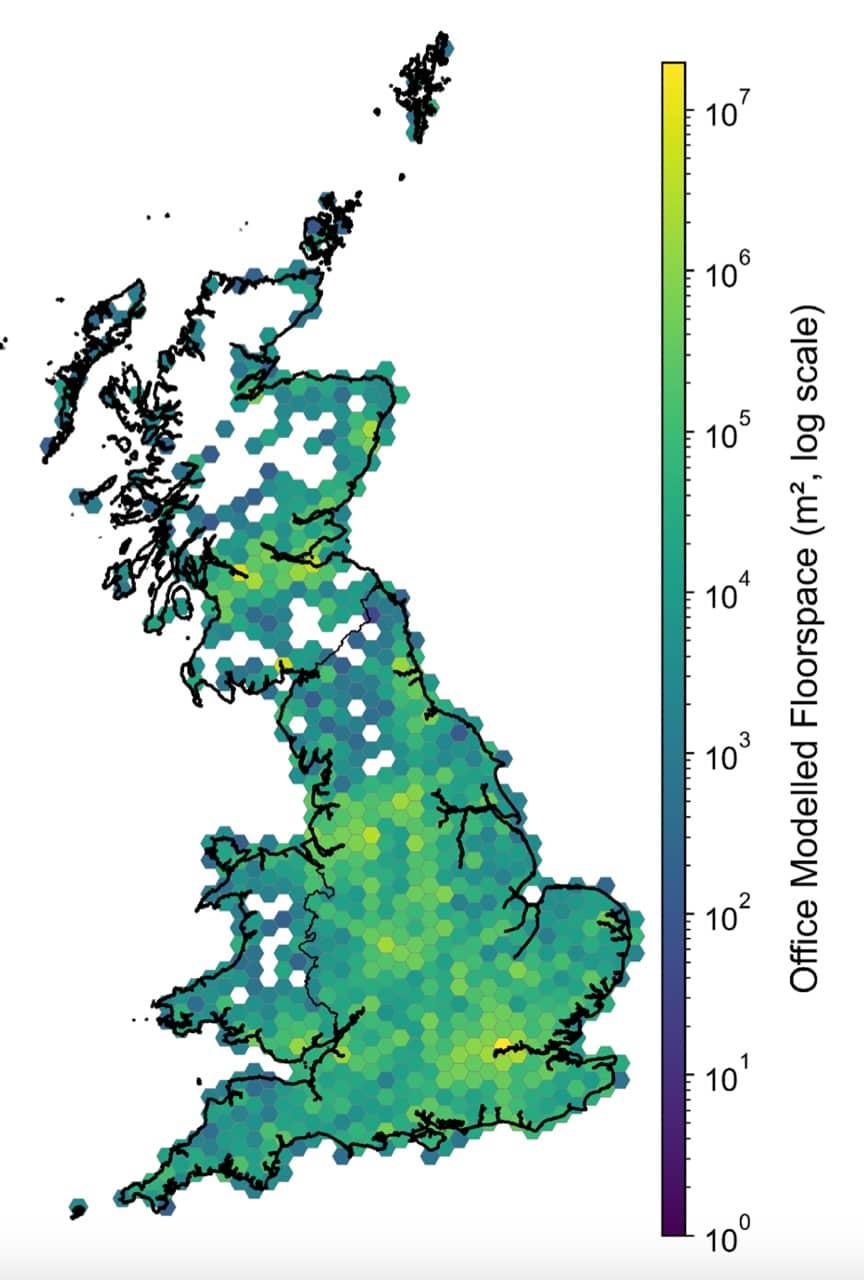
The 30 million dwellings are at present recorded with addresses, footprints and energy use but without 3D geometry. The 2.1 million non-domestic premises have full geometric descriptions with numbers of storeys and floor areas, plus materials of construction, estimates of age, and data on heating systems and energy efficiency measures installed. The activities in each premises are classified by some 485 categories, down to the level of 'bingo hall', 'lifeboat station' or 'garden centre'. Energy Performance Certificates (including domestic EPCs) and Display Energy Certificates are all attached, as are annual gas and electricity meter data.
The National Buildings Database (NBD) will allow DESNZ to carry out research into energy use and carbon emissions, to inform government strategy and policy on improving energy efficiency and reducing energy bills. NBD will be used for examining practical approaches to low carbon retrofitting for specific subsets of the stock, and for investigating the potential for integrating low carbon and renewable energy technologies.Through inclusion of every premises in Great Britain, NBD allows for specific segments and subsets of the stock to be identified and analysed, for example all public sector buildings, or all data centres. The rich detail allows for policy options to be developed and assessed based on actual premises and their features, for example estimating rooftop solar potential or supporting and evaluating updates to regulation. The spatial nature of the data allows for localised energy planning and decarbonisation action at scale, for example identifying opportunities for heat networks. Data from NBD will be made available in aggregate and anonymised form for other users.
A report containing detailed statistics on each sector of the non-domestic stock
has been published, together with downloadable data tables, at:
https://www.gov.uk/government/publications/national-buildings-database-phase-2-understanding-great-britains-buildings


Latest Peer-Reviewed Journal Content

Moving homes and energy poverty: residents’ concerns, capabilities and responses
M Jalas, J Rinkinen, S Numminen & E Valkealahti
Reference study for biogenic carbon storage in the residential building stock
O Iliescu, I Talvitie, A Amiri & S Junnila
Building space heating and cooling in NDCs 4.0
T P Lützkendorf
Building component reuse as sociomaterial interaction: lessons from precast concrete
J Uusikartano, L Alkki & V Capitani
Validating national reuse indicators from regional demolition data: a Swedish example
F Ericsson, K Mjörnell & U Janson
Climate change risk and decision-making [editorial]
S Foxell & I Cooper
Technologies of reconstruction [editorial]
P Tombesi
Urban form metrics for building occupancy modelling: applications and impacts
D Reiter, M Jehling & R Hecht
Retrofit realism: affordable low-carbon policies for existing homes
N Eyre & R Khosla
Join Our Community

The most important part of any journal is our people – readers, authors, reviewers, editorial board members and editors. You are cordially invited to join our community by joining our mailing list. We send out occasional emails about the journal – calls for papers, special issues, events and more.
We will not share your email with third parties. Read more
Latest Commentaries
Who is Responsible for Climate Change?
Ian Cooper (Eclipse Research) explores the questions of responsibility raised in the recent Buildings & Cities special issue ‘Climate Change Risk and Decision-Making’. Focusing here on carbon emissions and mitigation, global responses will require grounding in what can work locally. New responsibilities arise for the wide range of built environment decision-makers: clients, professionals and their institutions, central and local governments, product suppliers, financiers, insurers, etc. A framework is needed to manage the complexity of responsibilities especially for variety of actors, the time frames and spatial scales.
Professional Ethics in a Climate Crisis
The climate crisis has progressed into a dangerous phase with tragic consequences often counted in numbers of excess deaths, but also by powerful economic impacts of rising food prices, the increased costs of insurance and lending, costly damage to the built environment. Celia Davies, Director of Impact at the UK’s Town and Country Planning Association (TCPA) and Hugh Ellis, Director of Policy at TCPA, consider the responsibilities of professionals in shaping a built environment which is fit not just for today's climate risks but for the dramatic increase in severe and unpredictable weather which is now locked into our climate systems.