
www.buildingsandcities.org/insights/commentaries/decolonialising-urban-planning.html
Decolonialising Urban Planning
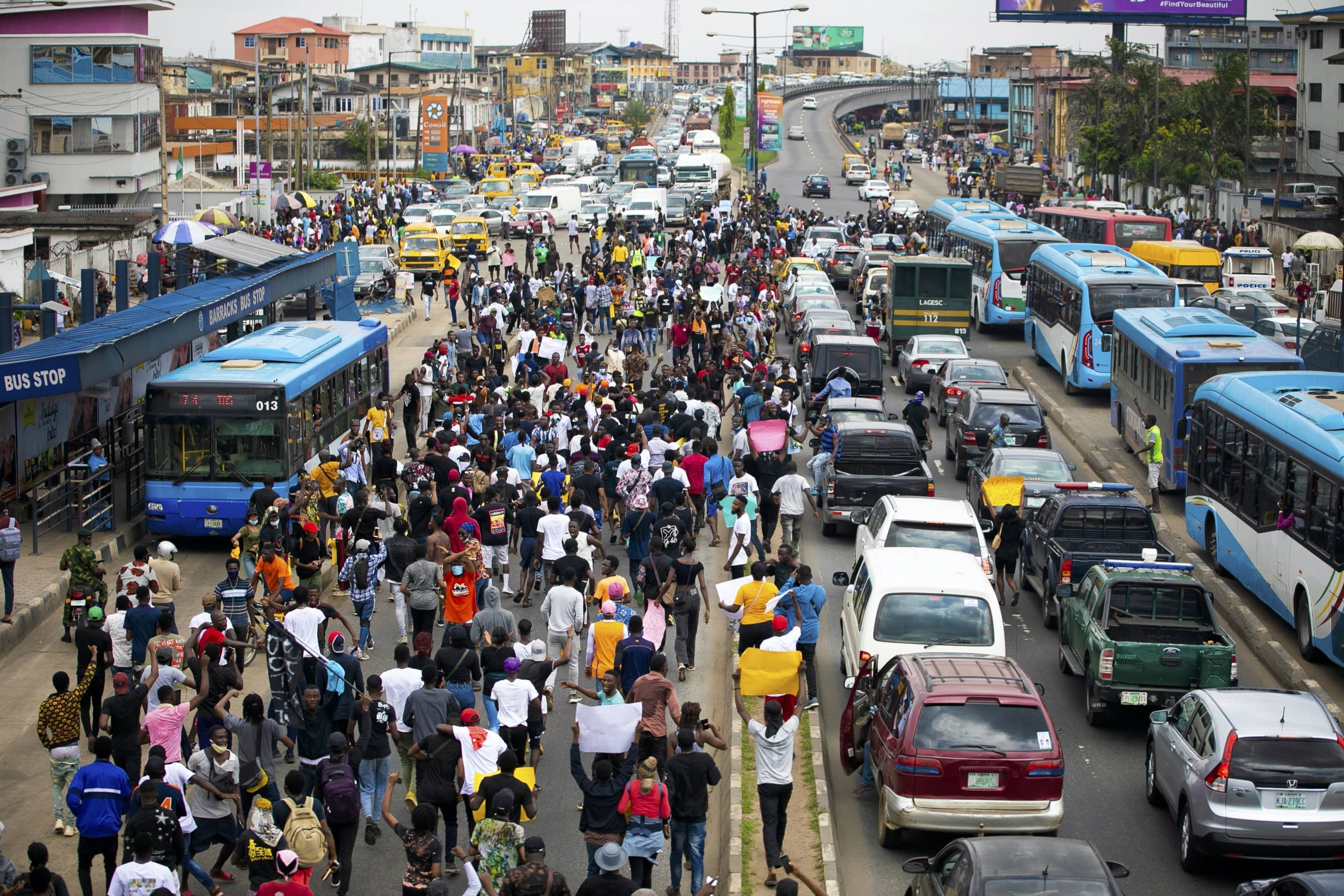
Applying lessons from indigenous urban planning can make Nigerian cities more sustainable
Mokọ́ládé Johnson (University of Lagos) explains why Nigerian cities have lost their vernacular approaches to urban planning and the resulting negative impacts that arise. Could former indigenous urban design principles be adapted to inform contemporary urban planning practices?
How has urban planning in Nigeria changed?
In pre-colonial times, Nigerian settlements tended to be planned around footpaths and walkways as the main mode of transport of its citizens and goods. This situation is no longer prevails. Cities are larger in scale, and services are no longer with walking distance. Mass-transit buses, trains, and highways are needed to link city neighbourhoods and services. Streets have had to adapt to accommodate automobiles, leaving little or no room for pedestrians. This negatively impacts on the health of citizens by reducing opportunities for walking and causing air pollution. However, fast urbanising metropolises like Lagos are comprised of urban villages. The opportunity exists to reintegrate walking into urban designs to promote healthier lifestyles.
In Nigeria, typical indigenous settlement and city forms are composed of tangible and intangible layers and materiality with blurred boundaries. For instance, overlaying a religious layer on the physical city often reveals a faded vernacular template at the home, neighbourhood, city, and regional scales. Ancestral schools of thought claim that the physical plans of Yorùbá cities can be either circular or elliptical or squarish. Yet all agree that the centre of the city is sacred and the site of socio-political power, a domain for the king and the administrative hierarchy of society. Traditionally, surrounding the centre are found verdant parcels of religious, agricultural, and productive landscape. This approach ensures those in power are at the geographic and political centre of the population, but this also has environmental benefits. For instance, locating agriculture adjacent to the urban centre means these green spaces help to mitigate the extremes of the hot-humid tropical climate in the city.
In Yorùbá, Nigeria, public realms are a blend of allotted backyard farms, agricultural lands, sacred groves, courtyard-houses, native-tree planted neighbourhoods, open space markets, and people-centred governance structures in cultural hierarchies. There is a cultural belief that no matter how big the city is, the voice of the deity must echo in every neighbourhood. However, these vernacular patterns, and planning principles are now lost to inherited or imposed colonial architecture and design doctrines in today's postcolonial cities in Nigeria. However, although these traditional features are now no longer part of contemporary urban planning principles, there remains a shadow of them that are still legible in Nigerian cities, though they are fading in the face of modernisation and urbanisation.
Economic development and demographic transition
Changes to Nigeria's economy have shaped its urban design. Forced slavery in Nigeria in the 1800s not only created profound cultural shock, it also imported new construction methods, materials and designs. More recently, the 2008 economic meltdown triggered a switch in decision-making to favour cheaper alternative options across all areas of urban development. New rail transport links between cities were downgraded from costly high speed options. There was also a move to using mass-produced construction materials, which often lead to designs emulating examples from the Global North, rather than traditional approaches.
Thus, shifts in economies have eroded tenets of cultural significance in Nigeria, which further accelerated the adoption of modern approaches and the loss of vernacular principles. But at what cost? Vernacularity holds agency over modern urban planning approaches when considering sustainability performance benefits. Indigeneity in a Nigerian urban context promotes organic cities, while more modern development tends to result in a reduction of green infrastructure in cities, and with it, a loss of the wellbeing, health and ecosystem services that these spaces can bring. Traditional planning metaphors created positive sustainable urban architecture in the past, but can reverting to such local heritage-identities that define homegrown realms, promote more sustainable cities today?
Fast urbanisation and industrialisation have turned the cities into economic engine rooms for the world today. Cities are projected to house over 75% of global populations before the end of the 21st century. As such, demographics play a significant role in urban development. Many postcolonial cities of the Global South assimilated Western ideas which had detrimental implications for urban spaces: the loss of sacred, agricultural, green and communal spaces.
The absorption of people from the countryside into the city had profound impacts on urban planning, taking cities today even further from their ancestral design. It has also affected the lives of citizens. Many Nigerians now live a dual way of life caught between "village" life and bustling "city" life. This duality is manifest both in the psychological and physical sense as the home in the village is more culturally significant than the city's. This results in people travelling across multiple urban zones in their daily life, and the continued pursuit of Eurocentric or foreign templates for infrastructural and urban policy agendas. This approach fails to address fundamental challenges and opportunities at different layers of urban growth.
Traditional culture and modern urban design
The struggle to maintain an ancestral family home in a village and a house in the city to be near employment is counter to the traditional Nigerian metaphor in life and death. When a person is alive, they work in the city and go to the village periodically to strengthen cultural and kinship ties. At the time of death, their body goes home for burial in the village as the final resting place. This suggests that the "city" can exist successfully where it is able to work harmoniously with the concept of the "village" and so traditional urban design concepts could help citizens balance culture and economic development in a modern world.
There are many indigenous ideas that informed all scales of urban design and planning from the house, to communities and regions. For instance, residential design around the indigenous courtyard system, creating social space at community level, and respect for central spaces for the civic realms. The historical incidences that led to the relegation of such indigenous competences and values need to be reconsidered. Older design doctrines are people-centred with participation via traditional tenets for enduring heritage. Reconnecting with these has potential to produce blended principles for replanning and refurbishing old city parts and the design of new suburban areas. We need to apply a mix of the best of the old methods and the best of modern practises, and much of the traditionally viable low-tech know-how could be scalable in today's technologically-driven urban villages.
Clearly, past decision-makers and city planners could not envisage the myriad challenges that modern cities face today, but historic designs could provide some principles for planning our urban spaces more sustainably. It is not clear that current trends in Nigeria's urbanisation will be reversed. The challenge for today's urban designers is to explore what potential synergies are possible to maximise the benefits and practicalities of old indigenous knowledge and blend these with efficient global technological ideas from modern culture.
A greater knowledge of indigenous culture and the capabilities to blend new ideas with cultural practices need to be incorporated into the education and training of future urban designers. The current curricula in the Global South often fails to do this and still reflects aspects of colonial doctrines, content and cultural approaches There is a need for stakeholders to decolonise syllabuses and infuse cultural content and context in training future architects and urban planners. Beyond education, there is a need to advocate for place-based policy change, where the present urban actors work with ideas that are compatible with the natural geography of their environment.

Latest Peer-Reviewed Journal Content
Building space heating and cooling in NDCs 4.0
T P Lützkendorf
Building component reuse as sociomaterial interaction: lessons from precast concrete
J Uusikartano, L Alkki & V Capitani
Validating national reuse indicators from regional demolition data: a Swedish example
F Ericsson, K Mjörnell & U Janson
Climate change risk and decision-making [editorial]
S Foxell & I Cooper
Technologies of reconstruction [editorial]
P Tombesi
Urban form metrics for building occupancy modelling: applications and impacts
D Reiter, M Jehling & R Hecht
Retrofit realism: affordable low-carbon policies for existing homes
N Eyre & R Khosla
Inside offsite: everyday dwelling in factory-built apartments
L Dorignon & R Horne
MMC for housing: sectoral perception on governance challenges
J Morgan, C Goodier, R Schmidt-III & K Ayinla
Reorganising specification practice for component reuse: an exploratory study
S Gao, K Jones, J Xu & J Glass
Kitchen retrofits to support food practices and wellbeing
F J Andrews, A Sal Moslehian, E Warner & R Tucker
From strategy to delivery: a comparative analysis of MMC roadmaps
G Goldman, D Sorokine, F Suerich-Gulick, C Carbone & M Jemtrud
Thermal comfort, ventilation and mosquito-borne disease risk in Zanzibar hospitals
O Sloan Wood, J B Knudsen, K L Schiøler, E Lupenza, M Msellem & F Saleh
Reusing precast concrete elements in construction: assessing the economic conditions
O Vigren, H Westerlind & T Malmqvist
Institutional readiness for industrialised social housing in Vietnam
T Q Nguyen, B N Nguyen, T H Q To & Z Aziz
Prefabrication for housing retrofit: governance, innovation and resident experience
E Pikas, K Kuusk, P Pihelo, R Liias, J Pukk & T Kalamees
Reframing heat pump transitions: a care perspective
J van der Haer, R Schelwald & F de Haan
Urban informal settlements in Africa: transforming adaptation governance
K Buyana & H Sseviiri
Reusing concrete products in indoor environments: chemical hazard assessment
K Tähtinen, A Helin, E Parshintsev & H Hovi
Negotiating net-zero carbon: an ANT analysis of two buildings
L Schweber & M Green
Design for disassembly: a review of public policy proposals
O Vorobjev, U Uotila, T Joensuu & A Saari
Retrofitting Norwegian residential buildings: an archetype-based dynamic stock model
L S A Rousseau, S Amini, S Akin & E G Hertwich
Decolonising time: vernacular villages and the politics of heritage temporality
R Al-Rabady
Commutes to alternative workplaces: GHG emissions and physical activity
J Taylor, L Thoen, A Espinosa Mireles De Villafranca, P Anashin, J Vanhatalo, D Milián
Bernal & I Okkonen
Nine ‘myths’ about the building stock of Great Britain
S Evans, P Steadman, A Neto-Bradley, D Humphrey, R Liddiard,H Shamsi, J Palmer & G Simons
Join Our Community

The most important part of any journal is our people – readers, authors, reviewers, editorial board members and editors. You are cordially invited to join our community by joining our mailing list. We send out occasional emails about the journal – calls for papers, special issues, events and more.
We will not share your email with third parties. Read more
Latest Commentaries
Who is Responsible for Climate Change?
Ian Cooper (Eclipse Research) explores the questions of responsibility raised in the recent Buildings & Cities special issue ‘Climate Change Risk and Decision-Making’. Focusing here on carbon emissions and mitigation, global responses will require grounding in what can work locally. New responsibilities arise for the wide range of built environment decision-makers: clients, professionals and their institutions, central and local governments, product suppliers, financiers, insurers, etc. A framework is needed to manage the complexity of responsibilities especially for variety of actors, the time frames and spatial scales.
Professional Ethics in a Climate Crisis
The climate crisis has progressed into a dangerous phase with tragic consequences often counted in numbers of excess deaths, but also by powerful economic impacts of rising food prices, the increased costs of insurance and lending, costly damage to the built environment. Celia Davies, Director of Impact at the UK’s Town and Country Planning Association (TCPA) and Hugh Ellis, Director of Policy at TCPA, consider the responsibilities of professionals in shaping a built environment which is fit not just for today's climate risks but for the dramatic increase in severe and unpredictable weather which is now locked into our climate systems.