
www.buildingsandcities.org/insights/commentaries/data-politics-tech-corporations.html
The Data Politics of Tech Corporations
Have civil society and governments ceded too much power and influence to a few tech corporations? Why analysis of the smart city needs to include private sector data.
Dillon Mahmoudi (University of Maryland, Baltimore County) and Alan Wiig (University of Florida) comment on the contributions of the Buildings & Cities special issue Data Politics in the Built Environment. This commentary considers how tech corporates such as Amazon are changing urban life and creating new forms of automated surveillance.
The timely collection of essays in the Buildings & Cities special issue 'Data Politics in the Built Environment' makes the case that scholars, practitioners and activists working towards more equitable and just cities must consider the politics of data. This commentary considers Sharma et al.'s (2023, p. 316, citing Kitchin 2021) provocation for scholars critical of the techno-utopianism of the smart city to 'trouble' the topic by directly addressing 'the injustices inherent to contemporary visions of [smart cities]'. Their paper calls for an intersectional approach that 'seeks to understand the dynamics of interaction between different oppressions showing how different oppressions shape and impact one another' (Sharma et al. 2023, p. 318).
The present commentary considers how corporate surveillance capitalism (Sareen et al. 2023, p. 613; citing Zuboff 2019) produces and reproduces the 'actually existing smart city' (Shelton et al. 2015; Mackinnon et al. 2022). Over the last decade-plus a few large firms have taken over foundational aspects of the urban, high-street economy of shopping, socialising and entertainment, but also embody many of the problematic and profitable elements of the smart city including automated surveillance and the rapid and efficient, digitised management of goods, services and workers.
In turn, this raises a challenge for urban scholars to think beyond the traditional data production and governance boundaries to include the economic activities that take place in the peripheral zones that so often house the warehouses and distribution centres (e.g. Amazon and its competitors). These spaces may sit outside the regulatory reach of municipal officials working on smart city projects (and on a city's management in general), but as Amazon's warehouses have replaced a city's brick and mortar storefronts, the corporation has taken on an outsize role in everyday urban life.
A brief illustrative case is presented to summarise ongoing research in Baltimore, Maryland, US. Baltimore is a coastal port city that rose to prominence in the 19th century with industrial manufacturing, shipbuilding, steel production and sprawling transshipment railways and ports (Liebel 2006). Since the 1960s the city has seen significant social and economic decline marked by population loss and urban decay.
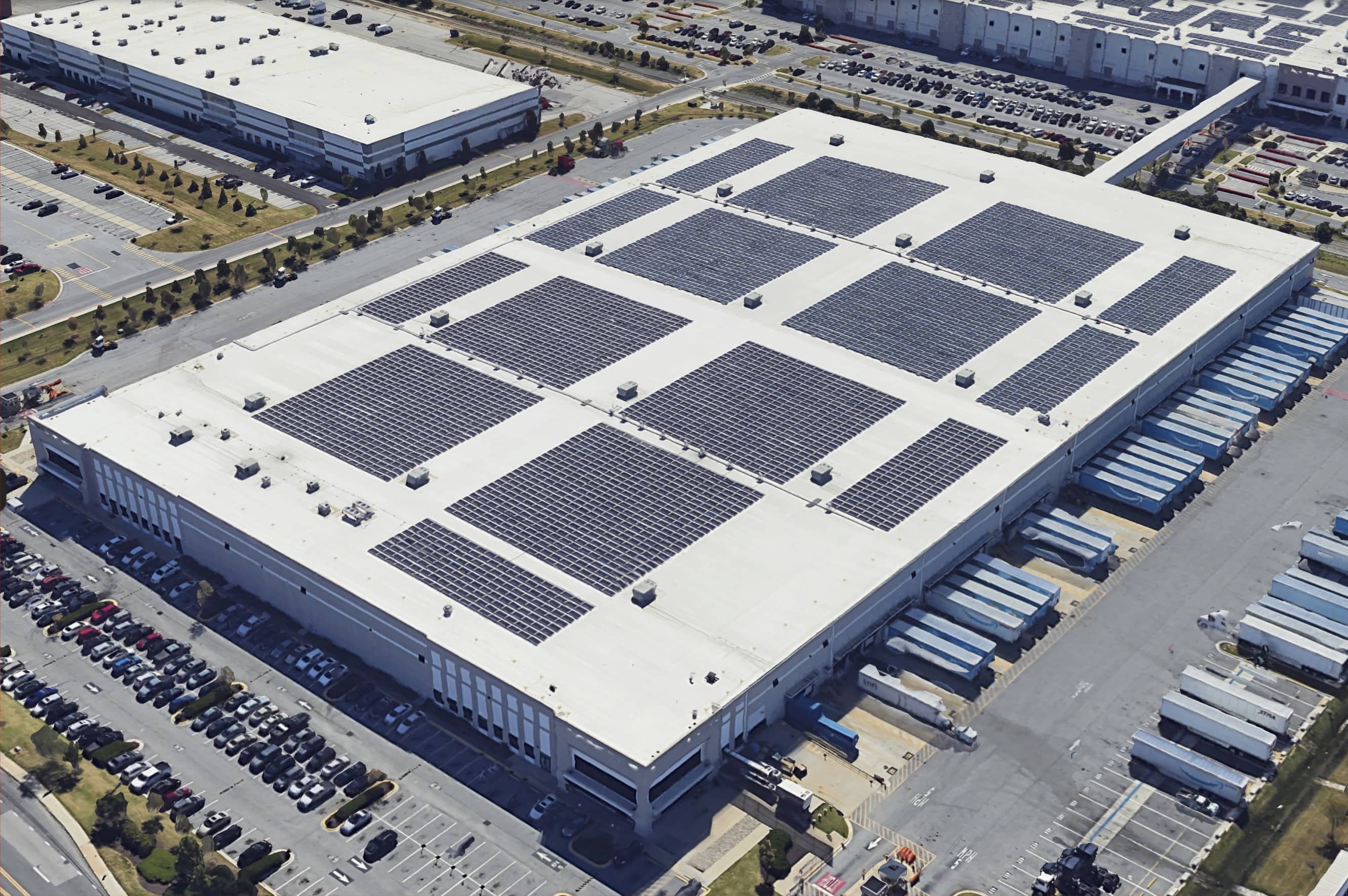
Today, on the formerly industrial waterfront is one of the largest Amazon fulfilment centres in the country. About 1,500 employees work in a windowless, 95,000 m2 facility that processes tens if not hundreds of thousands of packages a day and a short 6 km (4 miles) from the city centre (MacGillis 2021). Where once molten steel flowed to produce machinery and consumer commodities, bits now flow on the silicon microchips of robots and data servers to manage the efficient movement of commodities made in factories elsewhere, typically in Asia or Central America. From the outside, the structure appears as an anonymous, low-slung, windowless building complex surrounded by asphalt parking lots near a major freeway exchange. A constant stream of tractor trailers come and go from delivery docks, producing real time data on delivery status as each package is scanned during loading or offloading. Inside, the company houses a fulfilment centre made possible by cutting-edge technology and labour practices. Despite earning over $18 per hour, workers face challenging conditions and the inevitable threat of being laid-off due to automation, a stark contrast to the unionized waterfront labour of the 19th and 20th centuries. Warehouse workers labour alongside 'Pegasus' and 'Proteus' robots that aid in moving boxed stacks of products to the right location to be packed for delivery.
Amazon's digital services are inseparable from the act of shopping online and then receiving a package: Amazon Web Services' (AWS) data management is the backbone that makes the logistics of rapid package delivery a reality (Shane 2019). The interconnected systems maximize efficient distribution from production facility to fulfilment centre and then to customers' doorsteps, including the movement of products between different types of warehouses and distribution locations. For example, two more large Amazon regional sorting facilities (near to the Baltimore fulfilment centre) direct packages to the right location whether in Baltimore or elsewhere. In nearby Dundalk there are three more robotic large fulfilment centres and a delivery station network facility which serves the Washington D.C. metropolitan area and Maryland more broadly. Amazon's Prime Air delivers to these facilities through the Baltimore-Washington International Airport (BWI). Amazon's BWI cargo hub has separate delivery station hubs, its own fulfilment centre and a regional sorting facility. Prime Air moves more cargo through BWI than the global logistics companies FedEx and UPS combined, even though Prime Air is much newer than the other two.
The same AI-powered digital services that serve as the backbone of Amazon's logistics are also a source of revenue from cloud computing clients. Amazon's digital and cloud services account for one-third of the global $200 billion cloud computing market. Amazon's digital services seep into the city, like the historic Camden Yards stadium where the Baltimore Orioles professional baseball team play and the M&T Bank Stadium where the Baltimore Ravens professional American football team play. Amazon servers record, store and analyse every athlete's movement to find a competitive edge over other teams. Software running on Amazon servers match the video feed with the identifying microchips in helmets and shoulder pads of professional football players to analyse play patterns (Shane 2019). Radar tracks and records every pitch during a baseball game to maximize the effectiveness of both pitching and hitting. TV networks crunch analysis in real time to produce flashy infographics that loudly display an 'AWS-powered' logo for viewers, some of whom may be watching live on Amazon's Prime Video streaming service.
Amazon Web Services also serves as the digital backend for Amazon products, like the infamous Alexa-enabled smart speaker devices and Ring security cameras. After a rash of recent home burglaries and crimes in northern Baltimore, Amazon helped a group of Baltimore pastors secure $15,000 in funding to purchase Ring security cameras for neighbourhood residents. These networked cameras, together dubbed 'Operation On Guard' (Rector 2019), provide the Baltimore Police Department with a vast array of front door surveillance cameras that complement the nearly 780 Baltimore Police CCTV cameras and 235 AWS-powered ShotSpotter gunshot detection units that disproportionately surveil non-white neighbourhoods.
To conclude, the data politics of the smart city must include the proprietary private sector data that drives Amazon's business model. The promises of government efficiency, sustainability and openness that form the foundation of plans for smart cities (Wiig 2016) have been transformed through the profit-driven politics of global corporations. This has direct consequences for cities and urban life. Have civil society and governments ceded too much power and influence to a few corporations?
References
Liebel, T. (2006). Industrial Baltimore. Arcadia Publishing Library Editions.
Mackinnon, D., Burns, R. & Fast, V. (Eds.). (2022). Digital (In)justice in the Smart City. University of Toronto Press.
MacGillis, A. (2021). Fulfillment: Winning and Losing in One-Click America. New York: Farrar, Straus and Giroux.
Rector, K. (2019, August 21). 'Virtual neighborhood watch': Baltimore faith group building surveillance network with help from Amazon Ring. Baltimore Sun. https://www.baltimoresun.com/2019/08/21/virtual-neighborhood-watch-baltimore-faith-group-building-surveillance-network-with-help-from-amazon-ring/
Sareen, S., Smith, A., Gantioler, S., Balest, J., Brisbois, M.C., Tomasi, S., Sovacool, B., Torres Contreras, G.A., DellaValle, N. & Haarstad, H. (2023). Social implications of energy infrastructure digitalisation and decarbonisation. Buildings and Cities, 4(1), 612-628.
Shane, S. (2019, November 30). Prime mover: how Amazon wove itself into the life of an American city. New York Times. www.nytimes.com/2019/11/30/business/amazon-baltimore.html
Sharma, N., Hargreaves, T. & Pallett, H. (2023). Social justice implications of smart urban technologies: An intersectional approach. Buildings and Cities, 4(1), 315-333.
Shelton, T., Zook, M. & Wiig, A. (2015). The 'actually existing smart city'. Cambridge Journal of Regions, Economy and Society, 8(1), 13-25.
Wiig, A. (2016). The empty rhetoric of the smart city: from digital inclusion to economic promotion in Philadelphia. Urban Geography, 37(4), 535-553.


Latest Peer-Reviewed Journal Content

Building space heating and cooling in NDCs 4.0
T P Lützkendorf
Building component reuse as sociomaterial interaction: lessons from precast concrete
J Uusikartano, L Alkki & V Capitani
Validating national reuse indicators from regional demolition data: a Swedish example
F Ericsson, K Mjörnell & U Janson
Climate change risk and decision-making [editorial]
S Foxell & I Cooper
Technologies of reconstruction [editorial]
P Tombesi
Urban form metrics for building occupancy modelling: applications and impacts
D Reiter, M Jehling & R Hecht
Retrofit realism: affordable low-carbon policies for existing homes
N Eyre & R Khosla
Inside offsite: everyday dwelling in factory-built apartments
L Dorignon & R Horne
MMC for housing: sectoral perception on governance challenges
J Morgan, C Goodier, R Schmidt-III & K Ayinla
Reorganising specification practice for component reuse: an exploratory study
S Gao, K Jones, J Xu & J Glass
Kitchen retrofits to support food practices and wellbeing
F J Andrews, A Sal Moslehian, E Warner & R Tucker
From strategy to delivery: a comparative analysis of MMC roadmaps
G Goldman, D Sorokine, F Suerich-Gulick, C Carbone & M Jemtrud
Thermal comfort, ventilation and mosquito-borne disease risk in Zanzibar hospitals
O Sloan Wood, J B Knudsen, K L Schiøler, E Lupenza, M Msellem & F Saleh
Reusing precast concrete elements in construction: assessing the economic conditions
O Vigren, H Westerlind & T Malmqvist
Institutional readiness for industrialised social housing in Vietnam
T Q Nguyen, B N Nguyen, T H Q To & Z Aziz
Prefabrication for housing retrofit: governance, innovation and resident experience
E Pikas, K Kuusk, P Pihelo, R Liias, J Pukk & T Kalamees
Reframing heat pump transitions: a care perspective
J van der Haer, R Schelwald & F de Haan
Urban informal settlements in Africa: transforming adaptation governance
K Buyana & H Sseviiri
Reusing concrete products in indoor environments: chemical hazard assessment
K Tähtinen, A Helin, E Parshintsev & H Hovi
Negotiating net-zero carbon: an ANT analysis of two buildings
L Schweber & M Green
Design for disassembly: a review of public policy proposals
O Vorobjev, U Uotila, T Joensuu & A Saari
Retrofitting Norwegian residential buildings: an archetype-based dynamic stock model
L S A Rousseau, S Amini, S Akin & E G Hertwich
Decolonising time: vernacular villages and the politics of heritage temporality
R Al-Rabady
Commutes to alternative workplaces: GHG emissions and physical activity
J Taylor, L Thoen, A Espinosa Mireles De Villafranca, P Anashin, J Vanhatalo, D Milián
Bernal & I Okkonen
Nine ‘myths’ about the building stock of Great Britain
S Evans, P Steadman, A Neto-Bradley, D Humphrey, R Liddiard,H Shamsi, J Palmer & G Simons
Join Our Community

The most important part of any journal is our people – readers, authors, reviewers, editorial board members and editors. You are cordially invited to join our community by joining our mailing list. We send out occasional emails about the journal – calls for papers, special issues, events and more.
We will not share your email with third parties. Read more
Latest Commentaries
Who is Responsible for Climate Change?
Ian Cooper (Eclipse Research) explores the questions of responsibility raised in the recent Buildings & Cities special issue ‘Climate Change Risk and Decision-Making’. Focusing here on carbon emissions and mitigation, global responses will require grounding in what can work locally. New responsibilities arise for the wide range of built environment decision-makers: clients, professionals and their institutions, central and local governments, product suppliers, financiers, insurers, etc. A framework is needed to manage the complexity of responsibilities especially for variety of actors, the time frames and spatial scales.
Professional Ethics in a Climate Crisis
The climate crisis has progressed into a dangerous phase with tragic consequences often counted in numbers of excess deaths, but also by powerful economic impacts of rising food prices, the increased costs of insurance and lending, costly damage to the built environment. Celia Davies, Director of Impact at the UK’s Town and Country Planning Association (TCPA) and Hugh Ellis, Director of Policy at TCPA, consider the responsibilities of professionals in shaping a built environment which is fit not just for today's climate risks but for the dramatic increase in severe and unpredictable weather which is now locked into our climate systems.