
www.buildingsandcities.org/insights/commentaries/architecture-and-the-climate-emergency.html
Architecture and the Climate Emergency
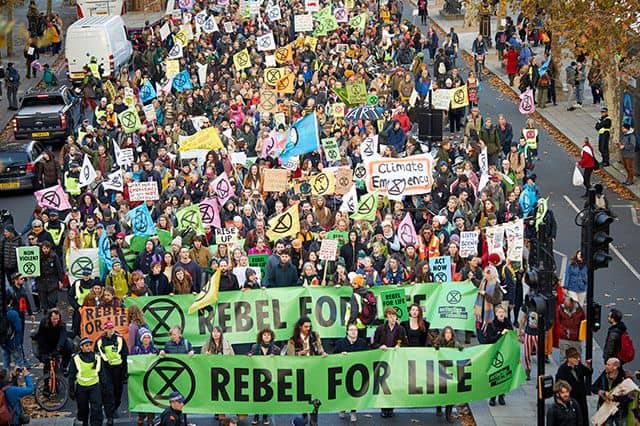
Alan Short responds to the Climate Emergency and argues we must rethink our dependency on the mechanical conditioning of buildings. A city comprised of buildings with high energy demand is risky and damaging to the climate. For change to occur, the behaviours and attitudes of the supply side need to change. The main barrier is for clients and their designers to break with the status quo.
There is an irony in watching film of Extinction Rebellion activists demonstrating beneath horizons of glass office towers. These buildings are significant contributors to the problem in their profligate use of electrically driven air conditioning. Over a third of all fossil fuel energy consumed globally goes into final energy use in buildings predominantly for heating and cooling.[1] The global energy demand for space cooling has tripled over the past 30 years. It now accounts for 50% of residential peak electricity demand.[2]
If we are to effectively counter the Climate Emergency, then it is imperative to rethink our dependence on the mechanical conditioning of buildings. This involves questioning some underlying cultural ideas about air and thermal comfort. There are other ways to achieve pleasant indoor thermal conditions without using the vast amount of embodied and operational energy entailed by mechanical engineering. Making this change is not merely a technical question, but a change in the way buildings are designed, constructed and operated. It is also a matter of re-framing how we think about what it really means to be comfortable. It means rethinking a dependence on mechanical solutions.
We have become accustomed to being in wholly artificial environments in glassy office buildings (and many other building types), regardless of the climate outside. Often these buildings are completely sealed off from the natural environment outside. The 'air we breathe' is mechanically cooled, dehumidified, rehumidified, reheated and blown at us by millions of fans at colossal cost in electrical energy. This is both unnecessary and wasteful. There are more sensible ways to move air in buildings and create pleasant indoor conditions without resorting to electrical fans and expensive equipment.
How did we arrive at this situation? This bizarre practice has a distasteful provenance, the no doubt well-intended response of early Modernists to suppress warmer environments to spare the climate-oppressed, unquestionably absorbing their contemporary climate determinists' damning diagnoses of all climates except the Cool Temperate. Leading determinist Ellen Semple wrote in 1911,
'Where man has remained in the Tropics, with few exceptions he has suffered arrested development. His nursery has kept him a child…. without the respite conferred by a bracing winter season....'[3]
Ellsworth Huntington (1876-1947) further popularized climate determinism in the United States which had a dark side of climate colonialism.[4] It was argued that air conditioning could limit moral degradation. Startlingly aggressive and overtly racist advertising for domestic and work-place air-conditioning promoted these views in the interwar and immediately post-war periods.
After 1945, respectable academics simply avoided discussion of the possibility of difference based on climate, certainly in formulating public policy advice. Perhaps the universal availability of air-conditioning and cheap energy had, in their minds, negated the issue. Were there other consequences for Western architecture? Did a 'clean aesthetic' wrapping a 'clean atmosphere' suppress other promising emerging architectural propositions?[5] Hygiene and de-odourised cleanliness becameassociated with transparency, the all glass building, a phenomenon with an extraordinarily complex provenance, perhaps, as the architectural critic Reyner Banham suggested, deriving from obsessions with cleanliness.[6] In this reading the all-glass building becomes a vessel of water, a translucent sac, completely sealed from the contamination and danger of the city beyond. It has no resilience at all in any climate and can only be sustained by air conditioning. This fragility is underpinned by rising energy costs and, in turn, environmental and climate impacts.
Why have modern Western (and other) societies and their architects contracted out the responsibility for delivering 'good' air in their interior spaces?
Architects have been complicit in transferring responsibility for indoor climate to the world of mechanical and electrical engineers and subcontractors. But design can remove the need for this artificial world. A highly developed art and science of making natural environments in public buildings already exists. The use of architectural configuration had developed though the nineteenth and early twentieth centuries, advancing through the design of hospitals for natural ventilation to dilute and vent away "bad air" (e.g. airborne bacteria). Most of this design knowledge has been forgotten: removed from the architectural curriculum and replaced by the reliance on mechanical engineering.
The behaviours and attitudes of the supply side are atrophied in a persistent social practice, a dull and repetitive way of building in contractually discrete packages including the internal environment. This is maintained further by networks of risk-shedding consultants, bound by intensely defensive contractual agreements and served by industry lock-in with an immense vested interest in maintaining the status quo. But given the current projections and modelling of the changing climate, who will want to own a glass tower anywhere in thirty years? Any building with dependency on a huge energy-consuming life support machine (i.e. mechanical ventilation and air conditioning) is risky and damaging to the climate. They will be a complete liability.
All is not lost, however. It is feasible to create perfectly comfortable low-energy buildings using natural ventilation, the stack effect and building mass. Practical alternatives exist.[7] The present declarations by architects and engineers express concern about the climate and biodiversity emergency. There is a willingness to act now on several fronts, especially the commitment to significantly reduce the embodied and operational CO2 emissions. This means clients and their designers must seek alternative means to achieving thermal comfort by severing the dependence on mechanical systems.
[1] International Energy Agency, 2019. https://www.iea.org/tcep/buildings/
[2] International Energy Agency, 2019. https://www.iea.org/tcep/buildings/cooling/
[3] Ellen Semple 1911 'Influences of Geographic Environment on the Basis of Ratzel's System of Anthropo-Geography',
[4] Huntingdon, E. (1919) World-Power and Evolution. New Haven: Yale University Press.
[5] Paul Overy investigates this possibility offering striking evidence in the 1930 German Hygiene Museum, its popular exhibit on human physiology in transparent plastic, 'The Glass Man', revealing his internal organs and veins, all illuminated. Overy comments, 'The figure clearly embodied ideas about the implied relationship between transparency and hygiene and cleanliness.' Overy P. (2007) Light, Air and Openness, Modern Architecture between the Wars, Thames and Hudson Ltd., London, p.50.
[6] Banham, R. (1969) The Architecture of the Well-tempered Environment. London: The Architectural Press.
[7] Short, C.A. (2017) The Recovery of Natural Environments in Architecture: Air, Comfort and Climate. Abingdon: Routledge.
Latest Peer-Reviewed Journal Content

Building space heating and cooling in NDCs 4.0
T P Lützkendorf
Building component reuse as sociomaterial interaction: lessons from precast concrete
J Uusikartano, L Alkki & V Capitani
Validating national reuse indicators from regional demolition data: a Swedish example
F Ericsson, K Mjörnell & U Janson
Climate change risk and decision-making [editorial]
S Foxell & I Cooper
Technologies of reconstruction [editorial]
P Tombesi
Urban form metrics for building occupancy modelling: applications and impacts
D Reiter, M Jehling & R Hecht
Retrofit realism: affordable low-carbon policies for existing homes
N Eyre & R Khosla
Inside offsite: everyday dwelling in factory-built apartments
L Dorignon & R Horne
MMC for housing: sectoral perception on governance challenges
J Morgan, C Goodier, R Schmidt-III & K Ayinla
Reorganising specification practice for component reuse: an exploratory study
S Gao, K Jones, J Xu & J Glass
Kitchen retrofits to support food practices and wellbeing
F J Andrews, A Sal Moslehian, E Warner & R Tucker
From strategy to delivery: a comparative analysis of MMC roadmaps
G Goldman, D Sorokine, F Suerich-Gulick, C Carbone & M Jemtrud
Thermal comfort, ventilation and mosquito-borne disease risk in Zanzibar hospitals
O Sloan Wood, J B Knudsen, K L Schiøler, E Lupenza, M Msellem & F Saleh
Reusing precast concrete elements in construction: assessing the economic conditions
O Vigren, H Westerlind & T Malmqvist
Institutional readiness for industrialised social housing in Vietnam
T Q Nguyen, B N Nguyen, T H Q To & Z Aziz
Prefabrication for housing retrofit: governance, innovation and resident experience
E Pikas, K Kuusk, P Pihelo, R Liias, J Pukk & T Kalamees
Reframing heat pump transitions: a care perspective
J van der Haer, R Schelwald & F de Haan
Urban informal settlements in Africa: transforming adaptation governance
K Buyana & H Sseviiri
Reusing concrete products in indoor environments: chemical hazard assessment
K Tähtinen, A Helin, E Parshintsev & H Hovi
Negotiating net-zero carbon: an ANT analysis of two buildings
L Schweber & M Green
Design for disassembly: a review of public policy proposals
O Vorobjev, U Uotila, T Joensuu & A Saari
Retrofitting Norwegian residential buildings: an archetype-based dynamic stock model
L S A Rousseau, S Amini, S Akin & E G Hertwich
Decolonising time: vernacular villages and the politics of heritage temporality
R Al-Rabady
Commutes to alternative workplaces: GHG emissions and physical activity
J Taylor, L Thoen, A Espinosa Mireles De Villafranca, P Anashin, J Vanhatalo, D Milián
Bernal & I Okkonen
Nine ‘myths’ about the building stock of Great Britain
S Evans, P Steadman, A Neto-Bradley, D Humphrey, R Liddiard,H Shamsi, J Palmer & G Simons
Join Our Community

The most important part of any journal is our people – readers, authors, reviewers, editorial board members and editors. You are cordially invited to join our community by joining our mailing list. We send out occasional emails about the journal – calls for papers, special issues, events and more.
We will not share your email with third parties. Read more
Latest Commentaries
Who is Responsible for Climate Change?
Ian Cooper (Eclipse Research) explores the questions of responsibility raised in the recent Buildings & Cities special issue ‘Climate Change Risk and Decision-Making’. Focusing here on carbon emissions and mitigation, global responses will require grounding in what can work locally. New responsibilities arise for the wide range of built environment decision-makers: clients, professionals and their institutions, central and local governments, product suppliers, financiers, insurers, etc. A framework is needed to manage the complexity of responsibilities especially for variety of actors, the time frames and spatial scales.
Professional Ethics in a Climate Crisis
The climate crisis has progressed into a dangerous phase with tragic consequences often counted in numbers of excess deaths, but also by powerful economic impacts of rising food prices, the increased costs of insurance and lending, costly damage to the built environment. Celia Davies, Director of Impact at the UK’s Town and Country Planning Association (TCPA) and Hugh Ellis, Director of Policy at TCPA, consider the responsibilities of professionals in shaping a built environment which is fit not just for today's climate risks but for the dramatic increase in severe and unpredictable weather which is now locked into our climate systems.