
www.buildingsandcities.org/calls-for-papers/building-performance-evaluation.html
Building Performance Evaluation: Achieving Better Outcomes
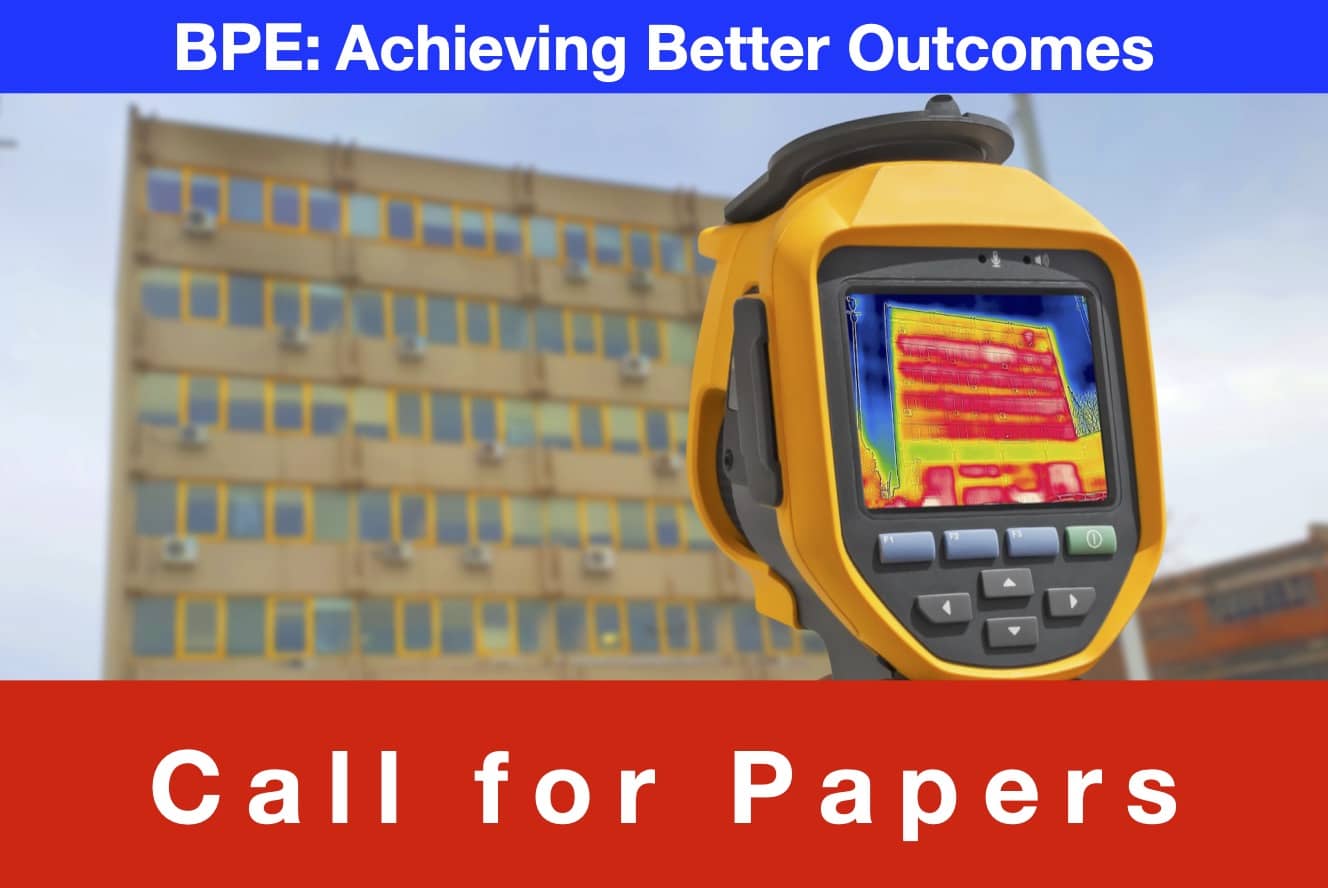
Guest editors: Bill Bordass, Paul Ruyssevelt & Fionn Stevenson
Abstract submission closed on: 23 March 2026 noon (GMT)
What is the potential for BPE to support better outcomes? How can BPE become mainstreamed?
As the built environment confronts accelerating climate change, rising energy demands, health crises and social inequality, the imperative to ensure new and upgraded buildings perform as well or better than intended—both technically and experientially—has never been stronger. Building Performance Evaluation (BPE) offers a powerful way to assess how buildings function in real-world use, and provides evidence-based insights into operational performance, occupant experience, and long-term sustainability.
The terms BPE and Post-Occupancy Evaluation (POE) are often used interchangeably. The editors prefer to use POE for BPE that is fully integrated into the activities of client, design and building teams. Such routine POE can focus the procurement of building works on achieved outcomes and can help close the gaps between design intent and actual performance. This feedback also provides insights that could greatly improve the performance and cost-effectiveness of future projects, practices and policies.
Aims of this special issue
- Map the state-of-the-art in BPE and POE, and explore how they can support better outcomes—for people, buildings, systems and the environment—in an increasingly complex and dynamic world
- Examine how outcome-driven practices and processes can be addressed in the activities of everyone involved in work to buildings; and point to achievements where BPE and POE has been embedded in practice and education
- Consider what is inhibiting BPE and POE in practice; and what needs attention for their full potential to be realised
- Identify fruitful new directions for research and practice, including any projects already underway
- Learn rapidly from all these experiences, insights and results, and consider how they can be disseminated better
- Open space for new research directions and cross-disciplinary debates and collaborations.
This disjunction between research, methods and practice outcomes raises several concerns:
- Why is BPE still not routine in education and outcome-driven building procurement and POE in practice?
- Where are BPE and POE happening and what circumstances helped to bring this about?
- What impact is BPE actually having? To what extent is it influencing professional practice through feedback?
- What innovations are underway in BPE and POE that promise to ensure better outcomes from projects?
Researchers, practitioners and policymakers are invited to critically examine the evolving roles of BPE and POE in addressing the pressing challenges facing buildings and cities. Submissions may span theoretical, methodological, empirical, organisational, governance or practice-based perspectives. We particularly encourage work that pushes the boundaries of BPE as evidence-based learning in architecture, construction, engineering, urbanism and social science.
Context
Apart from the occasional crisis that hits the press, it is unclear to what extent briefing, design, construction, and regulation of building work is actually driven by how well buildings perform once in use. Are appropriate drivers and incentives in place? Sixty years from the first attempts to embed in-use BPE into practices of client, design, construction and management teams, have we made that much progress? POE is still not routine; while practitioners and policymakers have usually been slow to take notice of powerful lessons as they emerge from BPE studies.
The 2001 special issue on POE of Building Research and Information (BRI) covered the strategic and more detailed findings from 16 published case study POEs of recent buildings from the Probe project, together with independent commentaries. In a quest to make POE and feedback routine for building teams, in 2005 BRI also published three papers on techniques being developed, as part of a larger special issue on BPE:Bordass & Leaman (2005a), Way & Bordass (2005) and Bordass and Leaman (2005b).
Since then, numerous special issues of research journals have covered BPE as a socio-technical entity, including:
- Building Performance Evaluation, BRI, 2005, 33(4).
- Housing Occupancy Feedback: Linking Behaviours and Performance, BRI, 2010, 38(5).
- Energy Retrofits of Owner-Occupied Homes, BRI, 2024, 42(4).
- Building Performance Evaluation, BRI, 2019, 47(3).
- Multi-Domain Investigations in the Built Environment for Occupant Health, Well-Being, and Performance, Building and Environment, 2024.
In practice, there has been a variety of attempts to embed BPE through UK buildings standards (e.g. BS40101, PAS2035, BS EN 13187, BS EN ISO 6781-3) and internationally (e.g. ISO 9869-1 for co-heating or U-value tests, ISO 16813:2024, NABERS (Australia and elsewhere), GreenMark (Singapore) and ASHRAE performance measurement protocols (US)). Attempts to bring BPE into building regulations have only met with partial success, including measuring actual airtightness and compliance aspects of some building services installations. Professional bodies (e.g. AIA, RIBA, CIBSE) have also attempted to incorporate POE into procedures and awards. Yet the number of clients, architectural and engineering practices carrying out BPE routinely remains low.
Papers in this special issue will address key questions and offer new insights in areas including:
- Case studies of how BPE has informed briefing/programming, design, build quality, commissioning, and aftercare
- Use of BPE in education of designers, builders and managers, participatory design, or co-design processes
- Investigations into discrepancies between predicted and actual performance (e.g. energy, IEQ, thermal comfort)
- Longitudinal studies of building use, adaptation, and degradation over time
- Occupant satisfaction, comfort, health, and productivity across building types
- BPE in residential settings, schools, healthcare, or under-served communitie
- Methods for involving occupants as co-evaluators or citizen scientists
- Innovations in BPE platforms, tools, methods, data management, and feedback to practitioners and policy makers
- BPE in the Global South, indigenous contexts, or informal settlements
- Culturally situated understandings of comfort, quality, and usability
- The role of BPE in public procurement, building standards, and ESG/green finance
- Developments in institutional and professional obligations and procedures
- Client-led requirements, new forms of contract, and improved industry practices
- Government- and industry-led frameworks (e.g. Government Soft Landings, NABERS Commitment Agreements)
- Ethical considerations around monitoring, data ownership, and surveillance
- Whose voices count in post-occupancy narratives, and how are they heard?
- Opportunities and barriers, including those associated with insurance companies
- Do researchers and practitioners have very different needs? Are these addressed effectively?
Timeline
| Deadline for abstract submission | 23 March 2026 noon (GMT) | |
| Full papers due | 11 September 2026 | NB: authors can submit sooner if they wish |
| Reviewers' comments to authors | 15 January 2027 | |
| Revised papers due | 19 February 2027 | |
| Publication of the special issue | May 2027 | NB: papers are published as soon as they are accepted |
Briefing note for contributors
We welcome contributions for a wide range of disciplines within the research community in both the Global North and Global South, as well as the building industry including engineers, architects, building code officials and software developers.You are invited to submit an abstract for this special issue. We are seeking two types of contribution:
- Research papers, subject to this journal's requirements (see our Guidance for Authors)
- Commentaries, which will be shorter, simpler and reviewed by the editors only. It is hoped this will appeal to practitioners.
Please send a 500 word (maximum) abstract by 23 MARCH (noon GMT) to the editor Richard Lorch and state whether this is intended to be a research paper or a commentary. Your submission must include these 3 items:
- The author's and all co-authors' names, institutional and departmental affiliations and contact details, email addresses
- The question(s) or topic(s) in this Call for Papers that the abstract and intended paper address
- The abstract (500 words maximum) defining the research question(s), scope, methods and results.
Abstracts will be reviewed by the editors to ensure a varied, yet integrated selection of papers around the topic. Authors of accepted abstracts will be invited to submit a full paper (6000 - 7500 words including abstracts and references), which undergo a double-blind review process, or a commentary (1500-2000 words).
General guidance for authors can be found at https://www.buildingsandcities.org/pdf/Information-for-Authors.pdf
Open access and Article Processing Charge
B&C is an open access journal and has an article processing charge (APC) of £1450 plus VAT for peer-reviewed papers. If you do not have institutional support, please contact the editor when submitting your abstract. We endeavour to assist those without funding.
Questions?
The editors are happy to discuss ideas with potential authors. Please contact: Richard Lorch
References
Boissoneault, A., & Peters, T. (2024). An exploration of post-occupancy evaluation in Canada: origins, milestones and next steps, Building Research & Information, 52(3). https://doi.org/10.1080/09613218.2023.2192905
Bordass, B. & Leaman, A. (2005a). Making feedback and post-occupancy evaluation routine 1: A portfolio of feedback techniques. Building Research & Information, 33(4), 347–352. https://doi.org/10.1080/09613210500162016
Bordass, B. & Leaman, A. (2005b). Making feedback and post-occupancy evaluation routine 3: Case studies of the use of techniques in the feedback portfolio. Building Research & Information, 33(4), 361–375. https://doi.org/10.1080/09613210500162032
Bordass, B., Leaman, A. & Ruyssevelt, P. (2001). Assessing building performance in use 5: conclusions and implications. Building Research & Information, 29(2), 144–157. https://doi.org/10.1080/09613210010008054
Building Research & Information. (2001). Special issue: Post-occupancy evaluation (2001),29(2). www.tandfonline.com/toc/rbri20/29/2
Elsayed, E., Pelsmakers, S., Pistore, L., Castaño-Rosa, R. & Romagnoni, O. (2023). Post-occupancy evaluation in residential buildings: A systematic literature review of current practices in the EU. Building and Environment, 236,110307. https://doi.org/10.1016/j.buildenv.2023.110307
Gram-Hanssen, K. (2014). Retrofitting owner-occupied housing: remember the people. Building Research & Information, 42(4), 393–397. https://doi.org/10.1080/09613218.2014.911572
Harputlugil, T. & de Wilde, P. (2021). The interaction between humans and buildings for energy efficiency: A critical review. Energy Research & Social Science, 71, 101828. https://doi.org/10.1016/j.erss.2020.101828
Leaman, A., Stevenson, F. & Bordass, B. (2010). Building evaluation: practice and principles. Building Research & Information, 38(5), 564–577. https://doi.org/10.1080/09613218.2010.495217
Li, P., Froese, T.M. & Brager, G. (2018).Post-occupancy evaluation: State-of-the-art analysis and state-of-the-practice review. Building and Environment,133, 187-202. https://doi.org/10.1016/j.buildenv.2018.02.024
Medrano-Gómez, L.M., Boarin, P. & Premier, A. (2025). The retrofit puzzle: Connecting practices, retrofit measures, and performance outcomes through socio-technical evaluations. Energy Research & Social Science, 120. https://doi.org/10.1016/j.erss.2025.103924
Medrano-Gómez, L.M., Boarin, P. & Premier, A. (2025). When retrofit programmes meet everyday life: A socio-technical evaluation of retrofit practices in Aotearoa New Zealand. Energy Research and Social Science, 130, 104453. https://doi.org/10.1016/j.erss.2025.104453
O’Brien, W., Tahmasebi, F., Korsholm Anddersen, R., Azar, E. … Zhou, J. (2020).An international review of occupant-related aspects of building energy codes and standards, Building and Environment, 179,106906. https://doi.org/10.1016/j.buildenv.2020.106906
Roa, C.D. et al. (2020). Targeted occupant surveys. Building & Environment, 184, 107129. https://doi.org/10.1016/j.buildenv.2020.107129
Preiser, W.F.E., Davis, A.T., Salama, A.M. & Hardy, A., eds. (2014), Architecture beyond criticism: Expert judgment & performance evaluation, Routledge. https://doi.org/10.4324/9781315740652
Sharpe, T. (2019). Ethical issues in domestic building performance evaluation studies. Building Research & Information, 47(3), 318–329. https://doi.org/10.1080/09613218.2018.1471868
Sharpe, T. (2019). Mainstreaming building performance evaluation for the benefit of users. Building Research & Information, 47(3), 251–254. https://doi.org/10.1080/09613218.2019.1526470
Stevenson, F. (2019). Embedding building performance evaluation in UK architectural practice and beyond. Building Research & Information, 47(3), 305–317. https://doi.org/10.1080/09613218.2018.1467542
Stevenson, F. & Leaman, A. (2010). Evaluating housing performance in relation to human behaviour: new challenges. Building Research & Information, 38(5), 437–441. https://doi.org/10.1080/09613218.2010.497282
Way, M. & Bordass, B. (2005). Making feedback and post-occupancy evaluation routine 2: Soft landings – involving design and building teams in improving performance. Building Research & Information, 33(4), 353–360. https://doi.org/10.1080/09613210500162008
Way, M., Bordass, B. Leaman, A. & Bunn, R. (2014). The Soft Landings Framework, 2nd edition. https://www.usablebuildings.co.uk/UsableBuildings/Unprotected/SoftLandingsFramework.pdf
Latest Peer-Reviewed Journal Content

Urban form metrics for building occupancy modelling: applications and impacts
D Reiter, M Jehling & R Hecht
Retrofit realism: affordable low-carbon policies for existing homes
N Eyre & R Khosla
Inside offsite: everyday dwelling in factory-built apartments
L Dorignon & R Horne
MMC for housing: sectoral perception on governance challenges
J Morgan, C Goodier, R Schmidt-III & K Ayinla
Reorganising specification practice for component reuse: an exploratory study
S Gao, K Jones, J Xu & J Glass
Kitchen retrofits to support food practices and wellbeing
F J Andrews, A Sal Moslehian, E Warner & R Tucker
From strategy to delivery: a comparative analysis of MMC roadmaps
G Goldman, D Sorokine, F Suerich-Gulick, C Carbone & M Jemtrud
Thermal comfort, ventilation and mosquito-borne disease risk in Zanzibar hospitals
O Sloan Wood, J B Knudsen, K L Schiøler, E Lupenza, M Msellem & F Saleh
Reusing precast concrete elements in construction: assessing the economic conditions
O Vigren, H Westerlind & T Malmqvist
Institutional readiness for industrialised social housing in Vietnam
T Q Nguyen, B N Nguyen, T H Q To & Z Aziz
Prefabrication for housing retrofit: governance, innovation and resident experience
E Pikas, K Kuusk, P Pihelo, R Liias, J Pukk & T Kalamees
Reframing heat pump transitions: a care perspective
J van der Haer, R Schelwald & F de Haan
Urban informal settlements in Africa: transforming adaptation governance
K Buyana & H Sseviiri
Reusing concrete products in indoor environments: chemical hazard assessment
K Tähtinen, A Helin, E Parshintsev & H Hovi
Negotiating net-zero carbon: an ANT analysis of two buildings
L Schweber & M Green
Design for disassembly: a review of public policy proposals
O Vorobjev, U Uotila, T Joensuu & A Saari
Retrofitting Norwegian residential buildings: an archetype-based dynamic stock model
L S A Rousseau, S Amini, S Akin & E G Hertwich
Decolonising time: vernacular villages and the politics of heritage temporality
R Al-Rabady
Commutes to alternative workplaces: GHG emissions and physical activity
J Taylor, L Thoen, A Espinosa Mireles De Villafranca, P Anashin, J Vanhatalo, D Milián
Bernal & I Okkonen
Nine ‘myths’ about the building stock of Great Britain
S Evans, P Steadman, A Neto-Bradley, D Humphrey, R Liddiard,H Shamsi, J Palmer & G Simons
Join Our Community

The most important part of any journal is our people – readers, authors, reviewers, editorial board members and editors. You are cordially invited to join our community by joining our mailing list. We send out occasional emails about the journal – calls for papers, special issues, events and more.
We will not share your email with third parties. Read more
Latest Commentaries
Who is Responsible for Climate Change?
Ian Cooper (Eclipse Research) explores the questions of responsibility raised in the recent Buildings & Cities special issue ‘Climate Change Risk and Decision-Making’. Focusing here on carbon emissions and mitigation, global responses will require grounding in what can work locally. New responsibilities arise for the wide range of built environment decision-makers: clients, professionals and their institutions, central and local governments, product suppliers, financiers, insurers, etc. A framework is needed to manage the complexity of responsibilities especially for variety of actors, the time frames and spatial scales.
Professional Ethics in a Climate Crisis
The climate crisis has progressed into a dangerous phase with tragic consequences often counted in numbers of excess deaths, but also by powerful economic impacts of rising food prices, the increased costs of insurance and lending, costly damage to the built environment. Celia Davies, Director of Impact at the UK’s Town and Country Planning Association (TCPA) and Hugh Ellis, Director of Policy at TCPA, consider the responsibilities of professionals in shaping a built environment which is fit not just for today's climate risks but for the dramatic increase in severe and unpredictable weather which is now locked into our climate systems.