
www.buildingsandcities.org/journal-content/special-issues/mmc-future-housing.html
MMC and the Future of Housing
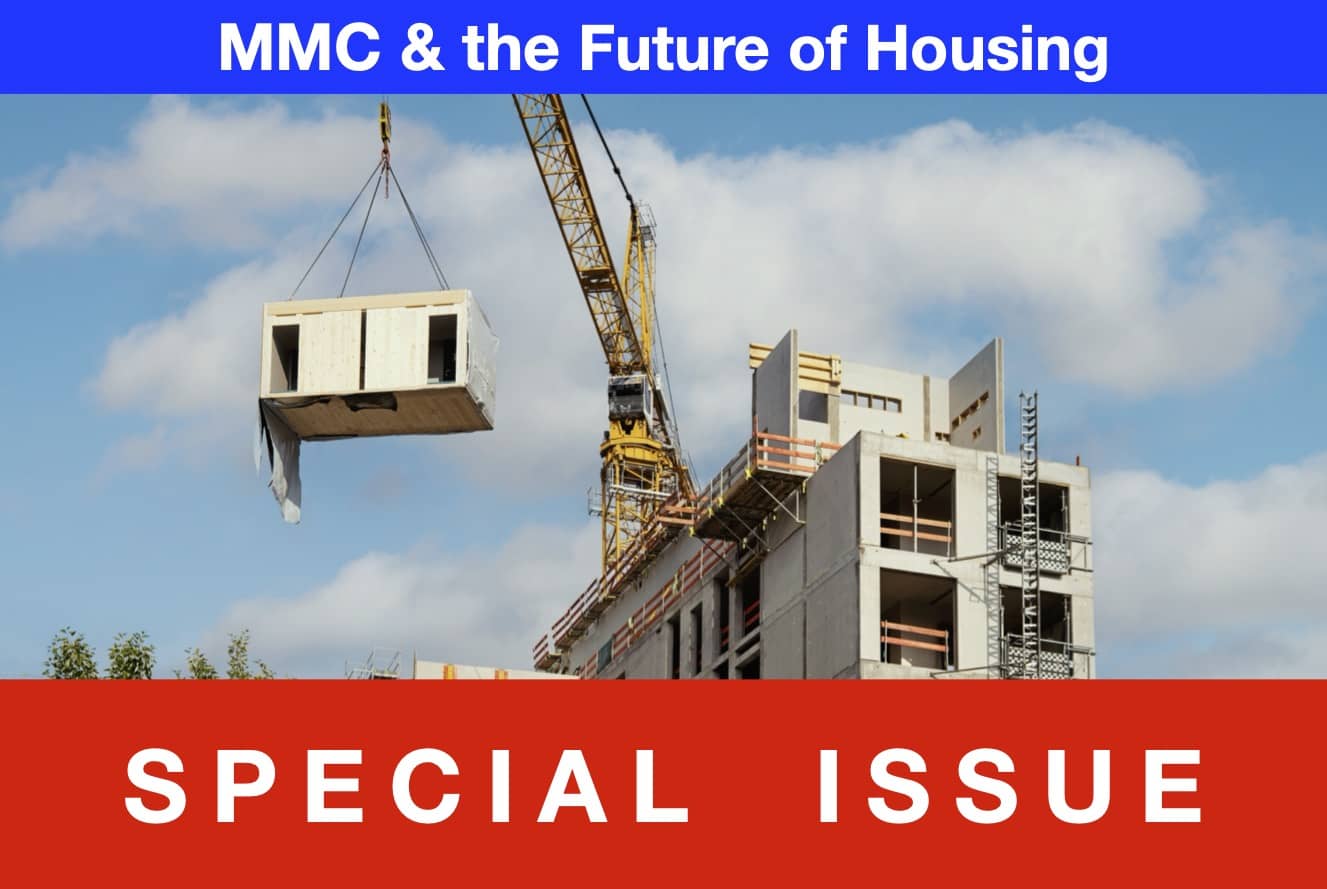
Can a critical social science perspective help to enable the uptake of Modern Methods of Construction (MMC)?
Housing faces intersecting crises of affordability, supply and decarbonisation. MMC (also known as offsite construction) is increasingly promoted to transform both new build and retrofit. This special issue provides a critical social science lens to go beyond the economic and technological aspects of housing to examine the claims, processes, relations and dynamics, outcomes and potential concerns associated with MMC and related industrialised approaches. The papers in this issue explore the political, social and cultural implications of MMC for housing.
Moving beyond techno-optimistic and productivity-based narratives, the contributions from 7 countries - UK, Germany, Estonia, Vietnam, Malaysia, Australia and the US - examine policy roadmaps, political economy and multilevel governance aspects of systemic change, innovation systems and institutional readiness, systemic intermediaries, and residents’ everyday experiences. Interrogating some of the claims made about the transformative potential of MMC, together they show that MMC offers tangible benefits, including speed, quality and reduced disruption, but that these are neither guaranteed nor evenly distributed. The prospects for MMC depend less on technological innovation than on systemic coordination, stable long-term demand, place-based conditions and outcome-focused public policy.
Guest editors: Rachel Macrorie and Andrew Karvonen
Table of contents
Modern methods of construction (MMC) and the future of housing [Editorial]
R. Macrorie & A. Karvonen
From strategy to delivery: a comparative analysis of MMC roadmaps
G. Goldman, D. Sorokine, F. Suerich-Gulick, C. Carbone & M. Jemtrud
MMC and the social housing crisis: A political economy appraisal
R. Macrorie
MMC for housing: sectoral perception on governance challenges
J. Morgan, C. Goodier, R. Schmidt-III and K. Ayinla
Scaling up retrofit: regional challenges and opportunities for MMC
H. Dörr, P. Späth & I. Goñi
Institutional readiness for industrialised social housing in Vietnam
T. Q. Nguyen, B. N. Nguyen, T. H. Q. To & Z. Aziz
Prefabrication for housing retrofit: governance, innovation and resident experience
E. Pikas, K. Kuusk, P. Pihelo, R. Liias, J. Pukk & T. Kalamees
Inside offsite: everyday dwelling in factory-built apartments
L. Dorignon & R. Horne

Latest Peer-Reviewed Journal Content

Temporal characteristics-based urban heat island effect assessment
R Rawal, S Das, M Agarwal, T Chavda, M Shah, S Banerjee,B Hickman & R Shanthi Priya
Uncertainty and equivocality in reuse-oriented deconstruction
L Jiang, M van den Berg, H Voordijk & A Hartmann
Modern methods of construction and the future of housing [editorial]
R Macrorie & A Karvonen
Integrating computational fluid dynamics into introductory architectural education
S Kawakubo, S Arata, K Wakui & H Kikumoto
MMC and the social housing crisis: a political economy appraisal
R Macrorie
Extending building longevity: wood-based product–service systems
A Viljanen, A Korsunova-Tsaruk, J Harmanen, E Oijala & A Toppinen
Capturing circular value for building sector actors
N Keena, D R Rondinel-Oviedo, M Pomasonco-Alvis, M Grozdanoska & M Parsaee
Summertime overheating in apartments with glazed balconies: a Finnish study
L Jegard, R Castaño-Rosa & S Pelsmakers
Reuse of cast-in-place concrete: overcoming industry barriers
M Romann & M Bastien-Masse
Timing matters: life cycle embodied GHG emissions of circular building strategies
A Wöhler, L Rosado, H Abu Ghaida, H Wallbaum & A Hollberg
Scaling up retrofit: regional challenges and opportunities for MMC
H Dörr, P Späth & I Goñi
Design as communicative activity: implications for sustainability assessment software
T Säwén, A Sasic Kalagasidis & A Hollberg
Indoor temperature and office work performance in a temperate climate
T Kramer & S Schiavon
Moving homes and energy poverty: residents’ concerns, capabilities and responses
M Jalas, J Rinkinen, S Numminen & E Valkealahti
Reference study for biogenic carbon storage in the residential building stock
O Iliescu, I Talvitie, A Amiri & S Junnila
Building space heating and cooling in NDCs 4.0 [briefing note]
T P Lützkendorf
Building component reuse as sociomaterial interaction: lessons from precast concrete
J Uusikartano, L Alkki & V Capitani
Validating national reuse indicators from regional demolition data: a Swedish example
F Ericsson, K Mjörnell & U Janson
Climate change risk and decision-making [editorial]
S Foxell & I Cooper
Technologies of reconstruction [editorial]
P Tombesi
Urban form metrics for building occupancy modelling: applications and impacts
D Reiter, M Jehling & R Hecht
Retrofit realism: affordable low-carbon policies for existing homes [briefing note]
N Eyre & R Khosla
Join Our Community

The most important part of any journal is our people – readers, authors, reviewers, editorial board members and editors. You are cordially invited to join our community by joining our mailing list. We send out occasional emails about the journal – calls for papers, special issues, events and more.
We will not share your email with third parties. Read more
Latest Commentaries
Two Key Messages for COP31
Space Heating & Cooling in NDCs 4.0: Nationally Determined Constributions (NDCs) are at the heart of the UNFCCC Paris Agreement. NDCs embody each country's efforts to reduce their emissions and adapt to the impacts of climate change. So it is essential to include the building stock (particularly space heating and cooling) in the next NDCs.
Realistic Retrofit: Residential buildings are major users of energy and emitters of CO2. What constitutes realistic retrofit? Affordable, practical low-carbon policies for homes are described for both the Global North and Global South.
Thomas Lützkendorf and Nick Eyre send their messages to COP31: prioritise the building stock in NDCs and implement policies for practical retrofit. Watch their videos - for links to the videos click on "More" below:
Practitioners’ Views of POE
Post-occupancy evaluation (POE) is widely valued but weakly embedded in practice. Ant Marsh, Kate van Someren, Lara Clarke and Tom Randall (Arup Building Performance and Commissioning Services) explain the findings from a survey and focus groups with UK construction industry practitioners. They identified fragmented responsibility, split commercial incentives and a persistent fear of “bad news”. Making POE routine requires a shift from producing reports to a focus on improving outcomes by owning and acting on learning.