
www.buildingsandcities.org/calls-for-papers/living-labs-cfp.html
Living Labs: Agents for Change
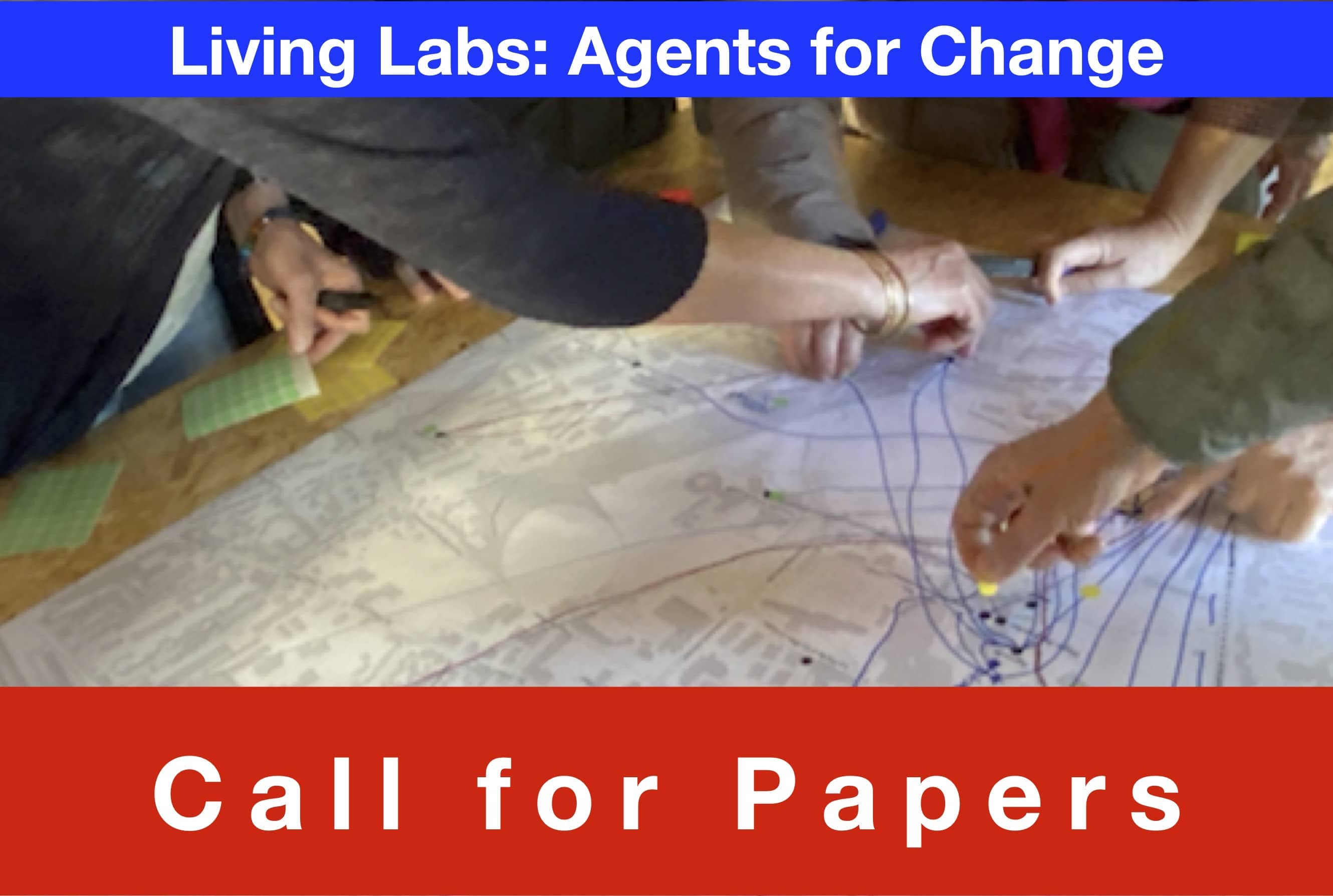
Guest editors: Nicola Antaki, Doina Petrescu & Vera Marin
Abstract submission closed on 10 February 2025 (noon GMT)
What are the roles and impacts that living labs play in increasing civic resilience and supporting ecological transition in different contexts and at different scales?
This special issue examines the roles that living labs have in creating or enhancing resilience in local communities. What mediation methods are used in the different stages of collaboration? How can success or efficacy be measured? What lessons arise about transferability between different labs / situations? What inventive methodologies are developed/used in living labs within different contexts and at different scales?
Context
Civic resilience can be described as the ability of (groups / networks of) residents to resist, adapt, and transform their living environment in the face of socio-economic, political, and climatic change, according to collectively held values and priorities. Civic resilience brings a civic dimension to the resilience discourse which introduces a dynamic perspective on change processes, addressed through subsequent notions such as 'adaptative capacity', 'transformation', 'transition' (Brown et al. 2012; Folke et al. 2010; Walker et al. 2004), and 'resourcefulness' (MacKinnon & Derickson 2013). Civic resilience includes aspects of community, citizenship, collective agency. (Butterworth, et al. 2022; Maharramli et al. 2021).
An important notion in relation with civic resilience is that of 'resourcefulness' which addresses the necessity to identify, make available and redistribute resources of space, knowledge and power across local actors and communities to improve resilience. The notion of resourcefulness situates resilience in a more positive light, relating it to the agency of empowerment of the community. Civic resilience is also key in processes of ecological transition (CoNECT 2022) defined as "an evolution towards a new economic and social model, a model of sustainable development that renews our ways of consuming, producing, working and living together to meet the major environmental challenges of climate change, resource scarcity, the accelerating loss of biodiversity and the multiplication of environmental health risks".
A Living Lab (LL) is a real-world environment where research, innovative products, or services are tested and co-developed with everyday participants in a collaborative setting. A LL can involve public, private, and community stakeholders working together to address real-life challenges, to create change and ensure that solutions are practical and user-centred. For example, LL researchers might work with a community and a council to understand local practices, then experiment and co-develop a product or platform for use after the project is over.
In the last decade, the LL methodology has arisen across Europe as a key methodology of conducting research by engaging with ecological transition, the practice of moving towards a more sustainable way of living, working, producing, being in the face of the climate crisis (Hopkins 2008) and being embedded in policy (Levy et al. 2022). Living labs offer the possibility of connecting researchers and citizens, engaging them in collective action to identify common needs, develop collaborative methods to respond to these needs and share methods for wider implementation. (Puerari et al. 2018). Living labs can be also read as a means of expanding the capacity of citizens to engage in processes of change and increased civic resilience. (Rizzo et al. 2021; Petrescu et al. 2022)
Numerous funding programs encourage the involvement of various stakeholders in testing ideas and collaboration mechanisms in lab settings. The frames for such labs are not defined through academic research projects only. A lab can be initiated by collectives of practitioners looking for alternatives, civic organisations that are aware of the importance of collaboration but also by local public administration where the need for mediation is recognised.
Moreover, the EU ambition through Horizon 2020 Research and Innovation Programme (Climate Neutral and Smart Cities Mission) is placing high expectations on pilot cities to demonstrate results in cooperation with academia, local communities and private sector in helix collaborations for innovation.
The scales of LL and networks can vary - from local small-scale labs with a focus on a small number of people or a small site or issue; through to multi-city or international labs spanning countries or continents and larger actor numbers. The networks might be old or new, expanding or contracting. The term lab is not necessarily spatial - we invite a range of understandings of the term.
Mediators are people or things that act to help build lab actions and networks. They might be participants or facilitators. Mediation can be understood as both transformative (Latour 2013), potentially creating specific outcomes with transformative urban potential, as well as in the intermediary sense of simply gathering, or exchanging information. We are interested in the range of mediation roles necessary for the development of living labs and networks of resilience. In what way are mediators transformative? How do they affect LL outcomes?
Key research questions
- How do different types of living labs act to enhance or expand networks of resilience? Which actors are involved? What kind of support do collaborators bring each other?
- What mediation methods are used in the different stages of collaboration? How can success or efficacy be measured?
- What lessons arise about transferability between different labs / situations?
- What inventive methodologies are developed/used in living labs within different contexts and at different scales?
Possible topics
1. Analysis of practices and case studies
- Living Lab Case Studies: Stories of success or failure, with a focus on challenges in relation to resilience and ecological transition.
- Evaluation Criteria: How have Living Labs been evaluated? What are the standards or criteria used?
- Typologies, Contexts, and Scales of Living Lab Action: Examining the different scales, contexts and types of living lab initiatives.
2. Tools, methods & methodologies
- Conception and Creation of Living Labs: Tools, methods and methodologies used in establishing and running living labs.
- Living Lab Methodologies: Techniques such as storytelling, workshops, co-design, oral histories and experimentation.
- Data Collection and Analysis Methodologies: What are the standards, guidelines or minimum requirements for data collection and analysis in living labs? Is there consistency in quality?
- Interdisciplinary/Transdisciplinary Approaches: How do these approaches impact living lab methodologies?
3. Definitions, theories & knowledge types
- Definitions and Theories: Understanding ecological transition, civic resilience and living lab roles.
- Types of Knowledge: How different knowledge types are mediated and utilized in living labs.
- More-than-Human Communities: Exploring multi-species approaches in ecological transition.
4. Roles, spaces & collaboration
- Roles in Living Labs: The roles of mediators, researchers, practitioners, universities, civic organizations, policy makers and citizens in living labs.
- Spaces and Living Labs: Exploring the scales, features, and transformations of physical and virtual spaces in living labs.
- Networks of/through Living Labs: How networks facilitate ecological transition and resilience.
- Participatory Planning in Living Labs: Co-production, mediation and agency in ecological transition processes.
5. Public policies & influence
- Public Policies: The influence of living labs on public resources, decisions and policies.
- Policy Influence: How data and insights from living labs shape environmental policies and regulations.
6. Civic resilience & empowerment
- Civic Resourcefulness: Behaviours, collaborations, and circularity in living labs.
- Community Empowerment: Building social cohesion and resilience through community engagement in living labs.
- Adaptation to Change: How living labs help communities adapt to future crises.
7. Innovation & ecological transition
- Innovation in Living Labs: Innovations for ecological transition, such as sustainable technologies and practices.
- Behavioural Change: Encouraging sustainable behaviours through citizen involvement.
- Mediation and Agency: Mediating between different knowledge types, actors, and spaces in ecological transition processes.
8. Research methodologies & critiques
- Weaknesses of Living Labs: Exploring the limitations and challenges faced by living labs.
- Interaction with Traditional Research: How do living labs complement or conflict with traditional research methods?
- Scientific Rigour in Living Labs: Evaluating the scientific rigour of living labs as a research method.
- Development of Living Labs: Are living labs a mature research method or do they require further development? What is needed to ensure they are robust and effective?
9. Transformative research & learning
- Transformative Research: The role of living labs in advancing research methodologies.
- Pedagogy and Curriculum Development: How living labs contribute to the development of educational practices for various age groups.
- Sharing and Commoning Practices: Collective action, sharing knowledge, space, and power in living labs.
Timeline
|
Abstracts due |
10 February 2025 |
|
Full papers due |
14 April 2025 NB: authors can submit sooner if they wish |
|
Referees' comments |
21 July 2025 |
|
Revised version due |
29 September 2025 |
|
Full issue published |
January 2026. NB: papers are published as soon as they are accepted |
Briefing note for contributors
We welcome different kinds of contributions (e.g. research, policy analysis, synthesis) not only from researchers but also from practitioners, policy makers and activists in the field.
You are invited to submit an abstract for this special issue. Please send a 500 word (maximum) abstract to editor Richard Lorch richard@rlorch.net by 10 February 2025. Your submission must also include these 3 items:
- the author's and all co-author's names, institutional & departmental affiliations and contact details
- the question(s) or topic(s) in this Call for Papers that the abstract and intended paper address
- the abstract (300 - 500 words maximum) defining the research question(s), scope, methods and results
Abstracts will be reviewed by the editors to ensure a varied, yet integrated selection of papers around the topic. Authors of accepted abstracts will be invited to submit a full paper (6000-7500 words), which undergoes a double-blind review process.
Buildings & Cities is an international, open access, double-blind peer-reviewed research journal. Its focus is the interactions between buildings, neighbourhoods and cities by understanding their supporting social, economic and environmental systems. More information can be found online: www.buildingsandcities.org & published papers are found here: https://journal-buildingscities.org
General guidance for authors can be found at https://www.buildingsandcities.org/pdf/Information-for-Authors.pdf
Open access and Article Processing Charge
Buildings & Cities is an open access journal and has an article processing charge (APC) of £1360. If you do not have institutional support, please contact the editor when submitting your abstract. We endeavour to assist those without funding.
Questions?
The Editors are happy to discuss ideas with potential authors. Please contact: Richard Lorch , Nicola Antaki , Doina Petrescu , Vera Marin .
References
Antaki, N. & Petrescu, D. (2022). Designers' roles in civic pedagogies of co-making: lessons from the Global South and North. CoDesign, 19(1), 51-73. https://doi.org/10.1080/15710882.2022.2123927
Brown, G., Kraftl, P., Pickerill, J. & Upton, C. (2012). Holding the future together: towards a theorisation of the spaces and times of transition. Environment and Planning A: Economy and Space, 44(7), 1607-1623. https://doi.org/10.1068/a44608
Butterworth, C., Schneider, T. & Šorn, M. (2022). Community place initiatives post-austerity, and how a 'civic' school of architecture might support them. Architectural Research Quarterly, 26(4), 331-344. https://doi.org/10.1017/S1359135522000495
CONECT (Collective Networks for Everyday Community Resilience and Ecological Transition) (2022). https://www.jpiconect.eu
Dell'Era, C. & Landoni, P. (2014). Living lab: A methodology between user‐centred design and participatory design. Creativity and Innovation Management, 23(2), 137-154.
Folke, C., Carpenter, S. R., Walker, B., Scheffer, M., Chapin, T. & Rockström, J. (2010). Resilience thinking: integrating resilience, adaptability and transformability. Ecology and Society, 15(4), 20. https://www.jstor.org/stable/26268226?seq=1&cid=pdf-
Hopkins, R. (2008). The Transition Handbook: From Oil Dependency to Local Resilience. Green Books.
Karvonen, A. & van Heur, B. (2014). Urban laboratories: Experiments in reworking cities. International Journal of Urban and Regional Research, 38(2), 379-392.
Kronsell, A. & Mukhtar‐Landgren, D. (2018). Experimental governance: The role of municipalities in urban living labs. European Planning Studies, 26(5), 988-1007.
MacKinnon, D. & Derickson, K.D. (2013). From resilience to resourcefulness: A critique of resilience policy and activism. Progress in Human Geography, 37(2), 253-270. https://doi.org/10.1177/0309132512454775
Latour, B. (2013). Reassembling the social. an introduction to actor-network-theory (translated by Irina Polonskaya). Journal of Economic Sociology, 14 (2). https://doi.org/10.17323/1726-3247-2013-2-73-87
Levy, I., Martin-Moreau, M. & Ménascé, D. (2022). From ecological transition to ecological transformation: consensus and fault lines,. Journal of Field Actions, Special Issue 24
Maharramli, B., Bredow, V. L. & Goodwin, L. (2021). Using civic ecology education to foster social-ecological resilience: A case study from Southern California. Journal of Environmental Education, 52(6), 445-462. https://doi.org/10.1080/00958964.2021.1999886
Petrescu, D., Petcou, C. & Baibarac, C. (2016). Co-producing commons-based resilience: lessons from R-Urban. Building Research & Information, 44(7), 717-736. https://doi.org/10.1080/09613218.2016.1214891
Petrescu, D., Petcou, C., Safri, M. & Gibson K. (2021). Calculating the value of the commons: Generating resilient urban futures. Env Pol Gov. 31: 159-174. https://doi.org/10.1002/eet.1890
Petrescu, D., Cermeño, H., Keller, C., Moujan, C., Belfield, A., Koch, F., Goff, D., Schalk, M. & Bernhardt, F. (2022). Sharing and space‐commoning knowledge through urban living labs across different European cities. Urban Planning, 7 (3), 254-273. http://doi.org/10.17645/up.v7i3.5402
Puerari, E., de Koning, J., von Wirth, T., Karré, P., Mulder, I. & Loorbach, D. (2018). Co‐creation dynamics in urban living labs. Sustainability, 10(6), Article 1893.
Rizzo, A., Habibipour, A. & Ståhlbröst, A. (2021). Transformative thinking and urban living labs in planning practice: A critical review and ongoing case studies in Europe. European Planning Studies, 29(10), 1739-1757.
Scholl, C., de Kraker, J. & Dijk, M. (2022). Enhancing the contribution of urban living labs to sustainability transformations: Towards a meta‐lab approach. Urban Transformations, 4 (7). https://doi.org/10.1186/s42854-022-00038-4
Walker, B., Holling, C. S., Carpenter, S. R. & Kinzig, A. (2004). Resilience, adaptability and transformability in social-ecological systems. Ecology and Society, 9(2), 5. http://www.ecologyandsociety.org/vol9/iss2/art5
Walker, J. & Cooper, M. (2011). Genealogies of resilience: from systems ecology to the political economy of crisis adaptation. Security Dialogue 42(2): 143-60. https://doi.org/10.1177/0967010611399616
Latest Peer-Reviewed Journal Content
Building space heating and cooling in NDCs 4.0
T P Lützkendorf
Building component reuse as sociomaterial interaction: lessons from precast concrete
J Uusikartano, L Alkki & V Capitani
Validating national reuse indicators from regional demolition data: a Swedish example
F Ericsson, K Mjörnell & U Janson
Climate change risk and decision-making [editorial]
S Foxell & I Cooper
Technologies of reconstruction [editorial]
P Tombesi
Urban form metrics for building occupancy modelling: applications and impacts
D Reiter, M Jehling & R Hecht
Retrofit realism: affordable low-carbon policies for existing homes
N Eyre & R Khosla
Inside offsite: everyday dwelling in factory-built apartments
L Dorignon & R Horne
MMC for housing: sectoral perception on governance challenges
J Morgan, C Goodier, R Schmidt-III & K Ayinla
Reorganising specification practice for component reuse: an exploratory study
S Gao, K Jones, J Xu & J Glass
Kitchen retrofits to support food practices and wellbeing
F J Andrews, A Sal Moslehian, E Warner & R Tucker
From strategy to delivery: a comparative analysis of MMC roadmaps
G Goldman, D Sorokine, F Suerich-Gulick, C Carbone & M Jemtrud
Thermal comfort, ventilation and mosquito-borne disease risk in Zanzibar hospitals
O Sloan Wood, J B Knudsen, K L Schiøler, E Lupenza, M Msellem & F Saleh
Reusing precast concrete elements in construction: assessing the economic conditions
O Vigren, H Westerlind & T Malmqvist
Institutional readiness for industrialised social housing in Vietnam
T Q Nguyen, B N Nguyen, T H Q To & Z Aziz
Prefabrication for housing retrofit: governance, innovation and resident experience
E Pikas, K Kuusk, P Pihelo, R Liias, J Pukk & T Kalamees
Reframing heat pump transitions: a care perspective
J van der Haer, R Schelwald & F de Haan
Urban informal settlements in Africa: transforming adaptation governance
K Buyana & H Sseviiri
Reusing concrete products in indoor environments: chemical hazard assessment
K Tähtinen, A Helin, E Parshintsev & H Hovi
Negotiating net-zero carbon: an ANT analysis of two buildings
L Schweber & M Green
Design for disassembly: a review of public policy proposals
O Vorobjev, U Uotila, T Joensuu & A Saari
Retrofitting Norwegian residential buildings: an archetype-based dynamic stock model
L S A Rousseau, S Amini, S Akin & E G Hertwich
Decolonising time: vernacular villages and the politics of heritage temporality
R Al-Rabady
Commutes to alternative workplaces: GHG emissions and physical activity
J Taylor, L Thoen, A Espinosa Mireles De Villafranca, P Anashin, J Vanhatalo, D Milián
Bernal & I Okkonen
Nine ‘myths’ about the building stock of Great Britain
S Evans, P Steadman, A Neto-Bradley, D Humphrey, R Liddiard,H Shamsi, J Palmer & G Simons
Join Our Community

The most important part of any journal is our people – readers, authors, reviewers, editorial board members and editors. You are cordially invited to join our community by joining our mailing list. We send out occasional emails about the journal – calls for papers, special issues, events and more.
We will not share your email with third parties. Read more
Latest Commentaries
Who is Responsible for Climate Change?
Ian Cooper (Eclipse Research) explores the questions of responsibility raised in the recent Buildings & Cities special issue ‘Climate Change Risk and Decision-Making’. Focusing here on carbon emissions and mitigation, global responses will require grounding in what can work locally. New responsibilities arise for the wide range of built environment decision-makers: clients, professionals and their institutions, central and local governments, product suppliers, financiers, insurers, etc. A framework is needed to manage the complexity of responsibilities especially for variety of actors, the time frames and spatial scales.
Professional Ethics in a Climate Crisis
The climate crisis has progressed into a dangerous phase with tragic consequences often counted in numbers of excess deaths, but also by powerful economic impacts of rising food prices, the increased costs of insurance and lending, costly damage to the built environment. Celia Davies, Director of Impact at the UK’s Town and Country Planning Association (TCPA) and Hugh Ellis, Director of Policy at TCPA, consider the responsibilities of professionals in shaping a built environment which is fit not just for today's climate risks but for the dramatic increase in severe and unpredictable weather which is now locked into our climate systems.